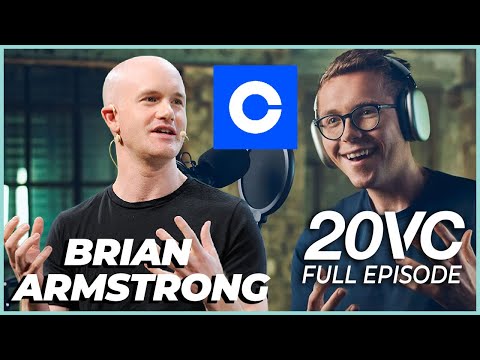
Brian Armstrong: Coinbase’s Failed NFT Launch, Thoughts on SBF & FTX, Crypto Winter | 20VC #946
Harry Stebbings (host), Brian Armstrong (guest)
In this episode of The Twenty Minute VC, featuring Harry Stebbings and Brian Armstrong, Brian Armstrong: Coinbase’s Failed NFT Launch, Thoughts on SBF & FTX, Crypto Winter | 20VC #946 explores brian Armstrong on ambition, crises, crypto winters, and conscious leadership Brian Armstrong reflects on his psychological drivers, evolving from fear of insignificance to a sustained love of building, learning, and scaling products that impact the world at large.
Brian Armstrong on ambition, crises, crypto winters, and conscious leadership
Brian Armstrong reflects on his psychological drivers, evolving from fear of insignificance to a sustained love of building, learning, and scaling products that impact the world at large.
He discusses leadership under pressure—how he distinguishes real from fake emergencies, handles public controversies like Coinbase’s politicization memo and the Neutrino backlash, and uses structured decision‑making as the company scales.
Armstrong explains why Coinbase’s NFT launch underperformed, how crypto cycles shape strategy, and what it’s like to be a public‑company CEO balancing stock volatility, regulation, and long‑term innovation.
Looking ahead, he imagines Coinbase as a multi‑product holding company focused on increasing economic freedom, potentially expanding into a broader “freedom stack” beyond financial services.
Key Takeaways
Evolving your motivation from fear to genuine passion is critical for longevity.
Armstrong started driven by insecurity and fear of insignificance; as Coinbase succeeded, he had to consciously re-anchor his drive in what he actually enjoys—building with technology, learning, and working on large‑scale problems.
Get the full analysis with uListen AI
Treat work as an addictive craft, but deliberately manage balance and recovery.
He openly frames his obsession with building and scaling as a kind of addiction that can be positive for the world, yet admits he sometimes overdoes it and must actively pull back to avoid burnout and maintain life “harmony” rather than strict balance.
Get the full analysis with uListen AI
Never over‑hype version one; under‑promise and iterate in public.
Regarding the underwhelming NFT launch, Armstrong calls it a classic mistake: pre‑launch hype and screenshots set expectations too high for an inevitably rough V1, reinforcing the principle that initial versions almost always “suck” and should be framed accordingly.
Get the full analysis with uListen AI
Differentiate real from fake emergencies and use holding statements in crises.
He distinguishes existential issues (site down, systemic misinformation, solvency fears) from noise (disappointing product launches) and advocates quickly acknowledging problems publicly with a holding statement while taking time to find ground truth before detailed responses.
Get the full analysis with uListen AI
Formal decision‑making frameworks reduce chaos as organizations scale.
Coinbase uses tools like RAPID and clear signature authorities so decisions have a single accountable owner and documented input, preventing “vetocracy,” confusion over who decides, and loss of speed in a large organization.
Get the full analysis with uListen AI
Public company status boosts capital access and legitimacy but demands cultural guardrails.
Armstrong highlights easier fundraising and Fortune 500 partnerships as big upsides, but counters this by instituting a cultural norm against talking about short‑term stock moves to combat morale swings and short‑termism.
Get the full analysis with uListen AI
Capital is a tool for impact, not just personal consumption.
He describes his long‑standing fascination with money as a way to marshal resources—fund projects, experiments, or public goods—arguing that beyond some comfort level, wealth is best used as a capital allocation engine rather than for status spending.
Get the full analysis with uListen AI
Notable Quotes
“I was like, “I’m gonna fucking go do something great here or die trying.””
— Brian Armstrong
“I happen to be addicted to building things and scaling them.”
— Brian Armstrong
“The version one of every product sucks. I’ve never seen a single product in tech where the V1 didn’t kind of suck.”
— Brian Armstrong
“Being the most trusted brand is 95% working with government and 5% protecting customers from bad government.”
— Brian Armstrong
“Capital is a way to accomplish more of what you want to do in the world.”
— Brian Armstrong
Questions Answered in This Episode
How can founders consciously transition from fear‑based motivation to passion‑based motivation without losing their drive?
Brian Armstrong reflects on his psychological drivers, evolving from fear of insignificance to a sustained love of building, learning, and scaling products that impact the world at large.
Get the full analysis with uListen AI
What practical criteria can leaders use in real time to distinguish between a genuine emergency and a noisy but noncritical issue?
He discusses leadership under pressure—how he distinguishes real from fake emergencies, handles public controversies like Coinbase’s politicization memo and the Neutrino backlash, and uses structured decision‑making as the company scales.
Get the full analysis with uListen AI
How should public‑company CEOs design culture and compensation to reduce the psychological impact of extreme stock‑price volatility on employees?
Armstrong explains why Coinbase’s NFT launch underperformed, how crypto cycles shape strategy, and what it’s like to be a public‑company CEO balancing stock volatility, regulation, and long‑term innovation.
Get the full analysis with uListen AI
In what concrete ways could Coinbase move beyond financial services into a broader “freedom stack” while still maintaining strategic focus?
Looking ahead, he imagines Coinbase as a multi‑product holding company focused on increasing economic freedom, potentially expanding into a broader “freedom stack” beyond financial services.
Get the full analysis with uListen AI
What is the right balance between cooperating with regulators and openly resisting policies you believe are harmful to innovation or consumers?
Get the full analysis with uListen AI
Transcript Preview
Brian, I'm so excited for this. So first off, thank you so much for joining me today.
Yeah. Thanks, Harry.
Not at all, but listen, uh, you've probably answered the question on, you know, how did you found Coinbase many, many times, and this show's gonna be very different in many ways. So I wanna dive by kind of going straight into it. We're all a function of our histories, and, you know, a product of our histories. If I ask you the question, what are you running from and what are you running towards, Brian, if we really just start at the deep end?
Mm-hmm. Yeah, well, I- I'm glad you're starting off right with the, the therapy session here. Um, you know-
(laughs)
... actually, not joke, all joking aside, I think there is a lot of psychology and therapy involved in starting a company. Um, so it's a, it's a really good question. I mean, look, I think a lot of people start off in their career, um, running from something. And I'll tell you what it was in my case. I think, you know, I was always a shy and introverted kid, and I had this fear of... It was a couple things. I felt like, you know, people didn't listen to me. They didn't maybe like... I ha- I, I felt like I have such good ideas, but I'm not like confident, I'm not articulate, and I couldn't get people to like hear my ideas. And then I think I had this like deep fear about never doing something important in my life. And I don't even know, really know exactly where that came from, but I, I was like, "I'm gonna, I'm gonna gosh darn do..." Can I, can I swear on this program? I don't know. I, I was like-
Yeah, yeah.
... "I'm gonna, I'm gonna fucking go do something great here or die trying." You know? And I, I had this real like desire to... Uh, maybe it was like a status thing or an imp- sense of importance. I just, I didn't feel important or worthwhile, like on my, you know, w- you know, on my own, which is like a deep kind of psychological thing. And then I would say that as people kind of... Oftentimes in a, in a entrepreneur's life, you, um, you grow, you see a little bit of success, and then what happens is the thing that was motivating you, which was probably like fear or anger or, you know, whatever, shame, initially, kind of starts to, uh, go away a little bit, maybe it's not 100%, and so you start to lose your motivation. And a lot of, I've seen a lot of entrepreneurs kind of go through this existential moment of crisis after they start to lose the, the initial thing that was driving them, like fear or anger, and then they have to move towards, you know, something that brings them actual joy or love or just that they're actually passionate about. And so I kind of had my own moment of that somewhere along the last 10 years, um, where I started to think, all right, what do I actually like doing now that Coinbase has been, you know, a billion dollar valuation or whatever, whatever goal I had in my mind. And I was like, okay, well, I love building things with technology. Like that's probably my favorite thing to do. If even if I was alone in a cabin in the woods for like a decade, you know, and I had no human contact, I'd probably just be building things. I don't know what I'd be doing, with wood and an axe or, um, you know, like building a garden or a road or a tree house, or like I'd be doing something and trying to make fire or whatever. And then the other thing I love doing is, is learning new things. So I'm always like curious, I'm trying to absorb new knowledge, and being a company CEO is always pushing you outside your comfort zone into new areas. And then I guess the last thing I just, I love is it makes me feel good to try to do things at scale that have an impact on, on like the big meta problems of the world. And so, you know, if I see like, oh, we went from a million people are using this to 10 million or something, it just gives me a high. I don't know why. It kind of, it gets me excited about, oh my gosh, like we can have even more impact. And some people, they don't have that. They're, they're very content having an impact with, you know, a classroom of 30 kids or maybe just helping one person that they're mentoring or whatever, and I, and they find that incredibly fulfilling, and I think that's great. For me, I couldn't, I don't get the same feeling unless I'm trying to do something at scale that has like a major impact on the world. So that's a little bit about my journey.
Install uListen to search the full transcript and get AI-powered insights
Get Full TranscriptGet more from every podcast
AI summaries, searchable transcripts, and fact-checking. Free forever.
Add to Chrome