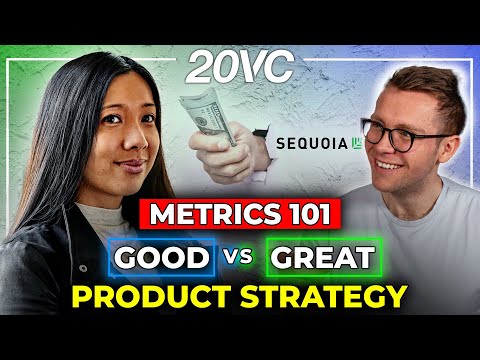
Vickie Peng: Why the Best Product People Actually Build Less Product? | E1141
Vickie Peng (guest), Harry Stebbings (host)
In this episode of The Twenty Minute VC, featuring Vickie Peng and Harry Stebbings, Vickie Peng: Why the Best Product People Actually Build Less Product? | E1141 explores sequoia’s Vickie Peng Explains Why Great Product Leaders Build Less Vickie Peng, product leader turned Sequoia partner, explains why the best product people obsess over scoping down, building only what’s necessary to learn, and relentlessly anchoring on customer value. Drawing on roles at TrialPay, Polyvore, Instagram, and Sequoia, she outlines a practical framework: mission, metric, product strategy, and an honest understanding of customer mindset.
Sequoia’s Vickie Peng Explains Why Great Product Leaders Build Less
Vickie Peng, product leader turned Sequoia partner, explains why the best product people obsess over scoping down, building only what’s necessary to learn, and relentlessly anchoring on customer value. Drawing on roles at TrialPay, Polyvore, Instagram, and Sequoia, she outlines a practical framework: mission, metric, product strategy, and an honest understanding of customer mindset.
She argues that pre–product-market fit teams overbuild and over-index on vanity metrics like MRR or NPS instead of a single action-based ‘happiness metric’ inside the product. A recurring theme is the dual responsibility to both build product and build belief—internally with teams and externally with customers and investors.
Peng introduces three archetypes of product-market fit—hair-on-fire, hard fact, and future vision—each with different strategic challenges around competition, habit, and disbelief. Throughout, she emphasizes differentiation in the customer’s own words, the power of asking “What problem are we trying to solve?”, and the importance of doing unscalable things and faking parts of the product early on.
Key Takeaways
Build belief, not just product.
In every role, Peng had to convince internal stakeholders that a ‘side hustle’ was worth resourcing; successful product leaders frame possibilities, show early traction, and turn skeptics into believers inside the building as much as outside it.
Get the full analysis with uListen AI
Scope down ruthlessly—build only what you must to learn.
Teams almost always overestimate how much product they need to validate a hypothesis; Peng ran Polyvore’s entire ad engine on a spreadsheet for a year, proving that minimal tooling can be enough to unlock major revenue and learning.
Get the full analysis with uListen AI
Use a single, action-based metric as your pre-PMF North Star.
Instead of NPS or MRR, define a metric tied to a core in-product action (e. ...
Get the full analysis with uListen AI
Always ask, “What problem are we trying to solve?”
At Instagram, what looked like an acquisition problem for SMB ads was actually a retention crisis; reframing the problem changed the roadmap and averted an eventual growth cliff, illustrating how misframed problems derail strategy.
Get the full analysis with uListen AI
Tell the story from the customer’s perspective, not yours.
Founders often lead with ‘we’ and features instead of how the customer’s life changes; effective product storytelling starts with the user’s problem and outcome and is validated when customers can explain your differentiation in one sentence.
Get the full analysis with uListen AI
Match your product strategy to the customer’s mindset archetype.
Hair-on-fire markets require differentiation in crowded spaces, hard fact markets require breaking ingrained habits and incumbents, and future vision markets require validating a paradigm shift via credible stepping-stone products.
Get the full analysis with uListen AI
Don’t import a complex product to a simpler customer.
Peng’s early Instagram mistake was ‘watering down’ a sophisticated ads platform for SMBs instead of designing from the baker’s real workflow; copying an enterprise tool and simplifying it rarely works without rethinking from the target user out.
Get the full analysis with uListen AI
Notable Quotes
“You are almost always going to overestimate the amount that you need to build to actually learn the thing that you want to learn.”
— Vickie Peng
“My job as a product leader is almost to scope down the product that I build. To build less product, I consider it successful.”
— Vickie Peng
“The most common reason founders don’t get product-market fit is not solving a problem that matters with a solution that’s compelling enough.”
— Vickie Peng
“Say it in their words, not yours.”
— Vickie Peng
“Nobody ever actually gets and keeps product-market fit. It is an ongoing battle, an ongoing journey.”
— Vickie Peng
Questions Answered in This Episode
Given Peng’s framework, how would you redefine your current product mission and single core metric, and do they genuinely reflect customer happiness?
Vickie Peng, product leader turned Sequoia partner, explains why the best product people obsess over scoping down, building only what’s necessary to learn, and relentlessly anchoring on customer value. ...
Get the full analysis with uListen AI
Where in your roadmap could you replace engineering work with ‘fake’ or unscalable operational hacks to learn faster with less product?
She argues that pre–product-market fit teams overbuild and over-index on vanity metrics like MRR or NPS instead of a single action-based ‘happiness metric’ inside the product. ...
Get the full analysis with uListen AI
Are you truly solving a hair-on-fire problem, or is your product actually living in the ‘hard fact’ or ‘future vision’ category—and how would that change your go-to-market plan?
Peng introduces three archetypes of product-market fit—hair-on-fire, hard fact, and future vision—each with different strategic challenges around competition, habit, and disbelief. ...
Get the full analysis with uListen AI
If you asked your best customers to explain what makes your product different in one sentence, what would they say—and does it match your own story?
Get the full analysis with uListen AI
Looking at your growth metrics, is the real constraint acquisition, retention, or something else entirely, and when was the last time you deeply interrogated that with data and user interviews?
Get the full analysis with uListen AI
Transcript Preview
So pre-product market fit, the strong advice to pick a number that represents customer happiness, and I recommend not using MPS. I recommend using a metric that's specifically an action in your product. So imagine any time this user takes an, uh, this action, they're pressing a button that says, "This product is great. I love this product," or "I, I'm using this product." So it could be an API call. It could be dashboard that's created. You are almost always going to overestimate the amount that you need to build to actually learn the thing that you wanna learn.
Ready to go? Vicky, I am so excited for this. I have to admit, I'm not sure if I'm allowed to say this, but it's the end of the day here and I'm just feeling a little bit looser than I normally do.
(laughs) So is Harry.
Alfred normally sends quite curt emails. You know, he's a busy guy. And with you recommending topics, it was like an essay-
(laughs)
... of your brilliance, which, you know, I, I wish he'd say such nice things about me.
Aw.
But, um, thank you for joining me today.
Thank you so much for having me, Harry. I'm so excited to be here.
Yeah. I'm excited for this, and I wanna kind of go through the different stages of your career until today, and just extract some learning. So if we start on TrialPay, much earlier in your career, I, I heard you joined when it was a social gaming, was considered a bit of a distraction there, and you turned it into this massive revenue driver. What was the single biggest product lesson from that experience with TrialPay?
Ooh, yeah. Big question. So I've actually been in product now for, uh, you know, reflecting on it, for about 15 years, which sounds like a very long time when you say that out loud. Um, (laughs) I was originally drawn, I think, to the career mostly because I love pulling order out of chaos, essentially. Um, you know in the movie, The Matrix, where you see, like, the lines of c- code floating in the air, or in A Beautiful Mind, he sees math formulas? I hear a big, kind of, like, meaty question, I see bullet points, or, like, pillars, or two-by-twos, and I just need to structure things. Sometimes people will be in meetings with me, and I just have to open my laptop and start typing in a doc, 'cause I just wanna make bullet points. Uh, and so product, I think, was an area that, it, it's just like the, just this engine of being able to kind of take these problems and break them down and make them tractable and take action on them. It's like this cycle of conviction and action. Build conviction, take action. Action helps you build conviction. It's just this cycle over and over again. And I find it so exciting. So, TrialPay was the first place that I was able to do that, and just, like, jump into a space where I was able to build some sort of hypothesis, and then build an actual product that tested that hypothesis. Um, but as you said, the product that I owned was kind of like a side hustle for the company. The company was already a growth stage company. We had found product market fit in the, you know, space of e-commerce and software, and there was this little nugget of a belief like, "Hey, could we apply this busi- business model to another space?" Which was social gaming, which was on the rise at the time. I don't know if you remember the times when everybody had their own farm or aquarium or whatever they were tending to in between, you know, their productive life. Uh, but-
Install uListen to search the full transcript and get AI-powered insights
Get Full TranscriptGet more from every podcast
AI summaries, searchable transcripts, and fact-checking. Free forever.
Add to Chrome