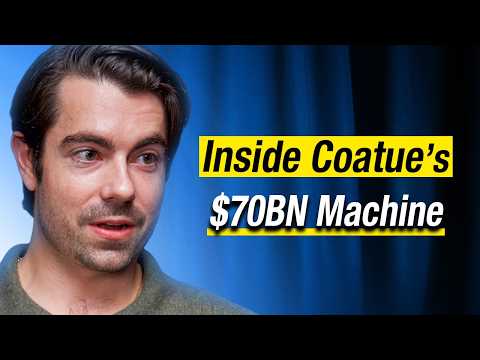
Lucas Swisher on How Mega Funds Can Still Do 5x Returns & Why Big Markets are the Most Important
Lucas Swisher (guest), Harry Stebbings (host)
In this episode of The Twenty Minute VC, featuring Lucas Swisher and Harry Stebbings, Lucas Swisher on How Mega Funds Can Still Do 5x Returns & Why Big Markets are the Most Important explores coatue’s Lucas Swisher on AI, mega-funds, and durable growth returns Swisher argues public SaaS is being “crushed” because investors are questioning SaaS’s terminal durability as AI changes switching costs, product moats, and value capture—creating broad uncertainty about which incumbents survive.
Coatue’s Lucas Swisher on AI, mega-funds, and durable growth returns
Swisher argues public SaaS is being “crushed” because investors are questioning SaaS’s terminal durability as AI changes switching costs, product moats, and value capture—creating broad uncertainty about which incumbents survive.
He explains Coatue’s approach: prioritize gigantic markets and companies that can hop multiple S-curves (multi-product expansion), treat valuation as a later question when growth is exponential, and underwrite whether you’d invest again at a higher price after execution.
On fund math, he contends $5B+ growth funds can still work because outcomes are larger in AI and late-stage private rounds allow deploying very large checks—if the strategy is highly concentrated rather than “spray and pray.”
He emphasizes nuance: gross margin can mislead early in architecture shifts (AI inference costs fall quickly), while retention is a critical safety signal for low-margin AI businesses; he also rejects simplistic “kingmaking” narratives while acknowledging capital can confer advantages.
Key Takeaways
AI is forcing markets to re-underwrite SaaS terminal value.
Swisher says investors are questioning whether SaaS remains an “annuity” as AI makes product categories more disruptable; once terminal value is questioned, valuation frameworks and tolerance for adjustments (e. ...
Get the full analysis with uListen
In uncertain AI disruption, investors sell first because winners are unclear.
He notes you can craft a bull and bear case for nearly every public SaaS name, prompting capital to rotate away until leading indicators (sequential growth, net new ARR, retention) confirm resilience.
Get the full analysis with uListen
Big markets are the first principle—especially at high entry prices.
If you pay growth-stage prices, a medium/small TAM creates fatal ceiling risk; Coatue’s bar shifted from the “$10B public company test” to underwriting whether a company can be an enduring $50B–$100B+ outcome.
Get the full analysis with uListen
The best underwriting test is: would you invest more at a higher price?
Rather than optimizing for an initial entry multiple, Swisher looks for businesses where strong execution makes the next, higher-priced round attractive—enabling compounding through double-downs.
Get the full analysis with uListen
Mega-funds can still generate strong returns—but only with concentration.
He argues $5B+ growth funds work because you can now put ~$1B into late-stage private rounds; a single 10x on that check can drive meaningful fund performance, which demands “few investments, big checks.”
Get the full analysis with uListen
3x outcomes aren’t exciting in growth because portfolio losses require 5–6x winners.
To net ~3x at the fund level, misses and 1x/2x outcomes force higher multiples elsewhere; he also underwrites whether public-market buyers can still see another 3x from the post-IPO price.
Get the full analysis with uListen
Margins matter at scale; early margins can be misleading during shifts.
He points to hyperscalers, Snowflake, and Databricks having poor early gross margins; in AI, inference costs are dropping fast and companies may trade lower gross margin for lower opex—potentially preserving strong operating margins later.
Get the full analysis with uListen
For low-margin AI apps, retention is the non-negotiable risk control.
Swisher says sticky usage/retention is essential because low gross margin leaves “no margin for error”; without high retention, small adverse changes can break the model.
Get the full analysis with uListen
Most double-down mistakes come from overestimating TAM and multi-product ability.
He claims misses are less about teams or near-term growth and more about wrongly assuming a company can expand into multiple markets or sustain platform-like breadth over time.
Get the full analysis with uListen
“Kingmaking” is overstated, but incentives and partners still matter.
He rejects the idea that top-tier capital ends competition, yet acknowledges capital can accelerate hiring/go-to-market when PMF is real; he values the question: “Who wants to help you, and who wants to hurt you?”
Get the full analysis with uListen
Notable Quotes
“For the first time ever, with this AI wave, people are questioning the terminal value of SaaS.”
— Lucas Swisher
“It’s not revenue growth that you wanna chase, it’s [the ability to reinvent and ride multiple S-curves].”
— Lucas Swisher
“I think price does matter, but I think it matters least.”
— Lucas Swisher
“Margin matters, but early, it can be a misleading indicator… Margin matters at scale.”
— Lucas Swisher
“Data is a prerequisite. It is not the answer.”
— Lucas Swisher
Questions Answered in This Episode
You mentioned leading indicators like sequential growth, net new ARR, and retention—what specific thresholds or patterns would convince you a public SaaS name is a “baby not bathwater” in the AI repricing?
Swisher argues public SaaS is being “crushed” because investors are questioning SaaS’s terminal durability as AI changes switching costs, product moats, and value capture—creating broad uncertainty about which incumbents survive.
Get the full analysis with uListen AI
When you say companies must be able to “hop multiple S-curves,” what concrete evidence (org design, product cadence, distribution changes) shows that ability early enough to invest?
He explains Coatue’s approach: prioritize gigantic markets and companies that can hop multiple S-curves (multi-product expansion), treat valuation as a later question when growth is exponential, and underwrite whether you’d invest again at a higher price after execution.
Get the full analysis with uListen AI
Your internal litmus test is whether you’d invest again at a higher price—can you give an example of what operational progress flips that answer from “no” to “yes”?
On fund math, he contends $5B+ growth funds can still work because outcomes are larger in AI and late-stage private rounds allow deploying very large checks—if the strategy is highly concentrated rather than “spray and pray.”
Get the full analysis with uListen AI
On mega-fund math: what’s the minimum ownership/check size you need in a late-stage round for it to matter to a $5B fund, and how does that change by valuation band?
He emphasizes nuance: gross margin can mislead early in architecture shifts (AI inference costs fall quickly), while retention is a critical safety signal for low-margin AI businesses; he also rejects simplistic “kingmaking” narratives while acknowledging capital can confer advantages.
Get the full analysis with uListen AI
You argue vertical SaaS isn’t a focus for big funds—are there verticals where AI expands TAM enough to re-qualify them, or is the category structurally capped?
Get the full analysis with uListen AI
Transcript Preview
I think price does matter, but I think it matters least. Margin matters, but early, it can be a misleading indicator. Data is a prerequisite. It is not the answer.
Now, I am bored. I am bored of recycled guests, interviews that have been done over and over again. Today's guest is rarely ever on a podcast, Lucas Swisher. He co-leads the growth fund at Coatue, and they've backed some of the best companies of the last few years.
One of the places where we don't spend time, these pre-revenue companies at really high valuations. I don't think the kingmaking concept is a real thing.
You don't?
Who's gonna wanna help you, and who's gonna wanna hurt you? Because that ultimately matters. Ready to go? [upbeat music]
Lucas, dude, it is so good to have you on the show. We've walked around Hyde Park. I feel like we bonded in my short shorts.
[laughing]
I've heard so many things now, 'cause I stalked the shit out of you, from David and specifically Jesse at Datadog. So thank you for doing this, man.
Of course. Thanks for having me.
We're gonna dive right in with a super easy question, which is public SaaS companies are getting killed. I'm looking at my book, dude, and I'm like, "I thought I was so good at this," and now I'm really starting to question it with the amount of red that I'm seeing. So why is the public-private boundary breaking down, and what's the better side to be on?
For the first time ever, with this AI wave, people are questioning the terminal value of SaaS, right? These were supposed to be like insurance companies, you know, annuity streams, that just have revenue streams and profit pools forever and ever and ever. And for the first time with a lot of AI, and I think in particular in the last six months with a lot of the coding models that have come out of Anthropic, OpenAI, and others, you are starting to question that value. And when you question that value, a lot of other things happen, right? The breaks that you got on SBC, stock-based comp, and GAAP versus non-GAAP earnings, those all start to go away. So that's the first dynamic, and then I think the second dynamic that's happening, um, is people don't know which SaaS is gonna be affected, right? Like, you can think of a bull case and a bear case for basically every SaaS company in the public markets, and when that happens, people are saying, "Okay, I'm just gonna take my bags, and I'm gonna walk away, and I'm gonna do something else," right? Because why own anything if I'm really not sure which one of these things is gonna work? I'm just gonna go own consumer internet, or SIMIs, or something else, right? And so I think, like, that's the real dynamic that's happening, is those two things are happening all at once, and all of a sudden, you know, that barrier breaks down.
Install uListen to search the full transcript and get AI-powered insights
Get Full TranscriptGet more from every podcast
AI summaries, searchable transcripts, and fact-checking. Free forever.
Add to Chrome