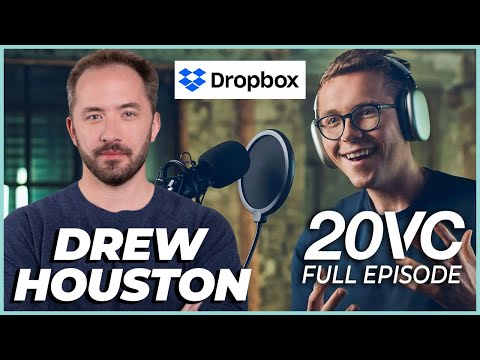
Dropbox CEO Drew Houston: How to Pick a Co-Founder; Steve Jobs' Attempt to Buy Dropbox | 20VC #938
Harry Stebbings (host), Drew Houston (guest), Narrator
In this episode of The Twenty Minute VC, featuring Harry Stebbings and Drew Houston, Dropbox CEO Drew Houston: How to Pick a Co-Founder; Steve Jobs' Attempt to Buy Dropbox | 20VC #938 explores dropbox CEO Drew Houston on Founders, Failure, and Beating Tech Giants Drew Houston recounts Dropbox’s origin as a personal frustration with lost thumb drives and his unconventional path into Y Combinator, including hustling Hacker News and ‘getting married on the second date’ with co‑founder Arash Ferdowsi.
Dropbox CEO Drew Houston on Founders, Failure, and Beating Tech Giants
Drew Houston recounts Dropbox’s origin as a personal frustration with lost thumb drives and his unconventional path into Y Combinator, including hustling Hacker News and ‘getting married on the second date’ with co‑founder Arash Ferdowsi.
He shares how to think about choosing co‑founders, building high‑talent teams, and evolving from a great product to a company that repeatedly ships great products at scale.
Houston dives into his own leadership evolution: executive coaching, the Enneagram, overcoming conflict avoidance, handling brutal press cycles, and navigating existential competitive threats from Apple, Google, and Microsoft.
He also describes turning down Steve Jobs’ acquisition attempt, the fast Sequoia deal, and his long‑term vision of Dropbox as the operating system for your working life, powered by AI.
Key Takeaways
Pick co‑founders on trust, shared values, and complementary strengths.
Strong founder relationships resemble serious personal relationships: you need deep alignment on mission and culture, overlap on existential decisions, and complementary skills so you can divide and conquer effectively.
Get the full analysis with uListen AI
Know what fundamentally motivates you—and make it explicit.
Houston emphasizes bringing your drivers (what you’re running from and toward) from the subconscious to the conscious, using tools like executive coaching and the Enneagram to understand patterns like competitiveness, fear of discomfort, or desire for impact.
Get the full analysis with uListen AI
High performance starts with results, but depends on process and mindset.
He defines performance as a stack: first outcomes, then the quality of systems and practices that produce them, and finally mindset—self‑awareness, coachability, and ownership instead of blame—because without the right mindset, improvement stalls.
Get the full analysis with uListen AI
Conflict avoidance quietly damages teams; direct feedback is a duty, not a luxury.
Avoiding hard conversations feels kind in the moment but robs people of the chance to improve and amplifies problems; learning to be clear, timely, and respectful—without over‑owning others’ emotional reactions—is a core CEO skill.
Get the full analysis with uListen AI
In hiring, obsess over talent density and calibrate what ‘great’ looks like.
Early on, hand‑pick exceptional people and guard the bar; for execs, use interim consultants and your investors’ networks to see truly top‑tier examples, because founders often can’t judge roles they’ve never done themselves.
Get the full analysis with uListen AI
As companies scale, founders must shift from building a product to building the system that builds products.
Houston describes the hard transition from a single brilliant product to an organization that repeatedly innovates—requiring more structure, discipline, and operational excellence than his natural ‘comfortable in chaos’ style.
Get the full analysis with uListen AI
Surviving competition from giants requires ruthless focus and re‑anchoring your purpose.
When Google, Apple, and Microsoft cloned and bundled Dropbox‑like features, Houston had to shut down beloved bets, accept public “failure,” and re‑commit to a deeper purpose and strategic focus rather than chasing every front.
Get the full analysis with uListen AI
Notable Quotes
“Our equivalent was like getting married on the second date.”
— Drew Houston
“A manager’s performance cannot be rated higher than the output of their organization.”
— Drew Houston (paraphrasing Andy Grove)
“If you like new ideas, you’re bored by routine and not super disciplined about little details.”
— Drew Houston
“There’s no such thing as a diplomatic hand grenade.”
— Drew Houston
“You guys are a feature, not a product. Now we’re going to have to compete with you and kill you.”
— Steve Jobs (as recounted by Drew Houston)
Questions Answered in This Episode
How can early‑stage founders practically test for trust and value‑alignment with a potential co‑founder before ‘getting married on the second date’?
Drew Houston recounts Dropbox’s origin as a personal frustration with lost thumb drives and his unconventional path into Y Combinator, including hustling Hacker News and ‘getting married on the second date’ with co‑founder Arash Ferdowsi.
Get the full analysis with uListen AI
What concrete practices can a naturally conflict‑avoidant leader adopt in the next 30 days to become more direct without feeling inauthentic?
He shares how to think about choosing co‑founders, building high‑talent teams, and evolving from a great product to a company that repeatedly ships great products at scale.
Get the full analysis with uListen AI
When Big Tech platforms start copying your product, how do you decide whether to double down, pivot, or shut down specific product lines?
Houston dives into his own leadership evolution: executive coaching, the Enneagram, overcoming conflict avoidance, handling brutal press cycles, and navigating existential competitive threats from Apple, Google, and Microsoft.
Get the full analysis with uListen AI
How should a founder know when it’s time to replace or layer an executive versus investing further in their development?
He also describes turning down Steve Jobs’ acquisition attempt, the fast Sequoia deal, and his long‑term vision of Dropbox as the operating system for your working life, powered by AI.
Get the full analysis with uListen AI
What indicators would show that Dropbox is truly becoming ‘the system that organizes your whole working life’ rather than just a smarter file sync tool?
Get the full analysis with uListen AI
Transcript Preview
Drew, I'm so excited for this. I told you beforehand, I listened to your show in 2018 with Tim Ferriss, and I thought, "Who is this genius? I have to have him on the show." It only took four years. But thank you so much for joining me today.
Oh, well, thanks Harry. It's great to be here.
I would love to start today with a little bit of an origin story. So what was the original unique insight you had with Dropbox? How did you get it and how did it lead to the founding of the company, in a succinct two to three minutes?
Sure, yeah. I mean, it was, uh... Kind of as a user, I, I kept forgetting my thumb drive. I had started another company at the time doing online SAT prep, of all things, um, but I needed to work w- from multiple computers. And so I had everything... All of our company's crown jewels were on this little thumb drive that I kept losing or almost putting in the washing machine, um, all the things that used to happen, and, um, it culminated in this. I, I was taking this bus ride from Boston to New York to visit my friends, but I wanted to get some work done for, uh, my company, and I realized when I got on the bus I had forgotten my thumb drive. Um, and, uh, you know, I, I... (laughs) And I wasn't like, "Oh, I hate my thumb drive." I was like, "Oh, I hate myself. God, I'm so disorganized. I need to, you know, be more on top of this." (laughs) . But as I thought about it, I'm like, "Man, I'm just so frustrated with this. This keeps happening. I never wanna have this problem again." And I started writing some code, some Python code, uh, on that ride 'cause I didn't have anything else to do. And, and this was like before you had iPhones and Wi-Fi on buses and things like that. But I had no idea it would turn... what it would turn into, but it was really just a personal frustration.
I, I, I love that. Now, speaking of kind of stories that we have to discuss, I spoke to, kindly thanks to your suggestion, uh, Adam before the show, and he told me that the YC story is the ultimate story of hustle and that I had to discuss it.
Yeah.
So starting there, what was the YC story that we have to hear?
Sure. Well, Adam Smith is one of my best friends, and we went to college together, and, uh, he did Y Combinator, and him... H- and he moved out to California. He got VC f- VC funding. Um, and so all of that, his experience was a big inspiration, uh, to me as, as he was going through all that. Um, and I... Uh, yeah, so I personally had a very winding road into Y Combinator myself. (laughs) So I actually applied in 2005 to the first batch with that SAT prep company, Accolade, uh, and was rejected. Um, and then I was still working on it when I had the idea for Dropbox. Um, and, um, I was getting a little burned out from the SAT prep thing. I'm like, "I, I don't know how many more equation, you know, equations about parallel lines or the train leaving Memphis and, you know, just like all the things with SAT prep you can..." I mean, as passionate about it as you can be, but kind of getting a little burned out, I recognize now. Um, uh, and I was like, "Hey, this might be a good fit for Y Combinator." Um, so I wanted to apply. That said, one thing that was useful from my whole, uh, test prep background was really understanding college admissions. Uh, actually pretty similar, a lot of similarities with something at YC- Y Combinator. You have a lot of people applying for a few slots, so anything you can do to get an edge or a hook would be helpful. So, to me, um, the Dean of Admissions here was Paul Graham, uh, the, the, uh, one of the founders of Y Combinator, and, um, so I'm... I was sort of working back from like, wha- you know, "What does Paul do all day? How do I get in front of my Dean of Admissions here?" Um, and I'm like, "You know? I think Paul probably does what most of the rest of us do, which is just keep refreshing Hacker News every day, which is Y Combinator's news site." (laughs) Um, it's kind of like Reddit for startup news. Um, and I'm like, "Man, if I can get something on Hacker News, like, Paul will see it. This might be good." So I made this demo video, uh, that actually hit the top of Hacker News for a couple of days in 2007. And so there's a link still, it's still out there. You can see I posted this little video, um, and the response was super good from, um, from the community and I... And sure enough, I... (laughs) it, it actually worked. I got an email from Paul saying, "Hey, like your idea, but, uh, you need a co-founder if you're gonna get into YC." Um, uh, and the only problem was I didn't have one, and the inter- the interview deadline was a couple weeks away, so it's sort of like saying, "I, I know you're not dating anyone, but you need to be married in the next couple weeks."
Install uListen to search the full transcript and get AI-powered insights
Get Full TranscriptGet more from every podcast
AI summaries, searchable transcripts, and fact-checking. Free forever.
Add to Chrome