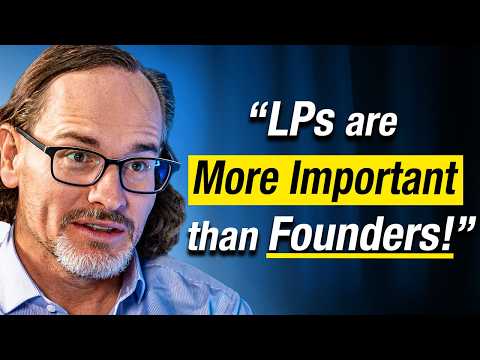
Mitchell Green, Founder @ Lead Edge Capital: Why Traditional VC is Broken
Mitchell Green (guest), Harry Stebbings (host)
In this episode of The Twenty Minute VC, featuring Mitchell Green and Harry Stebbings, Mitchell Green, Founder @ Lead Edge Capital: Why Traditional VC is Broken explores lead Edge’s Mitchell Green: Discipline, Liquidity, And Why VC’s Broken Mitchell Green, founder of Lead Edge Capital, argues that much of traditional venture capital is structurally broken: prices are irrational, exits too slow, and funds too focused on paper marks instead of cash back to LPs.
Lead Edge’s Mitchell Green: Discipline, Liquidity, And Why VC’s Broken
Mitchell Green, founder of Lead Edge Capital, argues that much of traditional venture capital is structurally broken: prices are irrational, exits too slow, and funds too focused on paper marks instead of cash back to LPs.
He explains Lead Edge’s highly quantitative ‘8‑criteria’ framework, outbound sourcing model, and obsession with selling and secondary liquidity, contrasting it with brand‑driven Silicon Valley VC and mega‑fund behavior.
Green believes AI is real but wildly overfunded at the infrastructure layer, that incumbents with distribution will win, and that the fantasy of one‑person billion‑dollar AI companies ignores sales, GTM and retention realities.
He urges LPs to hold managers accountable for DPI, ask how they behaved in 2020–21, and recognize that many mid‑tier SaaS companies can be solid PE exits if they accept they’re not the next Datadog or Snowflake.
Key Takeaways
Build and stick to a clear, objective investment framework.
Lead Edge evolved Bessemer’s early criteria into an ‘8‑point’ screen (revenue scale, growth, margins, retention, capital efficiency, etc. ...
Get the full analysis with uListen AI
Prioritize DPI and liquidity over paper marks and narratives.
Green insists the real job is returning cash, not showing high TVPI; Lead Edge runs a formal disposition committee, aggressively sells down positions (including via secondaries and strip sales), and is happy to take a 0. ...
Get the full analysis with uListen AI
AI is transformative long term, but today’s infra bets resemble 1997 web hosting.
He argues AI infra will commoditize like early web servers did, prices will crash, and the stock market’s reaction (NVIDIA down, software up) is rational—value will accrue to incumbents that embed AI to improve productivity and distribution, not to most standalone infra startups.
Get the full analysis with uListen AI
Incumbent distribution and customer base usually beat technical novelty.
Using examples like Gravity and large SaaS incumbents, he notes that 10 engineers plus Copilot can act like 30–40, and that Salesforce/Workday‑type players will typically outcompete greenfield challengers because go‑to‑market, regulation, and retention matter more than pure tech.
Get the full analysis with uListen AI
Most mid‑tier SaaS companies should aim for PE exits, not IPOs.
For $50–200M ARR companies growing mid‑teens with decent margins, the rational strategy is to reach Rule of 40, accept a 4–7x revenue exit to mid‑market PE, and stop pretending they’re future mega‑caps—otherwise they become ‘living dead’ with no natural buyer.
Get the full analysis with uListen AI
Gross dollar retention and capital efficiency are more telling than net expansion.
Green warns that high net retention can mask weak product–market fit if gross dollar retention is low; at scale, a big ‘hole in the bucket’ destroys sales efficiency and cash burn, whereas 90–99% gross dollar retention plus 1:1 revenue‑to‑cumulative‑burn ratios signal durable quality.
Get the full analysis with uListen AI
LPs should interrogate manager behavior in 2020–21 and on public distributions.
He urges LPs to ask how much unlocked public stock a manager held at the September 2021 peak, why it wasn’t distributed, and to reference exits (including failures) when assessing a GP’s discipline, transparency, and alignment—not just brand or self‑reported marks.
Get the full analysis with uListen AI
Notable Quotes
“Investing in AI infrastructure today is like investing in websites in 1997.”
— Mitchell Green
“The incumbents usually win. It’s customer distribution.”
— Mitchell Green
“The idea of a single-person AI company, I think, is comical at best.”
— Mitchell Green
“DPI is the most important thing, and marks are completely for suckers.”
— Mitchell Green
“Entry price matters. A lot. People didn’t learn a damn thing from ’20 and ’21.”
— Mitchell Green
Questions Answered in This Episode
How should early‑stage founders decide whether to optimize for a ‘generational’ IPO path versus building toward a PE exit and Rule of 40 outcomes?
Mitchell Green, founder of Lead Edge Capital, argues that much of traditional venture capital is structurally broken: prices are irrational, exits too slow, and funds too focused on paper marks instead of cash back to LPs.
Get the full analysis with uListen AI
If incumbents are likely to win in AI, where exactly are the defensible greenfield opportunities for startups over the next decade?
He explains Lead Edge’s highly quantitative ‘8‑criteria’ framework, outbound sourcing model, and obsession with selling and secondary liquidity, contrasting it with brand‑driven Silicon Valley VC and mega‑fund behavior.
Get the full analysis with uListen AI
What concrete metrics and behaviors should LPs use to distinguish genuinely disciplined managers from brand‑name funds with mediocre DPI?
Green believes AI is real but wildly overfunded at the infrastructure layer, that incumbents with distribution will win, and that the fantasy of one‑person billion‑dollar AI companies ignores sales, GTM and retention realities.
Get the full analysis with uListen AI
How can overfunded SaaS companies realistically pivot from ‘living dead’ status to attractive PE targets without destroying culture or product momentum?
He urges LPs to hold managers accountable for DPI, ask how they behaved in 2020–21, and recognize that many mid‑tier SaaS companies can be solid PE exits if they accept they’re not the next Datadog or Snowflake.
Get the full analysis with uListen AI
Could a more mature secondaries market fundamentally change how venture funds are structured and how long LP capital is locked up?
Get the full analysis with uListen AI
Transcript Preview
I think investing in AI infrastructure today is like investing in websites in 1997. The incumbents usually win. It's customer distribution. The idea of a single-person AI company, I think is like comical at best. I think the venture industry was about to be in for a rude awakening, and then AI showed up. People didn't learn a damn thing from '20 and '21. It's like shocking.
Ready to go? (instrumental music plays) Mitchell, I'm so excited for this. When Nigel Morris messages me and says, "Hey, you've gotta spend time with my friend Mitchell," I'm like, "You know what, Michael? Uh, you know what? Uh, this is gonna be a fun one." So thank you so much for joining me.
Absolutely. Thanks for having me on. Nigel's a legend, so...
He is a legend. Uh, always makes me feel very lazy though. Uh, so athletic.
He, he, he's also the hardest working man and, uh, you know, I was like, "Oh, how..." You know, I joked to him the first time I met him. I'm like, "Well, how's retirement?" And then he showed me his Outlook calendar, and I'm like, "I think you work more now than you did when you ran Capital One." But... And by the way, never ever go on a bicycle ride with him.
I would never. Uh, before we dive into LeadEdge-
Sure.
... there was Tiger and there was Bessemer before.
Yeah.
When you think about your takeaways from those experiences that shaped how you operate and run LeadEdge today, what are the one or two that really shape how you think about LeadEdge?
Uh, what I would tell you is my time at Bessemer was very like formative for why... and everything we do here at LeadEdge. So what... A little bit of context. When I joined Bessemer, Bes- this was 2005. Bessemer is this legendary early stage venture fund that is very Shark Tank-esque. And what I mean by that is every year a th- you know, a thousand entrepreneurs would walk in the door, and at the time they had five partners, and it was very like Shark Tank-esque. And they were wondering why, why Insight was calling, finding these $15 million revenue companies growing fast that have never raised money, and they were like personal friends with the guys at Ran-, you know, Jeff and Devin, the g- guys at Insight. And all that Insight was doing was replicating what Summit and TA did, which was hire 22 to 24-year-old knuckleheads, which my now partner Brian and I were, and pound the phones calling companies all day long. And you realize if the company calls you back, the company sucks. It's the CEO you talk to every two days for a month, and, you know, and, and you know how you know what a good company is, over two years talk to 10,000 bad companies. And so when we got there a week into the job, they're like, "Okay, next Monday you're gonna come and present your best companies." And we got there, we're like, "Oh, we found this great company. It's two million in revenue. It's gonna be the next Google." They're like, "No, it's not. This company sucks. Find us companies that meet like 10 million of revenue." And then the next week you'd find a company that meets 12 million of revenue but grows 10% a year, and they're like, "No, no, find us companies that grow fif- " for them it was like 50% a year. And then you find a company but it has, it's 20 million in revenue, grows 40% a year, but you know, has 30% gross margins. And they're like, "No, no, find us businesses with like 70% gross margins." And they had five, and they over like a period of a six-week time or eight-week time, built these like five criteria. And they basically said, "On Mondays when we do our pipeline meetings, we want you to never bring a company that meets less than three criteria. If it meets five, you better already have the meeting set up, the next meeting, and start the pipeline meeting with, 'I spoke to company ABC, it meets X number of criteria. Here's what it does.'" And so it just like was a very rigid framework. In a world where like you can call companies all day long and it's like an unlimited universe, like stay like very rigid. And so, and we took that framework, we expanded it to six, now it's the LeadEdge 8, and that defines everything we do.
Install uListen to search the full transcript and get AI-powered insights
Get Full TranscriptGet more from every podcast
AI summaries, searchable transcripts, and fact-checking. Free forever.
Add to Chrome