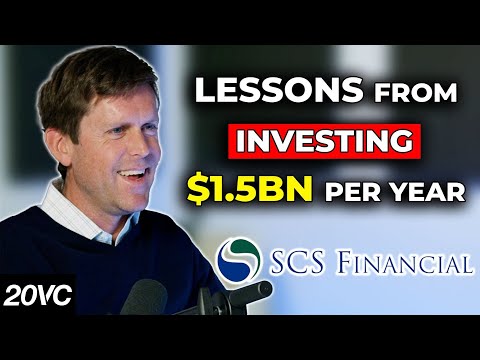
Peter Lacaillade: Why Now is the Best Time to Invest in Emerging Managers | E1096
Peter Lacaillade (guest), Harry Stebbings (host), Narrator, Narrator
In this episode of The Twenty Minute VC, featuring Peter Lacaillade and Harry Stebbings, Peter Lacaillade: Why Now is the Best Time to Invest in Emerging Managers | E1096 explores why Today’s LP Landscape Favors Agile Backers Of Emerging Managers Peter Lacaillade, a leading LP at SCS, explains why current market dislocation and LP pullbacks make this an unusually attractive time to back emerging managers, especially in venture and lower middle-market buyouts.
Why Today’s LP Landscape Favors Agile Backers Of Emerging Managers
Peter Lacaillade, a leading LP at SCS, explains why current market dislocation and LP pullbacks make this an unusually attractive time to back emerging managers, especially in venture and lower middle-market buyouts.
He contrasts his multifamily office structure and incentives with those of pensions, endowments, and banks, arguing that many large pools of capital are structurally unable or unwilling to take the risks required to back the next generation of top managers.
The conversation dives into how he evaluates GPs (emphasizing team quality and “force of nature” personalities over raw track record), constructs diversified portfolios of niche funds, and builds a scaled, fast-moving co-investment program.
Lacaillade also covers secondaries, liquidity management, and the common mistakes both LPs and emerging managers make, arguing that thoughtful partner selection and long-term alignment matter more than chasing brand names or short-term optics.
Key Takeaways
Now is an unusually good time to back emerging managers.
With many traditional LPs overallocated or structurally constrained, strong emerging managers are more accessible than they were in the 2016–2021 boom, allowing newer LP programs to gain entry to future franchise firms.
Get the full analysis with uListen AI
Track record matters, but team quality and strategy fit matter more.
Lacaillade treats historical returns as only the 4th or 5th-most important criterion; he prioritizes quality of team, clear competitive advantage, right-sized fund, and strong alignment over backward-looking performance.
Get the full analysis with uListen AI
Do targeted, off-list referencing to avoid echo chambers.
He assumes on-list references will all be positive and instead seeks off-list, trusted sources to surface nuanced weaknesses or risks, using soft questions to draw out what a manager really lacks.
Get the full analysis with uListen AI
Build a barbelled, highly diversified manager portfolio with focused underlying funds.
His model is 10–15 funds per vintage, mixing large franchises and small, highly concentrated specialists; across those, 3–5 funds exceed expectations, 3–5 meet them, and 1–3 underperform, still yielding attractive blended returns.
Get the full analysis with uListen AI
A scaled, fast, and selective co-investment program can materially boost net returns.
By co-investing only alongside top managers in their core areas, targeting 2. ...
Get the full analysis with uListen AI
Many large LPs are structurally blocked from backing the best small funds.
Rules like “no more than 10% of a fund” and “no check under $100M” effectively bar big pensions and sovereigns from sub-$1B vehicles, pushing them to large-cap funds and leaving an opening for more agile capital in lower and mid-market strategies.
Get the full analysis with uListen AI
Emerging managers should be extremely selective about LP composition.
Rather than taking the first money that appears, he advises targeting 20 or so thoughtfully chosen LPs, avoiding over-concentration (ideally <20% per LP), and prioritizing partners who can move quickly, stay through cycles, and genuinely add value.
Get the full analysis with uListen AI
Notable Quotes
“We had a choice: go into the B-plus funds everyone could access, or pick the next‑gen emerging winners. We chose the latter.”
— Peter Lacaillade
“Track record is important, but for me it’s maybe number four or five on the list.”
— Peter Lacaillade
“If I do ten funds, three to five exceed expectations, three to five meet expectations, and one to three underperform—and you still make money.”
— Peter Lacaillade
“If you see a venture fund on a bank platform, holy shit—that is not a good sign.”
— Peter Lacaillade
“Funds last longer than the average marriage. Don’t just take the quick money.”
— Peter Lacaillade
Questions Answered in This Episode
How should a new LP practically start sourcing and evaluating emerging managers in today’s market without an existing GP network?
Peter Lacaillade, a leading LP at SCS, explains why current market dislocation and LP pullbacks make this an unusually attractive time to back emerging managers, especially in venture and lower middle-market buyouts.
Get the full analysis with uListen AI
What specific signals does Peter look for in the first two meetings with a manager that tell him they’re a “force of nature” worth betting on?
He contrasts his multifamily office structure and incentives with those of pensions, endowments, and banks, arguing that many large pools of capital are structurally unable or unwilling to take the risks required to back the next generation of top managers.
Get the full analysis with uListen AI
How can an emerging manager balance the trade-off between taking a large, fast anchor commitment and avoiding over-concentration risk from a single LP?
The conversation dives into how he evaluates GPs (emphasizing team quality and “force of nature” personalities over raw track record), constructs diversified portfolios of niche funds, and builds a scaled, fast-moving co-investment program.
Get the full analysis with uListen AI
In a world of slower IPO markets and fewer obvious exits, how should GPs and LPs redesign their liquidity planning and secondary strategies?
Lacaillade also covers secondaries, liquidity management, and the common mistakes both LPs and emerging managers make, arguing that thoughtful partner selection and long-term alignment matter more than chasing brand names or short-term optics.
Get the full analysis with uListen AI
What would it take for large pensions and endowments to structurally fix their constraints and become truly competitive in backing early-stage and emerging managers?
Get the full analysis with uListen AI
Transcript Preview
You just have an unfair advantages over the public market. But the reality is- (digital beeping) ... when I joined SCS, we had $7 billion under management. I was investing maybe 200, 250 million a year. Now it's, like, about a billion and a half. It's amazing to me that the wealth management industry, it continues to be so fragmented, so under-served. If I do 10 funds, what I've found is three to five (bell dinging) exceed expectations, three to five (bell dinging) meet expectations, one to three underperform.
How quickly do you think you know the out-performers and the under-performers?
Like (censored) .
Peter, I am so excited for this. We've been friends for a while. You've been an amazing partner to me. So thank you so much for joining me today.
Harry, it's an honor. I, I'm big, big listener and, uh, great, great friendship, and thank you for having me.
Not at all. But you said to me before that you entered the world of LP and venture when you didn't really know what a multifamily office was. And so take me to your entry to SCS and how that came to be first.
Yeah, I mean, I'll back up for a second. So when I was at Georgetown, I wanted to be in the investing side, you know. I thought I could go right to the buy side. And then I found out, oh, actually, no, you n- need to do investment banking. And I worked at a scrappy, really kind of, you know, second, third-tier investment bank, but it was during '04 to '06. There were a lot of deals getting done, and so at a very young age, I was running around Santo Road doing financings with CEOs. I was, uh, doing IPO, being at the printer, like, leading, like, a team of accountants and lawyers and a guy from Deutsche Bank and ... So it was a very scrappy ... I didn't maybe get the best training in some ways, but formal training, but, like, go out there and do stuff was incredible and, um, my boss, Jeff Barlow, who's actually currently the head of banking, uh, or i- actually no, CEO of Canaccord, um, was a great mentor to me there. Uh, but I wanted to complement that with, um, a private equity firm and y- and I ended up at Harborvest, which was kind of the opposite, where great process, great people, and, and I saw the entire private equity world, and it really was a great insight into the different, the different pockets. When I went to business school, I thought, um, I would go into either, you know, low- lower middle market investing, either kind of on a control buyout or growth equity side, and I was interviewing or calling a bunch of Tuck alumni, GPs, trying to get a job. And one of the guys I called was like, "Well, I don't have a job for you, but the guys who manage my money are looking for a private equity person. Given your background at Harborvest, y- you could be a good fit." So I, I was interviewing with, like, four or five direct shops and then this random thing and, but then when I looked at it, I said, "Wow, this is an opportunity." They had 7 billion under management at the time, zero private equity, and there was one client that was investing 200, 250 million a year in the space. The, the comp was, like, the same. Like, I had ... So I had a vice president job at one private equity firm where I'd be the eighth person on a 14-person team, or build this out from scratch, and I, I took that and it's been, it's been amazing. I mean, it's really surpassed all expectations.
Install uListen to search the full transcript and get AI-powered insights
Get Full TranscriptGet more from every podcast
AI summaries, searchable transcripts, and fact-checking. Free forever.
Add to Chrome