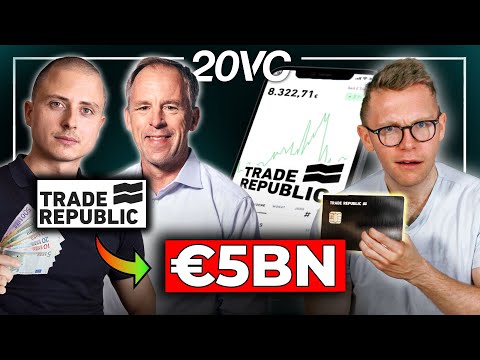
Christian Hecker & Johan Brenner: The Biggest Fundraising Lessons Having Raised $1.3BN | E1116
Harry Stebbings (host), Christian Hecker (guest), Johan Brenner (guest), Harry Stebbings (host)
In this episode of The Twenty Minute VC, featuring Harry Stebbings and Christian Hecker, Christian Hecker & Johan Brenner: The Biggest Fundraising Lessons Having Raised $1.3BN | E1116 explores founders and VCs Reveal Hard-Won Lessons From $1.3B Raised The conversation centers on Trade Republic’s journey from years of VC rejection and a disastrously dilutive angel deal to becoming a multi-billion-dollar European fintech that has raised $1.3B.
Founders and VCs Reveal Hard-Won Lessons From $1.3B Raised
The conversation centers on Trade Republic’s journey from years of VC rejection and a disastrously dilutive angel deal to becoming a multi-billion-dollar European fintech that has raised $1.3B.
Co‑founder Christian Hecker explains how they survived by bootstrapping, winning hackathons, and focusing relentlessly on product, regulatory moats, and early customers before capital became abundant.
Investor Johan Brenner describes why Creandum backed Trade Republic despite a broken cap table, the key risks they underwrote, and how fundraising narratives and metrics evolved as the company scaled.
They also dig into cap table design, how much to raise and when, board management, performance marketing vs. organic growth, and the broader strengths and weaknesses of the European tech ecosystem.
Key Takeaways
Early on, you often have no real choice in your cap table—opt for survival, then fix it later.
Trade Republic sold 75% of the company for €600K because no one else would fund them; only once they had traction and a banking license could they renegotiate ownership to be more founder-friendly with investor help.
Get the full analysis with uListen AI
Prove product-market fit and defensible moats before obsessing over valuation.
Once Trade Republic had a banking license and 10,000 paying customers, investors stopped questioning the model; the hard part was enduring years of conviction-driven building before the data was obvious.
Get the full analysis with uListen AI
Craft your fundraising story to add a new ‘10x layer’ each round.
Their A-round story was product-market fit, B-round was scaling Germany, and C-round was pan-European expansion—each successive pitch expanded the vision in a concrete, metrics-backed way.
Get the full analysis with uListen AI
Don’t over-rely on performance marketing; invest in products that drive organic growth.
After cutting performance marketing spend to zero, Trade Republic saw almost no decline in new customers, revealing that word-of-mouth, ambassadors, and savings products were the real acquisition engine.
Get the full analysis with uListen AI
For long-term financial products, optimize for recurring deposits, not trading activity.
Rather than pushing users to trade more, Trade Republic measures success by total assets and monthly recurring deposits via savings plans, aiming to build multi-decade customer relationships with minimal churn.
Get the full analysis with uListen AI
Effective boards require intentional design, preparation, and focus on a few key decisions.
Christian shares that great board meetings start with clear objectives, thorough pre-reads, and a consistent structure, while Johan stresses the value of independent members and periodic board evaluations.
Get the full analysis with uListen AI
In Europe, high talent density and performance culture must be explicitly chosen and defended.
Trade Republic leans into a demanding, performance-driven culture—quarterly evaluation, high expectations, and treating probation as extended interviews—to attract those who genuinely want to push hard.
Get the full analysis with uListen AI
Notable Quotes
“It's better to have a tiny shareholding of something big than a big shareholding of nothing.”
— Christian Hecker
“Most of the time, you don't have a choice. Basically, take what you can.”
— Christian Hecker
“Great at fundraising is absolutely the number one trait of great founders.”
— Johan Brenner
“We cut performance marketing to zero and got almost as many customers as before.”
— Christian Hecker
“If you cannot hide it, embrace it. We own our culture, which is very performance-driven.”
— Christian Hecker
Questions Answered in This Episode
If you were in Trade Republic’s position today, would you still take a 75% dilutive angel deal, or are there now better alternatives for capital-constrained founders?
The conversation centers on Trade Republic’s journey from years of VC rejection and a disastrously dilutive angel deal to becoming a multi-billion-dollar European fintech that has raised $1.3B.
Get the full analysis with uListen AI
How can founders realistically judge when to stop chasing VCs and instead pivot to bootstrapping or alternative funding routes?
Co‑founder Christian Hecker explains how they survived by bootstrapping, winning hackathons, and focusing relentlessly on product, regulatory moats, and early customers before capital became abundant.
Get the full analysis with uListen AI
At what point should a company seriously consider cutting performance marketing to test how much growth is truly organic?
Investor Johan Brenner describes why Creandum backed Trade Republic despite a broken cap table, the key risks they underwrote, and how fundraising narratives and metrics evolved as the company scaled.
Get the full analysis with uListen AI
How can European institutions and regulators better support the creation of ‘Charles Schwab–scale’ tech companies without overregulating?
They also dig into cap table design, how much to raise and when, board management, performance marketing vs. ...
Get the full analysis with uListen AI
What practical steps can founders take to build a high-performance culture in regions where work–life balance norms are more relaxed?
Get the full analysis with uListen AI
Transcript Preview
You sold 75% of the business to an angel investor. What happened, and how did that pan out?
So we tried to raise, many times. They were very eager to invest but they said, "Well, think we have leverage and so it's either this or nothing." And so we said, "Well, it's better to have a tiny shareholding of something big than a big shareholding of nothing." And then we raised 600,000 euros back then and sold 75% of the company.
And of course, we looked at the cap table and said, "Jesus, how are we going to manage this?" So we had several meetings with the seed investor. Explained that I think what's best for this company is if we have a cap table that's more founder-friendly.
What would be some of your biggest pieces of advice you've found is when thinking about building out your early cap table?
I think that it's important to acknowledge that most of the time, you don't have a choice.
Guys, I am so excited for this. I've heard so many wonderful things in doing the referencing for this show. So first, thank you so much for joining me today.
Thank you, Harry. It's great to be here. Looking forward to this for a long time.
Yeah, same. Thanks. Great to be here, and we're good, uh, listeners, so looking forward to be in it.
Well, that is very, very kind of you. So I want to start with just a little one-minute intro from each of you, just so the audience can get familiar with your voices. So, Christian, why don't we start with you? And then, uh, Johan, over to you.
Sure. So it's Christian. Uh, I'm one of the co-founders of Trade Republic. Uh, we started that journey, I think, nine years ago. Uh, before that worked in the investment banking, and before that, actually studied philosophy. So no clue how I ended up here, uh, but it's a lot of fun.
Johan? Yeah. I'm a venture capitalist. I'm a partner i- at Creandum, which is an early stage, uh, investor in primarily in Europe. Now I started my career in big companies, became an entrepreneur. My first company I started was actually an online trading outfit that I sold to E-Trade 20 years ago. Many moons later, uh, it's, it's Trade Republic. But I've, I've started my career as an operator, became an entrepreneur, and then joined, actually Benchmark, uh, in Europe 20 years ago, actually to the date, and joined Creandom a few years later. I've been with Creandom for 15 years.
You mentioned that, like, E-Trades, Johan, and like, when you know an industry so well, it's so easy to think that, actually, “Oh, I know everything in that site, not a good industry," or you have these preconceived ideas. Did you have preconceived ideas when you first met Christian?
Well, actually, I did. Uh, that story is kind of interesting. I didn't have preconceived ideas when I met Christian. When I met Christian, I fell in love with him and his team and what they were doing. But my colleague came to me one evening in, in, in March 9- 2019 and said, "We, we have this opportunity to look at a Robin Hood of Germany. Do you wanna take a look?" "No," I said.
Install uListen to search the full transcript and get AI-powered insights
Get Full TranscriptGet more from every podcast
AI summaries, searchable transcripts, and fact-checking. Free forever.
Add to Chrome