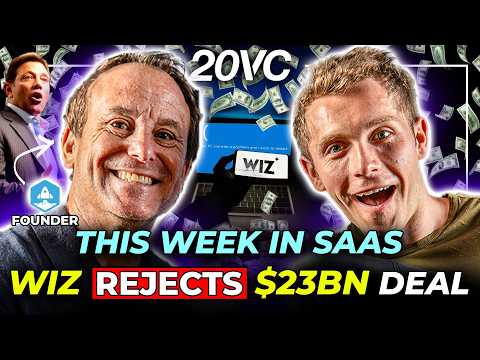
Jason Lemkin: Crowdstrike, WTF Happens From Here? Wiz Rejects Google’s $23BN Acquisition Offer|E1181
Jason Lemkin (guest), Harry Stebbings (host)
In this episode of The Twenty Minute VC, featuring Jason Lemkin and Harry Stebbings, Jason Lemkin: Crowdstrike, WTF Happens From Here? Wiz Rejects Google’s $23BN Acquisition Offer|E1181 explores jason Lemkin Dissects Wiz’s Rejection, CrowdStrike Meltdown, And Venture Delusion Jason Lemkin joins Harry Stebbings to unpack Wiz’s decision to reject Google’s $23B acquisition offer, arguing the price wasn’t crazy given Wiz’s growth and likely $1B forward ARR, but antitrust risk and distraction made an IPO path more rational for founders and late-stage investors.
Jason Lemkin Dissects Wiz’s Rejection, CrowdStrike Meltdown, And Venture Delusion
Jason Lemkin joins Harry Stebbings to unpack Wiz’s decision to reject Google’s $23B acquisition offer, arguing the price wasn’t crazy given Wiz’s growth and likely $1B forward ARR, but antitrust risk and distraction made an IPO path more rational for founders and late-stage investors.
They examine CrowdStrike’s catastrophic update that grounded airlines and crippled systems worldwide, critiquing its crisis communications and forecasting weaker upsell/NRR but limited near‑term churn, with Lemkin expecting markets to partially re-rate the stock once the dust settles.
The conversation broadens into today’s liquidity drought in venture, the pretense many funds are maintaining while deploying capital as if it were 2021, and the long tail of 1x funds likely to emerge from recent vintages.
They close by discussing late‑blooming winners like Clio, AI “feature parity” in SaaS (including Harvey.ai), under‑ and over‑appreciated public names like Klaviyo and Snowflake, and Lemkin’s own regrets around outbound sourcing and recruiting in venture.
Key Takeaways
Wiz likely made a rational choice rejecting Google’s $23B offer due to antitrust risk and distraction, not price.
At ~46x current ARR but roughly 20x forward ARR on an imminent $1B run-rate, Lemkin sees the offer as rich but not insane; the bigger issue was 18–24 months of regulatory overhang with a real chance of deal failure, which could severely damage momentum and culture.
Get the full analysis with uListen
In the current environment, founders should be biased toward taking strong acquisition offers, but exceptional outliers like Wiz can justify going public.
Lemkin now tells most founders to take meaningful exits because public life brings activist pressure, slowing growth, and long-term stress; Wiz is a rare case where growth, scale, and founder wealth already achieved make the IPO risk/return tradeoff acceptable.
Get the full analysis with uListen
Big tech M&A is driven by “chips” in good times, but antitrust has structurally reduced large-deal liquidity.
When cloud units are growing fast, leaders get political capital (“chips”) to spend on transformative deals like Wiz or HubSpot; however, cases like Adobe–Figma show regulators will block even non-obvious overlaps, meaning large M&A can no longer be relied on as a systemic liquidity valve.
Get the full analysis with uListen
CrowdStrike’s outage probably won’t cause mass churn, but it will hurt upsell, NRR, and brand for several quarters.
Because endpoint security is deeply embedded, true vendor swaps take 3–5 years; most customers will grant one pass—especially since this wasn’t a security breach—but sales teams will struggle to cross-sell 30+ modules into angry accounts, compressing expansion revenue.
Get the full analysis with uListen
Venture is “pretending” on liquidity: many funds will end at ~1x despite continuing to deploy aggressively.
With IPO and M&A markets constrained since late 2021, Lemkin expects a generation of funds to barely return capital; yet managers keep investing at near-2021 pace to maintain brand momentum and fee streams, rather than pacing strictly to realized liquidity.
Get the full analysis with uListen
For modern SaaS IPOs, it’s not just revenue size but growth profile—roughly $500M ARR with ~30% growth or $200M+ with 50–60% growth.
Lemkin notes that analyst attention, trading depth, and valuation support usually require either scale plus durable ~30% growth (e. ...
Get the full analysis with uListen
AI will rapidly become table stakes, leading to “AI parity” across many SaaS categories.
In verticals like legal tech or contact centers, nearly every serious vendor is adding similar AI capabilities (e. ...
Get the full analysis with uListen
Notable Quotes
“In venture, we're all pretending.”
— Jason Lemkin
“Your job in venture is not to modulate your pace. Your job is to find Wiz.”
— Jason Lemkin
“You gotta let your vendors screw up once every five years.”
— Jason Lemkin
“Most of us can’t be Wiz, but maybe we can be Clio.”
— Jason Lemkin
“There are so many funds that will end up a whole generation of 1x funds.”
— Jason Lemkin
Questions Answered in This Episode
Was Wiz right to prioritize control and long-term independence over a guaranteed $23B outcome given today’s regulatory landscape?
Jason Lemkin joins Harry Stebbings to unpack Wiz’s decision to reject Google’s $23B acquisition offer, arguing the price wasn’t crazy given Wiz’s growth and likely $1B forward ARR, but antitrust risk and distraction made an IPO path more rational for founders and late-stage investors.
Get the full analysis with uListen AI
How should founders realistically weigh the stress and scrutiny of being public versus the risk of multi-year, possibly failed, antitrust reviews in large M&A processes?
They examine CrowdStrike’s catastrophic update that grounded airlines and crippled systems worldwide, critiquing its crisis communications and forecasting weaker upsell/NRR but limited near‑term churn, with Lemkin expecting markets to partially re-rate the stock once the dust settles.
Get the full analysis with uListen AI
What concrete steps should a company like CrowdStrike take—technically and in communications—to rebuild trust and restart upsell momentum after a global outage?
The conversation broadens into today’s liquidity drought in venture, the pretense many funds are maintaining while deploying capital as if it were 2021, and the long tail of 1x funds likely to emerge from recent vintages.
Get the full analysis with uListen AI
If AI feature parity becomes the norm in SaaS, where will true differentiation and defensibility come from for AI-first startups like Harvey.ai?
They close by discussing late‑blooming winners like Clio, AI “feature parity” in SaaS (including Harvey. ...
Get the full analysis with uListen AI
As an LP or founder, how should you evaluate venture managers in a world where many recent funds may only return around 1x capital?
Get the full analysis with uListen AI
Transcript Preview
In venture, we're all pretending. (upbeat music) (screen whooshes) You know, early-stage folks have never worried about liquidity. And the late-stage guys, you gotta deploy money. The time's ticking on these funds, so you gotta deploy them. We're praying, we're hoping liquidity comes back. We're investing, Harry. Like, there's almost as much liquidity as 2021. And- (screen clicks)
Ready to go? (upbeat music) (mouse clicking) I am so excited for this, dude.
(laughs)
When I told the team that we were gonna do this today, they were like, "Oh, yes. Jason episodes are our favorite."
(laughs)
So, thank you so much for doing this with me, dude.
It is so great, it's such a... I feel like we went through a time when the news was trivial, and now, it's all over the place, right? That, I guess that's the way it works, right?
We're gonna start with item one on the agenda, okay? I'm gonna read the title. Wiz Rejects Google's $23 Billion Offer, Eyes IPO.
Yes.
I just wanna start with, first off, what do you think of the acquisition price? 23 billion, 500 million ARR, growing 120% year on year. It's a 46X ARR multiple. What do you th-
Yeah, I think it's, you know, it's not expens- a couple things. First, it's not expensive. And what I mean is, this is a company that has gone from nothing to 500 million in four years, okay? So, you ca- you, wh- you have to be careful. Look, in the old days of SaaS, we all kinda grew at the same rate, so we used ARR multiples, okay? But now you have to use forward ARR multiples, forward revenue multiples. This company will be at a billion in a blink of an eye. So let's, let's just value it at a billion. It, it's gonna be there in 12 months, 14 months, nine months. It's a billion forward. Until this little issue of CrowdStrike grounding the world's air fleet, and a few other issues which we'll get to, you know, CrowdStrike traded at almost 30X in today's world, well over 20X. So, 20X times a billion for, for Wiz, if... And you can't buy CrowdStrike, right? I mean, maybe you can today but... So I don't think, ironically, it's, I don't think it was overpriced. Um, I do think it might have been a good deal for the investors, because you avoid so much dilution and risk. I, 22 I think is 30 for the investors. I think it's 30 billion to the investors in a sense, um, because of dilution. Um, but I don't think it was as overpriced as you m- this growth rate, zero to 500 million in four years, you gotta, you gotta draw a line and say, "This is the top of the top of the top of the public comps." But I'd ha- and until, again, until CrowdStrike had a little bit of a, an implosion and felt, dropped almost 40%, it was consistent with CrowdStrike's forward growth, and growing much, much, much faster. So I don't think it's th- as crazy as it sounds, I don't think it was that expensive.
Install uListen to search the full transcript and get AI-powered insights
Get Full TranscriptGet more from every podcast
AI summaries, searchable transcripts, and fact-checking. Free forever.
Add to Chrome