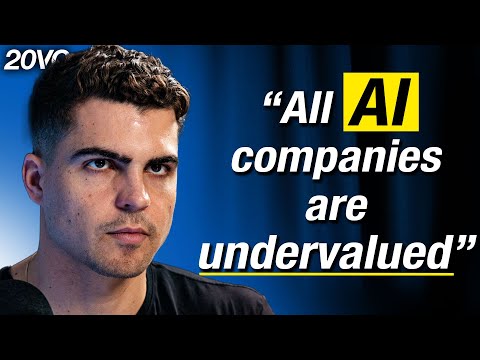
George Sivulka, Co-Founder & CEO @Hebbia: The Future of Foundation Models | E1250
George Sivulka (guest), Harry Stebbings (host)
In this episode of The Twenty Minute VC, featuring George Sivulka and Harry Stebbings, George Sivulka, Co-Founder & CEO @Hebbia: The Future of Foundation Models | E1250 explores hebbia’s George Sivulka: Beyond RAG Toward Agentic, Enterprise-Grade AI George Sivulka, founder and CEO of Hebbia, traces his path from misfit math kid with immigrant-athlete parents to Stanford PhD dropout and AI founder living in a literal closet while building the company.
Hebbia’s George Sivulka: Beyond RAG Toward Agentic, Enterprise-Grade AI
George Sivulka, founder and CEO of Hebbia, traces his path from misfit math kid with immigrant-athlete parents to Stanford PhD dropout and AI founder living in a literal closet while building the company.
He argues that early-life adversity often fuels great founders, and that relentless persistence, almost to unhealthy extremes, is a core ingredient in startup success.
On the product and industry side, Sivulka contends that Retrieval-Augmented Generation (RAG) mostly fails in real enterprise use, and that the future lies in agentic systems, platform-style “AI Excel” products, and scaling compute at inference rather than just bigger training runs.
He predicts $100 trillion of new economic value from AI, believes model providers will commoditize while infrastructure and application layers win, and sees xAI, AMD, and agentic platforms like Hebbia as major beneficiaries.
Key Takeaways
Early adversity can be a powerful founder motivator.
Sivulka and Stebbings both connect feeling like family misfits or disappointments to a deep drive to prove themselves, arguing many iconic founders share backgrounds of trauma, queerness, or adoption that create an enduring chip on the shoulder.
Get the full analysis with uListen AI
Relentless persistence often matters more than immediate fit or talent.
His NASA internship story—getting rejected five times, showing up in person, cold-calling from the sidewalk, bombing the interview, then returning with overnight self-study—illustrates how refusal to give up can brute-force opportunities that credentials alone wouldn’t.
Get the full analysis with uListen AI
RAG is overhyped and fails most real enterprise questions.
Hebbia deployed RAG at large finance firms and found ~90% of queries weren’t simple ‘find this quote’ tasks; they required reasoning about documents, not just retrieving passages, leading him to call most enterprise RAG deployments “vapor” that demo well but fail in production.
Get the full analysis with uListen AI
The next frontier is agentic systems that scale compute at inference.
Instead of only training ever-bigger models, Hebbia orchestrates hundreds or thousands of LLM calls across documents for a single question, effectively assembling many smaller ‘engines’ at inference time to achieve higher accuracy on complex tasks like deal diligence.
Get the full analysis with uListen AI
AI platforms will coexist with specialized apps and agents, not replace them.
Using Excel’s history as an analogy, Sivulka argues that horizontal platforms (like Hebbia) and vertical applications will mutually reinforce each other, with ‘agent employees’ emerging as a new layer rather than all business software collapsing into a single agent.
Get the full analysis with uListen AI
AI will augment most knowledge workers rather than eliminate them—at least near term.
He expects lower-cognition, back- and middle-office tasks to be automated, but believes AI will empower juniors with firm-wide pattern recognition, improve decision quality, increase AUM and output, and echo how Excel changed work without erasing jobs.
Get the full analysis with uListen AI
Model and chip dynamics will shift value from training to inference and from NVIDIA to challengers.
Sivulka sees model APIs becoming interchangeable, with stickiness in infrastructure and applications; as workloads shift from training to inference, he predicts more upside for AMD and custom chips, while still viewing NVIDIA and major AI companies as undervalued.
Get the full analysis with uListen AI
Notable Quotes
“You can brute force your way as a founder. Just screw product–market fit; you could literally brute force anything in the world.”
— George Sivulka
“I actually don’t think RAG works at all.”
— George Sivulka
“If there was $100 trillion of value created from the introduction of the computer, I actually think $100 trillion of value will be created from the introduction of AI compute in the next 60 years.”
— George Sivulka
“Chat is a useful interface, but it’s like a single cell in Excel.”
— George Sivulka
“Tech is not the hard part of all of this… the hardest part of AI change management, no matter what company you are, is people.”
— George Sivulka
Questions Answered in This Episode
If RAG fundamentally ‘doesn’t work’ for most enterprise questions, what should teams building on RAG today do differently in the next 12–24 months?
George Sivulka, founder and CEO of Hebbia, traces his path from misfit math kid with immigrant-athlete parents to Stanford PhD dropout and AI founder living in a literal closet while building the company.
Get the full analysis with uListen AI
How can enterprises practically transition from experimental AI budgets and flashy demos to tightly scoped, repeatable use cases that demonstrably drive P&L impact?
He argues that early-life adversity often fuels great founders, and that relentless persistence, almost to unhealthy extremes, is a core ingredient in startup success.
Get the full analysis with uListen AI
What governance and interface patterns will make it possible for humans to meaningfully supervise and ‘manage’ thousands of specialized AI agents inside a firm?
On the product and industry side, Sivulka contends that Retrieval-Augmented Generation (RAG) mostly fails in real enterprise use, and that the future lies in agentic systems, platform-style “AI Excel” products, and scaling compute at inference rather than just bigger training runs.
Get the full analysis with uListen AI
If the cost of intelligence trends toward zero, which kinds of business models and pricing schemes for AI platforms and agents will be most sustainable?
He predicts $100 trillion of new economic value from AI, believes model providers will commoditize while infrastructure and application layers win, and sees xAI, AMD, and agentic platforms like Hebbia as major beneficiaries.
Get the full analysis with uListen AI
How can younger professionals in finance or other fields build real judgment and craft if AI tools increasingly handle the analytical ‘training ground’ work they used to do manually?
Get the full analysis with uListen AI
Transcript Preview
You can bucket great founders into three backgrounds. The most common is that you had kind of a messed up childhood. The second most common would be, uh, you're gay. And the third most common would be you were adopted. Look at, like, a list of- of- of all-time greats, Elon Musk, kind of messed up childhood, Jeff Bezos, Steve Jobs, adopted, Peter Thiel, Sam Altman, publicly gay. All of these early life experiences end up giving you some desire, some deeper passion to go out and prove yourself.
Ready to go? George, I am so excited for this, dude. I've been really looking forward to this one. I spoke to Kevin Hart, Sangeen, Corey. I found out all the shit there is to know. So thank you for joining us.
Yeah. And- and- and, I mean, it sounds like you did a lot of research, so thank you for diving deep and I'm really excited to meet you as well.
Yeah. As a venture capitalist, it's amazing the amount of free time you have. Uh, talk to-
(laughs)
Talk... This is gonna be a fun show. Uh-
Yeah.
... talk to me about your childhood. I spoke to Sangeen and he was like, "This was a really interesting part of me getting to know George." So talk to me about your childhood. And I'm leaving that deliberately open for you.
It's, uh... It is fair. And, uh, I think the first time, you know, I met with Sangeen, who's one of our investors at the Series B, it was like a 30-minute, uh, lunch that turned into almost two hours of us talking in- in depth about, uh, the dynamics that- that I think made me have a chip on my shoulder. But in short, uh, I was born in Staten Island, New York City, which, you know, you already have a chip on your shoulder from that. Uh, grew up kind of around New York City, in- in New Jersey primarily, which a second chip. Um, but my mom, uh, is probably, like, a, you know, mafia child, born and raised Staten Island. And my dad is an immigrant from Slovakia who grew up under the Iron Curtain and then immigrated, really escaped to the United States. They, both of them actually fully intended to be professional athletes, and they had four children of which only one was a boy. Uh, and so, you know, you can imagine their dismay when I was, uh, you know, chasing butterflies on the soccer pitch, uh, or, like, falling on my head many times, which I- I have plenty of stories of me literally, like, falling over while trying to dribble a basketball. Uh, and I think, you know, my whole childhood, I was- I was really just a math kid. Like, pretty, like, not very out there, wasn't really talkative, only really good at math. And my parents barely even knew what Stanford was. So growing up, you know, you kind of have this whole misalignment of- of who I was and who I wanted to be, uh, with who they wanted me to be. And I think that gave me this drive and desire and passion to go out and prove myself in a way that was really tangible, uh, maybe not only to them, but, like, hopefully to- to my own kids one day.
Install uListen to search the full transcript and get AI-powered insights
Get Full TranscriptGet more from every podcast
AI summaries, searchable transcripts, and fact-checking. Free forever.
Add to Chrome