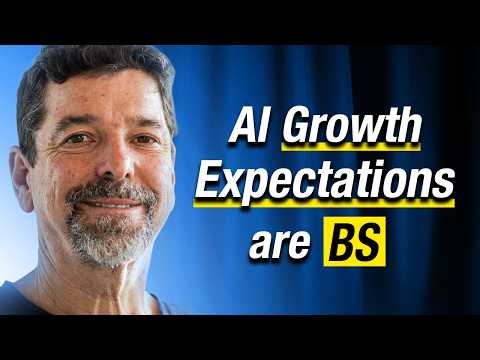
Oren Zeev: Why AI Growth Expectations Are BS & Won't Last? Why GPs Shouldn't Tell LPs Their Strategy
Oren Zeev (guest), Harry Stebbings (host), Harry Stebbings (host)
In this episode of The Twenty Minute VC, featuring Oren Zeev and Harry Stebbings, Oren Zeev: Why AI Growth Expectations Are BS & Won't Last? Why GPs Shouldn't Tell LPs Their Strategy explores oren Zeev challenges AI hype, VC growth myths, and LP dynamics Zeev argues the best venture outcomes usually look “wrong” early because being contrarian reduces early competition and can create time to build real moats.
Oren Zeev challenges AI hype, VC growth myths, and LP dynamics
Zeev argues the best venture outcomes usually look “wrong” early because being contrarian reduces early competition and can create time to build real moats.
He sees AI as a historic “tsunami” that will shift value across every industry, but rejects simplistic claims that incumbents will broadly die; complex, integrated, data-rich businesses can become AI beneficiaries.
He criticizes today’s obsession with extreme growth rates, warning it incentivizes unhealthy behavior (e.g., circular revenue deals) and ignores the unchanging math of compounding and the importance of durable unit economics.
On fund-building, he predicts a shakeout where many mid-tier firms struggle to raise, explains why he takes $0 personal income from management fees for radical LP alignment, and insists GPs shouldn’t lock themselves into a declared strategy because flexibility is core to good decision-making.
Key Takeaways
Great venture outcomes often start as contrarian and “weird.”
Zeev says ideas that look wrong tend to face fewer copycats, buying 2–3 years of limited competition—enough time to build a moat if the thesis is correct.
Get the full analysis with uListen AI
In AI, “beneficiary vs victim” is now a gating question.
He increasingly avoids companies that are neutral to AI, not just those harmed by it, because AI-driven value shifts can compress moats and reprice markets quickly.
Get the full analysis with uListen AI
Incumbents won’t universally die; complexity and data matter more than hype.
He argues AI disruption is overgeneralized: operationally complex, integrated, regulated, distribution-heavy businesses—often with superior data—are harder to displace and can leverage AI to widen advantages.
Get the full analysis with uListen AI
AI doesn’t change compounding math—sustainability does.
Zeev rejects the idea that “1→5M ARR isn’t impressive anymore” on principle; doubling still yields 32x in five years. ...
Get the full analysis with uListen AI
Obsession with top-line growth invites dangerous behavior.
He warns that “only growth matters” pushes companies toward unsustainable tactics like circular purchasing arrangements that inflate revenue without creating real value—sometimes sliding toward fraud.
Get the full analysis with uListen AI
Don’t confuse round labels with risk reduction—especially at Series A.
He says the seed-to-A valuation jump has always been prone to optics over substance; investors must judge whether traction is a real PMF signal or early noise (logos without renewals/commitment).
Get the full analysis with uListen AI
Preemptive mega-rounds are fine—if founders behave like they didn’t happen.
Zeev advises founders to take high-valuation money when offered but avoid spending simply because it’s available; overfunding can dilute focus and worsen decision quality.
Get the full analysis with uListen AI
VC will bifurcate; the “middle” is structurally pressured.
He expects platforms (brand + services + capital) and differentiated boutiques/solo GPs to win, while traditional undifferentiated partnerships struggle to access top deals and to raise—predicting ~50% may slowly die.
Get the full analysis with uListen AI
LP trust hinges more on GP motivation than valuation methodology.
Because marks have wide latitude, he believes the key diligence question is: does the GP need inflated paper gains to raise? ...
Get the full analysis with uListen AI
Radical alignment changes decision-making incentives.
Zeev reinvests 100% of management fees and takes no personal income until LP capital is returned, claiming this reduces pressure to sell secondaries for optics (DPI) and keeps focus on long-term value.
Get the full analysis with uListen AI
Notable Quotes
“If everyone is doing something, it's a reason not to do it, not a reason to do it.”
— Oren Zeev
“Every investment, I have to ask myself: Is this company a likely beneficiary of AI or not?”
— Oren Zeev
“I think this notion that only growth matters is a very dangerous one, and I've seen this movie many, many times.”
— Oren Zeev
“We humans are not truth seekers, we are self-validation machines.”
— Oren Zeev
“I tell LPs I only have one rule, and that rule is that I have no rules.”
— Oren Zeev
Questions Answered in This Episode
When you label a company “AI-neutral,” what specific criteria make it effectively a pass rather than a “wait and see” opportunity?
Zeev argues the best venture outcomes usually look “wrong” early because being contrarian reduces early competition and can create time to build real moats.
Get the full analysis with uListen AI
You argue operational complexity and integration protect incumbents—what are concrete examples of “complexity” that actually create defensibility versus just technical debt?
He sees AI as a historic “tsunami” that will shift value across every industry, but rejects simplistic claims that incumbents will broadly die; complex, integrated, data-rich businesses can become AI beneficiaries.
Get the full analysis with uListen AI
Navan: beyond support automation and margin expansion, what are the most important AI-driven product experiences that change customer outcomes (without disclosing sensitive details)?
He criticizes today’s obsession with extreme growth rates, warning it incentivizes unhealthy behavior (e. ...
Get the full analysis with uListen AI
How do you detect “circular deal” behavior early from board-level data—what metrics or audit patterns are the strongest red flags?
On fund-building, he predicts a shakeout where many mid-tier firms struggle to raise, explains why he takes $0 personal income from management fees for radical LP alignment, and insists GPs shouldn’t lock themselves into a declared strategy because flexibility is core to good decision-making.
Get the full analysis with uListen AI
You say 100%+ growth at $20M ARR can still be dismissed incorrectly—what benchmark set do you use to judge whether a 2x grower is truly category-leading?
Get the full analysis with uListen AI
Transcript Preview
I think this notion that only growth matters is a very dangerous one, and I've seen this movie many, many times. We humans are not truth seekers, we are self-validation machines, meaning that-
Today, we have one of the most prominent solo capitalists in venture, Oren Zeev, who now manages over a billion dollars. [upbeat music]
In every one of my funds, I'm the biggest LP, every single one. By the way, I pay myself zero. I don't see anything, which is very unusual. I don't know any VC in the world that has zero income from the management fees. So I tell LPs I only have one rule, and that rule is that I have no rules. Listen, AI is the biggest change ever in the history of humanity. It changes everything, and whenever there's change, there's opportunity to make things better and to build huge amount of value.
Has what you look for changed in the last twenty-four months in the dawn and the wave of AI that we're looking at today? [upbeat music] Ready to go? [upbeat music] Oren, it is so good to have you back on the show, dude. It's been several years since we last did this, so thank you so much for joining me, man.
Yeah. No, it's my pleasure. I... As you know, I was skeptical that I would be able to, uh, bring anything new to this conversation. You insisted, but, uh [chuckles]
I, I insi- I insisted because I... last time we actually did a show, I don't think I was a very good interviewer. And call it a lack of humility, but I hope that I've improved as an interviewer. I think now is quite an hard time to be investing. Again, I'm gonna use the next hour as an advice session for me as an investor because I think I have a lot to learn from you. Now is a weird time because a lot is uncertain, and so when we look at picking investments, that is our job, that's what we're paid to do in a lot of ways. Why do so many of the best outcomes look wrong or weird at the time where we when we invest?
Look, I think if they're long... If they, if they look weird and they look wrong, then probably there aren't gonna be fifteen or twenty or a hundred other startups doing it. So you're probably gonna have two or three years without real competition, and you have a chance of really building something, um, you know, a real moat. Now, [chuckles] if you're wrong, it's not gonna help you. Y- you know, it, it... But if you happen to be right, then the- these are some of the, the greatest outcomes. Uh, and, uh, you know, and, and again, this is not- this is really some level of contrarian plus being right. Um, that's the, uh, ingredients, uh, typically of, of, of, of great outcomes.
I get you. The challenge that we have today is the level of competition has changed so much. You know, when, when we first met, you know, ten years ago, there was always one or two competitors. Now, for every company I meet, there's legitimately eight to ten at a minimum.
Install uListen to search the full transcript and get AI-powered insights
Get Full TranscriptGet more from every podcast
AI summaries, searchable transcripts, and fact-checking. Free forever.
Add to Chrome