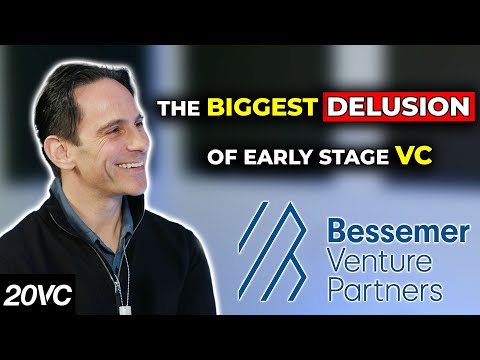
Adam Fisher: Why Small Markets are Better Than Big Markets | E1106
Adam Fisher (guest), Narrator, Harry Stebbings (host)
In this episode of The Twenty Minute VC, featuring Adam Fisher and Narrator, Adam Fisher: Why Small Markets are Better Than Big Markets | E1106 explores adam Fisher Explains Why Niche Markets Beat Hyper-Growth Moonshots In VC Adam Fisher, a long-time Bessemer partner and leading Israeli VC, describes his early serendipitous entry into venture and how the industry evolved from closed, paternalistic capital to open, founder-partner relationships.
Adam Fisher Explains Why Niche Markets Beat Hyper-Growth Moonshots In VC
Adam Fisher, a long-time Bessemer partner and leading Israeli VC, describes his early serendipitous entry into venture and how the industry evolved from closed, paternalistic capital to open, founder-partner relationships.
He argues that durable, big outcomes more often come from patient, efficient companies in smaller or niche markets, rather than hyper-ambitious, fast-burning category-creation plays in crowded spaces.
Fisher dives into how he evaluates founders (first-time vs second-time, insiders vs outsiders), market size, fundraising dynamics, pricing, and reserves, emphasizing contrarian comfort with being the sole backer in an unfashionable market—while still ensuring future fundability.
He also lays out his philosophy on hiring, exits, late-stage misalignments, and his public stance on Israeli politics, framing his role as the investor who knows all the wrong ways to do things and serves as a lighthouse rather than a co-captain.
Key Takeaways
Smaller, under-the-radar markets can yield superior risk-adjusted returns.
Fisher prefers being the first or only serious player in a niche where competition is low and adjacent expansions are possible, rather than being a number two or three in a huge, crowded market where even second place often loses.
Get the full analysis with uListen AI
Speed-dating fundraising leads to bad, long-term ‘marriage’ decisions.
He criticizes the current norm of closing lead checks in days, arguing that his worst investments were those done fastest under competitive pressure; deep mutual diligence over months produces better decade-long board partnerships.
Get the full analysis with uListen AI
Founder efficiency and real risk-taking matter more than early KPIs.
He looks for signs like founders quitting jobs, self-funding, making the first sales themselves, and learning quickly between meetings, seeing this mindset as a more reliable signal than seed-stage metrics.
Get the full analysis with uListen AI
Outsider, even naive, founders can outperform insiders—if self-aware.
Fisher likes outsiders who don’t know all the ‘impossibilities’, bringing fresh thinking and innovation, provided they recognize what they don’t know and have the charisma to persuade employees, investors, and customers.
Get the full analysis with uListen AI
Category creation is usually a retrospective label, not an upfront strategy.
He cautions against starting with “we’re creating a category” and instead focuses on discovering new buyers or segments; only later, if many players move in a similar direction, does a true category emerge.
Get the full analysis with uListen AI
Valuation mistakes at growth stage can be more fatal than down rounds.
Fisher warns that raising at exit-level valuations traps companies, making recaps, depressed M&A, and class conflicts likely; down rounds themselves are survivable if founders communicate honestly and treat staff like adults.
Get the full analysis with uListen AI
Pattern recognition is best used to avoid what won’t work, not to anoint winners.
He believes experience is most valuable for spotting doomed strategies, bad hires, and non-viable markets; overconfidence in predicting winners leads to dangerous doubling-down and distorted board behavior.
Get the full analysis with uListen AI
Notable Quotes
“I don’t think the way you build a big company is by investing in the most ambitious companies growing the fastest. Those are also the companies that crash and burn.”
— Adam Fisher
“I’m the other type of investor. I say, ‘Oh no, there’s already competition and there’s not even a market.’ I get comfortable when I think, ‘It’s only us, but if we’re right, we’re going to be the leader.’”
— Adam Fisher
“Naivety is a strength in these cases. Insiders are just blinded by convention, by knowing a little bit too much of what hasn’t worked in the past.”
— Adam Fisher
“It’s not because I know the right way. It’s ’cause I know all the wrong ways.”
— Adam Fisher
“We’re not next to the captain shouting which way to go. We’re like the lighthouse. We just tell them where the rocks are so they don’t crash, but we actually don’t know how to get there.”
— Adam Fisher
Questions Answered in This Episode
How should early-stage founders practically push back against ‘speed dating’ fundraising pressures without losing competitive rounds?
Adam Fisher, a long-time Bessemer partner and leading Israeli VC, describes his early serendipitous entry into venture and how the industry evolved from closed, paternalistic capital to open, founder-partner relationships.
Get the full analysis with uListen AI
What concrete steps can a first-time, outsider founder take to harness their naivety as an asset while avoiding obvious rookie mistakes?
He argues that durable, big outcomes more often come from patient, efficient companies in smaller or niche markets, rather than hyper-ambitious, fast-burning category-creation plays in crowded spaces.
Get the full analysis with uListen AI
How can founders and boards jointly decide when a company has truly ‘peaked’ and it’s time to pursue a sale rather than keep pushing?
Fisher dives into how he evaluates founders (first-time vs second-time, insiders vs outsiders), market size, fundraising dynamics, pricing, and reserves, emphasizing contrarian comfort with being the sole backer in an unfashionable market—while still ensuring future fundability.
Get the full analysis with uListen AI
In a world awash with AI hype and capital, what specific AI opportunities would still fit Fisher’s preference for niche, low-competition markets?
He also lays out his philosophy on hiring, exits, late-stage misalignments, and his public stance on Israeli politics, framing his role as the investor who knows all the wrong ways to do things and serves as a lighthouse rather than a co-captain.
Get the full analysis with uListen AI
How can VCs systematically separate ‘great storytellers’ from genuinely strong operators when both can raise money in frothy environments?
Get the full analysis with uListen AI
Transcript Preview
I don't think that the way you build a big company or the way you get a big exit is by investing in the most ambitious companies growing the fastest. Those are also the companies that crash and burn.
This is Adam Fisher, partner at Bessemer Venture Partners. He is one of the most prolific early-stage investors in Israel, with some of the most successful company exits, including Wix, Fiverr, and Habana.
I see my role as a VC as picking up an entrepreneur when they're, like, on the ground, but also pulling them down when their head's in the clouds. The entrepreneurs that come to me, they realize that I have that balance and react to entrepreneurs, whether it's good news or bad news, with some kind of composure. They become more transparent with you.
What's the best investment advice you've received?
There are two pieces of advice which are contrary. The first is...
Adam, I am so excited for this. I stalked the shit out of you beforehand. I spoke to Byron, Amit, Daniel, the list goes on. But thank you so much for joining me.
Thank you. It's a pleasure to be here.
Now, I would love to start with your entry into venture. We had a little chat about it before. Tell me, Adam, how did you make your way into the world of venture and come to be at Bessemer today?
So it was serendipitous. I was a student, uh, at the time I was an undergrad at, uh, Georgetown University, and I did a one-year program at the Hebrew University of Jerusalem. And, uh, in my first days, I was looking for an internship. That's just what we did at Georgetown. Every single semester, I had an internship somewhere. These are unpaid types of roles where you learn. And, uh, somebody pulled out, they went through this, like, uh, box full of, of, like, letters or faxes, and they said, uh, "Well, here's one." Now, I told them I was interested in business. And, uh, it was for a venture capital fund. Now, it's serendipitous because literally a month before, I had read an article about venture capital in Israel in a now defunct Israel American business magazine called Link at the time, and I just leapt at that opportunity. I said yes. Uh, now nobody knew what venture capital was at the time. Certainly not in Israel, but also not in the United States, not in, not to college students. And for years, I would tell people what this was and what I did, and they were kind of, you know, loo- didn't look at me with a strange face.
And this was 1996?
This is 1996, um, and so that's how I got started as an intern. This was a tiny fund. All funds in Israel at the time were tiny. We're talking $15 to $20 million funds. Uh, there was one partner, one secretary, and one internet connection. And I had to ask the secretary to get off her computer so I could, uh, search the, the, the internet. Um, this is pre-Google, o-obviously. Uh, business plans would come in the mail in a big fat manila envelope. And I like to say that those business plans actually taught me more than my undergrad, undergrad degree did because they, they really spent a lot of time explaining everything. And these were very technologically oriented, uh, companies. So that's how I got started, uh, very young, I'll admit, very early. Um...
Install uListen to search the full transcript and get AI-powered insights
Get Full TranscriptGet more from every podcast
AI summaries, searchable transcripts, and fact-checking. Free forever.
Add to Chrome