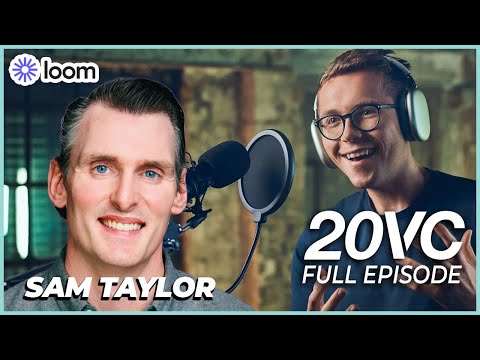
Sam Taylor: How I Became VP of Sales at Loom; Lessons from Dropbox | 20VC #908
Harry Stebbings (host), Sam Taylor (guest)
In this episode of The Twenty Minute VC, featuring Harry Stebbings and Sam Taylor, Sam Taylor: How I Became VP of Sales at Loom; Lessons from Dropbox | 20VC #908 explores from PLG Roots to Enterprise Sales: Loom VP Sam Taylor’s Playbook Sam Taylor, VP of Sales at Loom and early Dropbox sales hire, explains how product-led growth (PLG) and enterprise sales can coexist, and when to layer in a sales team on top of a viral product. He contrasts rigid “playbooks” with adaptable frameworks, emphasizing storytelling, genuine discovery, and using sellers as ‘workflow therapists’ to deeply understand user behavior and organizational culture.
From PLG Roots to Enterprise Sales: Loom VP Sam Taylor’s Playbook
Sam Taylor, VP of Sales at Loom and early Dropbox sales hire, explains how product-led growth (PLG) and enterprise sales can coexist, and when to layer in a sales team on top of a viral product. He contrasts rigid “playbooks” with adaptable frameworks, emphasizing storytelling, genuine discovery, and using sellers as ‘workflow therapists’ to deeply understand user behavior and organizational culture.
He walks through how founders should think about first sales hires, interviewing, onboarding, compensation, and building outbound motions after a long period of inbound-led growth. A recurring theme is the importance of cross-functional relationships—especially between sales, product, and support—and systematically capturing customer insights to shape roadmap, positioning, and ideal customer profile.
Taylor also shares concrete tactics for hiring and ramping early salespeople, running deal reviews and post-mortems, probing for real customer priorities, and avoiding common mistakes like premature variable comp and isolating sales as an “orphan” function.
Key Takeaways
Treat sales as adaptable frameworks, not rigid playbooks.
Taylor prefers ‘frameworks’ (persona/vertical plays, repeatable stories, key health indicators) over step-by-step scripts, because effective selling depends on deep listening, adapting to context, and telling relevant customer stories rather than mechanically following a script.
Get the full analysis with uListen AI
Use your PLG motion to earn the right to sell upmarket.
Before pushing for enterprise features like RBAC and SSO, validate depth of user engagement and bottoms‑up adoption; dense usage and organic champions make enterprise conversations easier and more credible than leading with security and compliance alone.
Get the full analysis with uListen AI
Founders are already the first salespeople—and must codify what works.
If a founder has raised capital and won early customers, they have a working pitch; their job is to record calls, capture key value props, analyze “perfect-fit” customers, and hand these raw ingredients to early sales hires who can systematize them into frameworks.
Get the full analysis with uListen AI
Hire early salespeople for curiosity and insight generation, not just quota.
In the earliest stages, Taylor optimizes for people who love learning from customers, ask high‑quality questions, and can structure feedback for product and leadership, because those insights shape the go‑to‑market much more than short‑term revenue alone.
Get the full analysis with uListen AI
Build outbound like a new muscle—measure early inputs, not just revenue.
Shifting from inbound/PLG to outbound requires 12–18 months of experimentation; leaders should focus on early indicators (meeting acceptance, repeatable messaging that wins conversations, quality pipeline) rather than immediately judging on closed ARR.
Get the full analysis with uListen AI
Integrate sales deeply with product, support, and engineering from day one.
Taylor warns against making sales an “orphaned function”; he pushes new reps to run structured listening tours across functions and even sit in support early, so they become credible internal partners and strong external product evangelists.
Get the full analysis with uListen AI
Delay heavy variable comp until you have real performance data.
For first hires, he recommends mostly base salary with light upside or input-based incentives, because without historical data on ramp, close rates, and deal sizes, traditional commission structures are likely to be misaligned and demotivating.
Get the full analysis with uListen AI
Notable Quotes
“If you raised money and have customers, you’re already in sales.”
— Sam Taylor
“I refer to our early sales team as workflow therapists—lay on the couch, tell me all your problems.”
— Sam Taylor
“Playbooks sound rigid. I’d rather talk about frameworks you can adapt.”
— Sam Taylor
“The absolute best thing you can do for your career is sit at lunch with anyone other than the sales team.”
— Sam Taylor (relaying advice from Armando Mann)
“Variable compensation is an excellent lever at the right time—and the right time is not your first couple of hires because you’ve got no data.”
— Sam Taylor
Questions Answered in This Episode
How can a founder objectively decide the right moment to layer in a formal sales team on top of a PLG motion?
Sam Taylor, VP of Sales at Loom and early Dropbox sales hire, explains how product-led growth (PLG) and enterprise sales can coexist, and when to layer in a sales team on top of a viral product. ...
Get the full analysis with uListen AI
What concrete metrics or behavioral signals should guide the definition—and redefinition—of an ideal customer profile as the company moves upmarket?
He walks through how founders should think about first sales hires, interviewing, onboarding, compensation, and building outbound motions after a long period of inbound-led growth. ...
Get the full analysis with uListen AI
How would Taylor adjust his hiring criteria for first salespeople in a deeply vertical, non-horizontal product?
Taylor also shares concrete tactics for hiring and ramping early salespeople, running deal reviews and post-mortems, probing for real customer priorities, and avoiding common mistakes like premature variable comp and isolating sales as an “orphan” function.
Get the full analysis with uListen AI
What does an ideal 90-day plan look like for the very first sales hire at a PLG startup?
Get the full analysis with uListen AI
How should companies balance category creation storytelling with short-term ROI proof when selling into conservative enterprises?
Get the full analysis with uListen AI
Transcript Preview
(beeping) Three, two, one, zero. You have now arrived at your destination. Sam, this is such a joy. You know I always love our chats, but, uh, thank you so much for putting up with my dulcet tones once again.
Get out of here with that. It's always great to see you. Always great to hear from you.
You know, fake humility is always good to have.
(laughs)
Um, but, uh ... (laughs) But, uh, for those that missed our first show, tell me, how did you make your way into the world of tech and, most importantly, sales? What was that entry point for you?
So, definitely not a direct line from university or school straight into it. Held a number of random jobs in a number of different industries. So, studied environmental science, did environmental consulting. I was on the purchasing side of the house, that got me on the phones, uh, at a silicon wafer distribution company. Won't even get into-
(laughs)
... or unpack what that means. Take a whole show. Um, but ultimately, uh, got my start on both the technology and sales side at Salesforce back in 2010. Um, was fortunate enough to stumble my way into the Dropbox organization as one of their first five salespeople back in 2011. Uh, and it's really snowballed from there. And so, have been having the opportunity to learn from and work with some amazing teams between the Dropbox crew/now mafia. Uh, I think a number of folks have been on this show with you. And, uh, then also ended up on, on a couple of small growth teams at Quip, which brought me back to Salesforce, and then now, been holding things down with the Loom crew for the last, roughly, 18 months.
I mean, actually it's perfect timing 'cause we released a show, uh, just, just recently with Zhenya, and obviously he spent time, I presume, with you at Dropbox. And-
He did. Yep.
... so I'm, I'm fascinated to hear. When we think about Salesforce and Dropbox, two such iconic companies, if we were to isolate, like, one or two takeaways for you from each, what would you say those are that've really shaped how you think today as a sales leader?
So, I think Dropbox, with it being a decently early pioneer, if we want to call it, on the product-led side of the house, I think the, the early learning for me particularly is we were building the direct sales motion in tandem with the product-led side, is-
Yeah.
... security's not enough. You need to find more value than just security when you're thinking about a consolidation plan. I think a learning for me along the way was we were really trying to take the density of user engagement and our, our de facto was going and selling to IT or CIOs around, "How do we roll this up and how do we protect the house," so to speak. Um, which when you put it in those terms, like, you're basically positioning your service as a liability as opposed to a value add. Uh, and effective in certain ways, but, you know, in a, a environment where I think that we have to make sure that we are continuing to align with the goals of our customers, align with the impact, and particularly on the future of work side of things, like, what are we doing to enable a more effective and efficient workforce? And so I think, for me, really taking that lens, particularly when I went to Quip, which was my next opportunity, um, and really focusing on the workflow and the day-to-day engagement and impact, and then how do you roll up that positive, that additive, um, experience as a core part of your value prop. That was a key takeaway for me through Dropbox.
Install uListen to search the full transcript and get AI-powered insights
Get Full TranscriptGet more from every podcast
AI summaries, searchable transcripts, and fact-checking. Free forever.
Add to Chrome