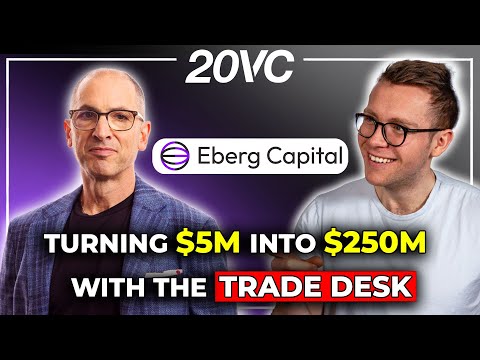
Roger Ehrenberg: Why VC Returns Will Get Worse & Why LP Incentive Structures are so Broken | E1117
Roger Ehrenberg (guest), Harry Stebbings (host), Narrator, Harry Stebbings (host)
In this episode of The Twenty Minute VC, featuring Roger Ehrenberg and Harry Stebbings, Roger Ehrenberg: Why VC Returns Will Get Worse & Why LP Incentive Structures are so Broken | E1117 explores roger Ehrenberg Dissects Broken LP Incentives And Shrinking VC Returns Roger Ehrenberg argues that while venture capital is awash in capital and mid-to-late stage is becoming commoditized, true early-stage, artisanal VC will remain differentiated and hard to scale. He believes traditional LP incentive structures are fundamentally broken, with many LPs prioritizing career risk and brand over net returns, but sees sovereign wealth funds and large family offices as a corrective force demanding fairer fees and real DPI. Liquidity will remain constrained, with continuation funds emerging as a key bridge for GPs and LPs stuck in illiquid but high-quality portfolios. Beyond market structure, he discusses portfolio liquidity decisions, investor psychology, wealth, raising children in financial abundance, and the ingredients of a long-term marriage and career motivation.
Roger Ehrenberg Dissects Broken LP Incentives And Shrinking VC Returns
Roger Ehrenberg argues that while venture capital is awash in capital and mid-to-late stage is becoming commoditized, true early-stage, artisanal VC will remain differentiated and hard to scale. He believes traditional LP incentive structures are fundamentally broken, with many LPs prioritizing career risk and brand over net returns, but sees sovereign wealth funds and large family offices as a corrective force demanding fairer fees and real DPI. Liquidity will remain constrained, with continuation funds emerging as a key bridge for GPs and LPs stuck in illiquid but high-quality portfolios. Beyond market structure, he discusses portfolio liquidity decisions, investor psychology, wealth, raising children in financial abundance, and the ingredients of a long-term marriage and career motivation.
Key Takeaways
Early-stage venture will stay artisanal while mid/late stage commoditizes.
Ehrenberg rejects the idea that all VC is commoditized; he sees mega-firms evolving into multi-stage asset managers, while true incubation, pre-seed, and seed remain boutique, hands-on, and structurally hard to scale.
Get the full analysis with uListen AI
Traditional LP incentive structures are misaligned and enable mediocrity.
Many endowment and pension LPs optimize for brand safety and career risk (being in Sequoia/Andreessen) rather than net DPI, allowing underperforming managers to raise successive billion-dollar funds and collect high fees without real distributions.
Get the full analysis with uListen AI
New LP classes will pressure mid/late-stage fees and returns.
Sovereign wealth funds and large family offices, focused on after-fee performance, are reshaping the LP base; Ehrenberg expects a hedge-fund-like equilibrium where differentiated, smaller, long-dated managers command premium fees while large, later-stage platforms face fee compression.
Get the full analysis with uListen AI
Continuation funds will be a major liquidity valve in a frozen market.
With IPO and M&A windows largely shut, he expects more managers to use continuation vehicles to crystallize value, let impatient LPs exit, and bring in new capital at today’s valuations, especially for high-quality portfolios caught in bad timing.
Get the full analysis with uListen AI
Venture still belongs in portfolios, but sizing and expectations must adjust.
For perpetual or very long-term investors, a 5–7% allocation to top managers can add meaningful convexity, even if industry returns compress; the key is accepting illiquidity, focusing on manager selection, and targeting a clear premium (e. ...
Get the full analysis with uListen AI
Systematic, pre-agreed liquidity frameworks reduce regret in exits.
His experience with The Trade Desk shows the value of having a clear, debated policy on when and how to sell—considering franchise-making outcomes, downside regret, and ‘schmuck insurance’—rather than reacting emotionally to market highs or lows.
Get the full analysis with uListen AI
Humility, partnership, and psychology are central to durable investing careers.
He emphasizes openly processing misses and wins with partners, recognizing luck, avoiding overconfidence after success, and cultivating mentors or trusted peers—especially important for solo GPs managing volatile portfolios and down rounds.
Get the full analysis with uListen AI
Notable Quotes
“Venture is never gonna be commoditized. Maybe mid and late stage will stop looking and feeling like venture and feel more like institutional asset management, but incubation, pre-seed and seed will always occupy a different place.”
— Roger Ehrenberg
“Traditional LP structures are completely broken. LPs have been enablers of too many venture firms being created and of venerable Silicon Valley firms raising Fund 12, 13, 14 when they haven’t even returned capital from Fund 4.”
— Roger Ehrenberg
“The ability to withstand short-term pain for long-term gain is a superpower. Being able to let a thesis play out, even if it’s unpopular, can lead to amazing compound returns.”
— Roger Ehrenberg
“I’m not a regretful person. As long as you’re thoughtful and analyze the context and trade-offs, it kind of is what it is. Life is not in your control.”
— Roger Ehrenberg
“You should never have the mindset of winning or losing versus your spouse. It’s not about winning. Words matter, and sometimes the best thing you can do is just not say that thing you’re dying to say.”
— Roger Ehrenberg
Questions Answered in This Episode
How can emerging managers design fund strategies and theses that truly differentiate them from large multi-stage platforms rather than competing on price or speed?
Roger Ehrenberg argues that while venture capital is awash in capital and mid-to-late stage is becoming commoditized, true early-stage, artisanal VC will remain differentiated and hard to scale. ...
Get the full analysis with uListen AI
What concrete changes to LP compensation and governance would realign incentives around net DPI instead of brand signaling and career risk management?
Get the full analysis with uListen AI
Under what conditions should a GP choose a continuation fund over simply waiting for more favorable IPO/M&A markets or selling positions opportunistically in secondaries?
Get the full analysis with uListen AI
How should institutional allocators recalibrate their target venture allocation and return expectations in an era of lower industry-wide returns and greater capital supply?
Get the full analysis with uListen AI
What practical frameworks can investors adopt to manage their own psychology—around regret, FOMO, and overconfidence—when making hard decisions on selling or holding breakout winners?
Get the full analysis with uListen AI
Transcript Preview
(instrumental music) I'm not in pure tech anymore. But if I was, I would literally be spending almost no time in pure AI. Venture is never gonna be commoditized. Maybe mid and late stage, we'll feel more like institutional asset management, but I think incubation, pre-seed, and seed will always occupy a different place.
How much longer does venture have on the two and 20 model before there becomes real pressure on fee structures?
It's gonna be just like hedge funds. You know, look at Sequoia. And the best firms charge premium fees and will be able to get it because on an after-fee basis, they still outperform.
You have many absolute bangers. How did you think about whether to distribute versus whether to hold and sustain?
That is one of the hardest questions I have dealt with.
Roger, I am so excited for this. You just said, you know, the magic happens in the conversation. It does. Thank you so much for joining me today.
Thanks, Harry. As usual, I am thrilled to be here with you.
Now, I was listening to you on Eric's show the other day, and you've said before about essentially seeing these seismic shifts in landscapes every kind of 17 years, which I thought was kind of mysterious why it was every 17 years. But if we go back to the first seismic shift that you saw when you went from banking to venture, what was that seismic shift that you saw that others didn't?
I felt like there was almost a, a euphoria on the street back in those days. You know, I had been running derivatives desks at Citi and Deutsche, and then my last tour of duty on the street was as the CEO of DB Advisors, which was this multi-billion dollar trading platform. Money was coming really easily, but also with that, knives were never sharper in terms of, you know, the politics, whether it's inside hedge funds or at the top of Wall Street, because the pie is big and people in those cultures want as much of the pie as they possibly can. And I just found that culture corrosive, and I also felt like this fell too easy in a way. The markets were up into the right, money was being minted really across the street, debt and equity markets in addition to trading, that, just sense that things feel a little too good, and I personally had felt like my learning curve had stopped and I couldn't really imagine another traditional job on the street that was exciting and would enable me to grow. That's really what precipitated my spending the next five years really digging into the seed stage technology world, and then it was really during that period that I crystallized my hypothesis that, uh, very early, very concentrated, that kind of big data infrastructure theme was something that ultimately was gonna be a background.
Install uListen to search the full transcript and get AI-powered insights
Get Full TranscriptGet more from every podcast
AI summaries, searchable transcripts, and fact-checking. Free forever.
Add to Chrome