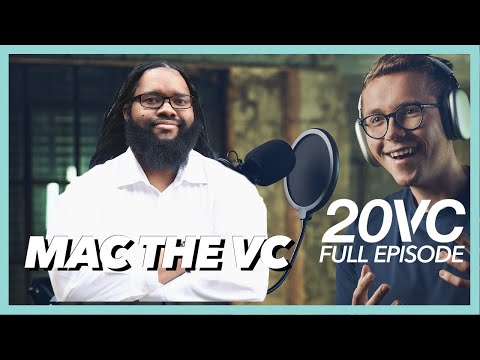
Mac the VC on the Journey from Homeless To Becoming A VC | Full Interview with Harry Stebbings
Harry Stebbings (host), Mac the VC (McKeever Conwell II) (guest), Narrator
In this episode of The Twenty Minute VC, featuring Harry Stebbings and Mac the VC (McKeever Conwell II), Mac the VC on the Journey from Homeless To Becoming A VC | Full Interview with Harry Stebbings explores from Homeless Founder To VC: Mac Challenges Venture’s Broken Rules Mac (Mac the VC), a former software engineer and twice founder, shares his unconventional path into venture capital, culminating in launching RareBreed Ventures without a degree, finance background, or savings. He explains how personal failure, depression, and support from family and friends reshaped his identity beyond startup success. The conversation dives into how he raised a $10M pre-seed fund largely via Twitter DMs and 506(c), while deliberately ignoring many traditional fund rules. Mac also critiques structural problems in venture—especially around hot deals, LP behavior, and performative diversity—while outlining his long-term ambition to build a top-tier, Baltimore-based multi-stage firm.
From Homeless Founder To VC: Mac Challenges Venture’s Broken Rules
Mac (Mac the VC), a former software engineer and twice founder, shares his unconventional path into venture capital, culminating in launching RareBreed Ventures without a degree, finance background, or savings. He explains how personal failure, depression, and support from family and friends reshaped his identity beyond startup success. The conversation dives into how he raised a $10M pre-seed fund largely via Twitter DMs and 506(c), while deliberately ignoring many traditional fund rules. Mac also critiques structural problems in venture—especially around hot deals, LP behavior, and performative diversity—while outlining his long-term ambition to build a top-tier, Baltimore-based multi-stage firm.
Key Takeaways
Your worth is not defined by startup success or failure.
After his second company failed, Mac hid at home, depressed, until he realized friends and family loved and respected him regardless of the outcome—freeing him to move forward without tying identity solely to entrepreneurial success.
Get the full analysis with uListen AI
You can enter venture without a traditional pedigree by leveraging real startup experience and networks.
Despite lacking a degree or finance background, Mac broke into the State of Maryland’s investment arm by emphasizing his founder experience and local startup network, proving non-traditional paths are possible.
Get the full analysis with uListen AI
Fund structures are far more flexible than most emerging managers are told.
Mac ignored norms on GP commits, first-close percentages, and capital calls, opting for rolling closes, flexible payment schedules for LPs, and zero GP commit, showing emerging managers can design structures that fit their realities.
Get the full analysis with uListen AI
Social platforms can be powerful fundraising and learning tools if used deliberately.
He used Twitter to identify and DM VCs, took over 1,100 meetings in a few months, and raised his first $2M soft circle, illustrating how consistent content and targeted outreach can substitute for an existing LP network.
Get the full analysis with uListen AI
Chasing hot deals is a poor proxy for generating real returns.
Mac criticizes the industry’s obsession with “hot” Sequoia-style rounds and LPs using them as validation, arguing that only capital-returning outcomes matter and that pre-seed investors must learn to pick before something is obvious.
Get the full analysis with uListen AI
Diversity in venture must start with LPs and decision-makers, not just junior hires.
He notes institutional LPs were largely silent post–George Floyd and that many diverse associates aren’t empowered internally, arguing that real change requires diverse investment committees and dedicated emerging-manager allocation strategies.
Get the full analysis with uListen AI
Pre-seed funds can optimize for multiples with larger early checks into overlooked markets.
RareBreed targets $250K–$100K checks into 40–45 companies, mostly outside traditional hubs, emphasizing that the highest multiples are at pre-seed and seed and that strong growth metrics will eventually attract later-stage capital.
Get the full analysis with uListen AI
Notable Quotes
“Hot deals do not mean good deals. The deals that matter are deals that return capital.”
— Mac
“I don't care about any of these rules. These are all just legal structures—they can be changed.”
— Mac
“When I started raising the fund, I was broke. I wasn’t even an accredited investor.”
— Mac
“If you're growing 40% month over month with strong margins, you’ll get a check from somebody somewhere.”
— Mac
“I’m going to build the next NEA, the next Greenspring Associates, the next top-tier firm—based out of Baltimore.”
— Mac
Questions Answered in This Episode
How can other emerging managers practically redesign fund structures to better fit their circumstances without scaring off LPs?
Mac (Mac the VC), a former software engineer and twice founder, shares his unconventional path into venture capital, culminating in launching RareBreed Ventures without a degree, finance background, or savings. ...
Get the full analysis with uListen AI
What specific metrics or signals does Mac prioritize at pre-seed when a company is too early for traditional traction?
Get the full analysis with uListen AI
How can institutional LPs build effective small-check or emerging-manager programs that genuinely support diverse GPs?
Get the full analysis with uListen AI
What are concrete ways founders and investors can leverage Twitter or other platforms today, given it’s more crowded than in 2020?
Get the full analysis with uListen AI
How does Mac plan to evolve RareBreed from a $10M pre-seed fund into a multi-stage, top-tier Baltimore-based platform over the next decade?
Get the full analysis with uListen AI
Transcript Preview
(beeping) Three, two, one, zero. You have now arrived at your destination. Mac, this is such a joy to do. I've wanted to do this for a long time, having been a bit of a fan of your Twitter for a long time. So, huge pleasure and thank you so much for joining me today.
Thank you for having me here, man. This is like a crazy moment for me to actually be on the 20 Minute VC Show, like, it's truly an honor.
Well, I mean, listen, it is great to have you here. But I wanna start with a little bit of context because, um, you know, you've heard the show many times that, "Oh, I serendipitously fell into venture from being at Harvard Business School and Google (laughs) and it was just so surprising to me." It's not your background. So tell me, how did you make your way into venture and what was that entry point for you?
Yeah, it's- it's weird. Like, so it's like, um, I was a software engineer and I was a government contractor for years, and then went on to be a two-time founder. But my second company wasn't a success, it was a failure. And so I ended up working at a marketing firm for a year and that firm ended up getting a client I didn't agree with ethically. And so I quit, but when I quit, I didn't have any plans. And so I quit on a Friday and the very next Monday, I get this email saying The Investment Arm for the State of Maryland's hiring. I'm like, "Okay. I don't have a college degree, I don't have a finance background, but I know startups and I know a lot of people in Baltimore. Let's go ahead and try this." And four and a half months later, they hired me.
(laughs)
That's how I broke in.
I- I- I- I love that. Can I ask one thing which is like, you know, I- I've failed many times, you know, failed to get jobs when I was, uh, early. I got rejected by many venture firms which not many people know, but we're gonna have an open conversation today, so this is gonna be a fun one. When you failed with the startup, how did you manage that? A- and how did you deal with that personally? It's such a tough time.
Um, I didn't deal with it well, right?
(laughs)
Um, I basically got burnt out, told my investors, "Hey, thanks, but no thanks. Um, here's what little money we have left. You can all have it back." And I basically hid in my house for six months 'cause I didn't wanna see anybody or talk to anybody. Um, and I was basically depressed because to fail in such a public way, when you got all these people and supporters around you, everybody's telling you how great you are, how smart you are, how you're gonna be the next this, the next that, and then it doesn't work out. That felt terrible. Like, I spent all this time networking and being around people to like not wanting to see anybody, 'cause I didn't never have, I didn't wanna have to explain what happened. I didn't want anybody asking like, "How's your startup doing?" And me be fake about it and did the smile and be like, "Ah, we're doing okay." And so, um, I was, I was just stuck in my house. And then something incredible happened. I recognized that the people who truly cared about me and loved me didn't care. Like, whether or not I succeeded in that startup didn't change the way they thought about me or change how smart they thought I was or how much they respected me. Like, love and- and respect from your friends and your family members can truly be unconditional. And so when I looked up and everybody was like, "Yeah, you, m- so what? Like, you've done all these other amazing things. You had one thing that didn't work out. Oh, boo-hoo, like, it's okay. You have a great skill set. If you need to, you can always get a job. Are you coming over for the holiday dinner 'cause like we, everybody wants to see you?" It's like, "But I failed and I lost these people's money and, you know, I thought all these things were gonna happen and nothing happened, right?" And everybody's like, "Okay, so do something else, but let's go get, grab a drink, go to a bar and watch the game. Like, we miss you." And that helped me move forward and recognize like whether or not I succeeded in a startup or a venture or anything didn't dictate how the people around me felt about me. And so that was really liberating.
Install uListen to search the full transcript and get AI-powered insights
Get Full TranscriptGet more from every podcast
AI summaries, searchable transcripts, and fact-checking. Free forever.
Add to Chrome