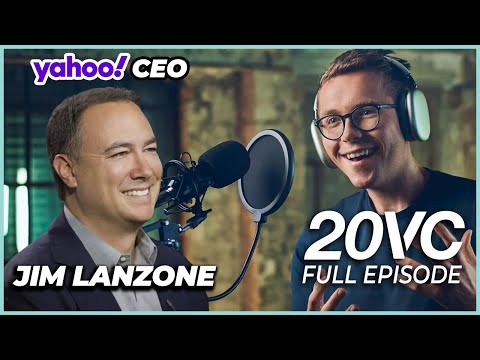
Yahoo CEO Jim Lanzone: The Yahoo Turnaround Plan | 20VC #911
Jim Lanzone (guest), Harry Stebbings (host)
In this episode of The Twenty Minute VC, featuring Jim Lanzone and Harry Stebbings, Yahoo CEO Jim Lanzone: The Yahoo Turnaround Plan | 20VC #911 explores jim Lanzone Reveals Yahoo’s Turnaround Playbook and Leadership Philosophy Jim Lanzone, CEO of Yahoo, walks through his 25-year journey across Ask Jeeves, CBS Interactive, Tinder, and now Yahoo, highlighting how repeated turnarounds shaped his leadership style.
Jim Lanzone Reveals Yahoo’s Turnaround Playbook and Leadership Philosophy
Jim Lanzone, CEO of Yahoo, walks through his 25-year journey across Ask Jeeves, CBS Interactive, Tinder, and now Yahoo, highlighting how repeated turnarounds shaped his leadership style.
He explains his framework for building high-performing teams, prioritizing product roadmaps, and sustaining velocity in large organizations, emphasizing domain expertise, EQ, ambition, and ‘love of the game.’
Lanzone details how he approaches crises and downturns—protecting the balance sheet, seeing opportunity in crashes, and maintaining grounded optimism—while also sharing how Yahoo is being restructured under Apollo to focus on growth.
Throughout, he underscores the importance of resource allocation, clear ROI-driven decision making, and rebuilding product and organizational “bones” to revive legacy brands like Yahoo.
Key Takeaways
Build teams around four traits: domain expertise, EQ, ambition, and love of the game.
Lanzone hires people who deeply understand their field, work well with others, are intrinsically driven, and genuinely care about the specific business (e. ...
Get the full analysis with uListen AI
Ditch formulaic interviews and use multi-touch, conversational vetting.
He avoids stock questions, instead having several organic conversations over multiple sessions and cross-checking with trusted references to reveal how candidates truly think, operate, and fit culturally.
Get the full analysis with uListen AI
Prioritize product work via ROI across short, medium, and long term.
For consumer internet companies, he anchors roadmaps in clear user journeys, data on underperformance, and explicit growth/revenue targets, while reserving capacity for ‘big swings’ that can change the trajectory.
Get the full analysis with uListen AI
Use downturns to survive first—and then to gain advantage.
In crashes, he focuses on protecting the balance sheet, recognizing that tough periods can be prime opportunities to take market share, buy assets cheaply, and emerge stronger if you can “thread the needle.”
Get the full analysis with uListen AI
Don’t overgeneralize rules like “when there’s doubt, there’s no doubt.”
He views such maxims as too rigid; doubt can be healthy, informing better risk-taking and product decisions, and context matters far more than one-size-fits-all leadership slogans.
Get the full analysis with uListen AI
Turnarounds require ‘good bones’: traffic, a known brand, sticky but underdeveloped products.
Across Ask Jeeves, CBS, Tinder, and Yahoo, his playbook depends on inheriting real user scale and brand awareness, then upgrading products and re-optimizing organizations to unlock latent value.
Get the full analysis with uListen AI
Reorganize large portfolios with empowered GMs and a ‘federal and state’ model.
At Yahoo, he’s installing general managers as mini-CEOs over verticals like sports, finance, and email, with a lean central org providing leverage rather than top-down control to restore focus and velocity.
Get the full analysis with uListen AI
Notable Quotes
“Never mistake activity for achievement.”
— Jim Lanzone (quoting John Wooden)
“I truly believe your company values are the people you hire.”
— Jim Lanzone
“If you took the name Yahoo off of this, at these growth rates and those numbers, what would you think it’s worth in this market?”
— Jim Lanzone
“You can’t be an ideologue… I don’t want a board where every time I walk in, I have to convince them climate change exists.”
— Jim Lanzone
“Winning is always hard. You never hear about the 900 companies that didn’t make it.”
— Jim Lanzone
Questions Answered in This Episode
How exactly is Yahoo’s new GM-based structure changing decision-making speed and accountability versus the previous centralized product model?
Jim Lanzone, CEO of Yahoo, walks through his 25-year journey across Ask Jeeves, CBS Interactive, Tinder, and now Yahoo, highlighting how repeated turnarounds shaped his leadership style.
Get the full analysis with uListen AI
What specific product bets or ‘big swings’ does Lanzone see as most critical to making Yahoo a growth story again?
He explains his framework for building high-performing teams, prioritizing product roadmaps, and sustaining velocity in large organizations, emphasizing domain expertise, EQ, ambition, and ‘love of the game.’
Get the full analysis with uListen AI
How can earlier-stage founders apply Lanzone’s turnaround lessons when they don’t yet have large traffic or a well-known brand?
Lanzone details how he approaches crises and downturns—protecting the balance sheet, seeing opportunity in crashes, and maintaining grounded optimism—while also sharing how Yahoo is being restructured under Apollo to focus on growth.
Get the full analysis with uListen AI
Where is the line between healthy optimism and damaging denial when leading a company through a crash or deep restructuring?
Throughout, he underscores the importance of resource allocation, clear ROI-driven decision making, and rebuilding product and organizational “bones” to revive legacy brands like Yahoo.
Get the full analysis with uListen AI
Given his emphasis on domain expertise and EQ, how would Lanzone design an interview loop for a key executive hire from scratch?
Get the full analysis with uListen AI
Transcript Preview
(beeping) Three, two, one, zero. You have now arrived at your destination.
Jim, this is such a joy to do. I've had so much fun doing the references for this in preparation, so thank you so much for joining me today, Jim.
It's so good to be here, Harry. Big, big, big fan, so it's good to finally be on with you.
Listen, I really needed a bit of an ego inflation, so thank you for that.
(laughs)
Uh, but (laughs) I would love to start today.
You're rocking that hat.
Just give me that... Uh.
I think you know, I think you know how, how awesome you are.
I mean, you're just teasing people who are listening on podcasts and not watching TikToks.
(laughs)
But I wanna start today with a little on your inc- I mean, 25 years plus now in the industry, how did you make your way first into the tech industry, and then kind of skipping a little bit, (laughs) a little bit, uh, how did you come to be CEO of Yahoo most recently?
Well, I'll give you the, um, the, the quick, uh, Wikipedia, you know, origin story. So I, I had had never had a real job. I, I wound up in law school, uh, which worked. I met my wife. I hated it. I switched to business school and wound up, this is the middle of, of the internet in-, uh, industry starting, I wound up as a product manager as a summer job. Got really cocky with a couple classmates, started a company outta school. By the day we graduated, we already had a couple million in funding and a few million users of our website, you know, at the time. Uh, and had the full Web 1.0 ride. Uh, we ra- we raised $50 million, we were gonna go public, and then we crashed like you wouldn't believe with the crash. We sold what was left to Ask Jeeves, uh, which is pretty much the only company that wanted us. Uh, I got really lucky and they hired me as the head of product there, and we went on, I think, probably the best turnaround run of the 2000s. We 50X'd that stock. We became, uh, a leading innovator in the space with a brand that, you know, was, uh, not that, you know, popular and, and kind of the poster child of the crash. We sold it to IAC and I became CEO as part of that transition. I wound up working for Barry Diller for many years. Left and did another startup. Uh, Bill Gurley and Jeff Yang were my investors. It was called Clicker. It was internet TV guide or search engine. Um, you know, we were looking at ahead at internet TV in 2008 and '09, so a little early. Uh, we wound up selling that to CBS in 2011. I became CEO of CBS Interactive. I was there for nine years. Uh, left with the Viacom merger, uh, after, you know, I think, uh, you know, we had a really good run there. And became the CEO of Tinder during COVID. And then, in the middle of all that, I met the guys from Apollo who were just buying Yahoo, and it was a company that I'd known a long time and had really been building up over time, I think, to become, uh, you know, the right person to take this amazing asset and drive it forward. So I, I made the big leap last September and, and became CEO.
Install uListen to search the full transcript and get AI-powered insights
Get Full TranscriptGet more from every podcast
AI summaries, searchable transcripts, and fact-checking. Free forever.
Add to Chrome