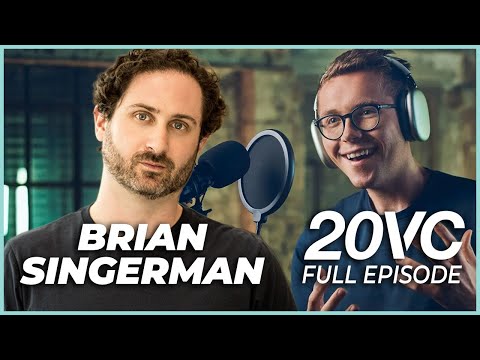
Brian Singerman: How I Became a Partner at Founders Fund, Why We Put $400M into Anduril | 20VC #943
Harry Stebbings (host), Brian Singerman (guest), Narrator, Narrator
In this episode of The Twenty Minute VC, featuring Harry Stebbings and Brian Singerman, Brian Singerman: How I Became a Partner at Founders Fund, Why We Put $400M into Anduril | 20VC #943 explores brian Singerman on Upside-Obsessed Venture, Pricing Discipline, Anduril Bet Brian Singerman, partner at Founders Fund, explains his venture philosophy: put the most money possible into the best founders in the biggest markets at the best achievable price, and ignore everything else. He argues traditional concepts like “buy low, sell high” and elaborate downside protection structures are largely irrelevant for true upside-driven venture capital. Much of the conversation centers on today’s pricing mismatch between public and private markets, his deliberate slowdown in deployment, and why Anduril is the one company he backed with a massive $400M across funds. He also discusses sourcing as Founders Fund’s biggest controllable challenge, their “no dogma, adapt-or-die” culture, and how they hire uniquely differentiated partners rather than clones.
Brian Singerman on Upside-Obsessed Venture, Pricing Discipline, Anduril Bet
Brian Singerman, partner at Founders Fund, explains his venture philosophy: put the most money possible into the best founders in the biggest markets at the best achievable price, and ignore everything else. He argues traditional concepts like “buy low, sell high” and elaborate downside protection structures are largely irrelevant for true upside-driven venture capital. Much of the conversation centers on today’s pricing mismatch between public and private markets, his deliberate slowdown in deployment, and why Anduril is the one company he backed with a massive $400M across funds. He also discusses sourcing as Founders Fund’s biggest controllable challenge, their “no dogma, adapt-or-die” culture, and how they hire uniquely differentiated partners rather than clones.
Key Takeaways
Venture is about upside maximization, not buy-low-sell-high timing.
Singerman argues that because venture outcomes play out over a decade and span multiple macro cycles, trying to time markets like a public investor is misguided; the job is to back exceptional companies at non-ridiculous prices and aim for fund-returners, not optimize small multiples.
Get the full analysis with uListen AI
Pay attention to macro, but don’t try to predict it.
He acknowledges macro conditions affect pricing and fundraising (e. ...
Get the full analysis with uListen AI
Only invest heavily when price and quality align—otherwise, wait.
Founders Fund feels no pressure to deploy capital; Singerman has drastically slowed investing because great companies still want 2021-era valuations, with Anduril being the lone large check he wrote in 2022 where quality and price made sense.
Get the full analysis with uListen AI
Fund size should match the largest check you’re truly comfortable writing.
He advises emerging managers to raise the smallest fund they can dominate, and to size funds so that writing a 25–30% of fund check feels realistic; his comfort with $200M–$500M checks justifies multi-billion-dollar funds, but he warns that scaling fund size materially increases difficulty of strong returns.
Get the full analysis with uListen AI
Founders plus big markets plus real moats are non-negotiable.
Founder quality is 80–90% of his thesis, but a small market cannot move a multi-billion-dollar fund; he looks for uniquely advantaged teams attacking truly large markets with defensible moats, as he saw with Airbnb’s network effects and Anduril’s tech, talent, and timing in defense.
Get the full analysis with uListen AI
Seeing, picking, and getting into deals are equally important muscles.
Singerman believes top firms must excel across all three: sourcing the right opportunities, selecting winners, and actually winning allocation; brand helps with “getting in” but can hurt “seeing,” so he obsessively works on fresh networks and creative sourcing to avoid stale deal flow.
Get the full analysis with uListen AI
Adapt-or-die culture and hiring for unique moats drive Founders Fund.
Internally, they avoid rigid dogma and actively hire partners with sharply differentiated strengths (e. ...
Get the full analysis with uListen AI
Notable Quotes
“Venture capital is a game of upside maximization. You’re not trying to minimize your downside.”
— Brian Singerman
“If you’re waiting around for perfect information, you’re going to be terrible at this job.”
— Brian Singerman
“We feel zero pressure to invest capital. We can just wait until prices actually catch up.”
— Brian Singerman
“Put the most money possible into the best companies possible at the best price possible. That’s venture capital.”
— Brian Singerman
“My life strategy is to maximize my dollars-to-fame ratio.”
— Brian Singerman
Questions Answered in This Episode
How sustainable is an investing strategy that largely ignores downside protection in favor of pure upside, especially with very large single-position checks?
Brian Singerman, partner at Founders Fund, explains his venture philosophy: put the most money possible into the best founders in the biggest markets at the best achievable price, and ignore everything else. ...
Get the full analysis with uListen AI
In a prolonged valuation mismatch between public and private markets, what practical signals should founders use to decide when to raise and at what price?
Get the full analysis with uListen AI
How can newer or smaller funds realistically compete on ‘getting in’ to top deals against brands like Founders Fund that already attract the best founders?
Get the full analysis with uListen AI
To what extent can a firm’s ‘adapt-or-die’ philosophy conflict with having a consistent, long-term strategy that LPs can underwrite?
Get the full analysis with uListen AI
What are the ethical and strategic implications for Silicon Valley as more top-tier firms back defense companies like Anduril at massive scale?
Get the full analysis with uListen AI
Transcript Preview
Bryan, I'm excited for this. I always love our chats. So first, thank you so much for joining me once again today, Bryan.
No problem, Harry.
Listen, I wanna start, for those that maybe missed our first show-
(pinging)
... just with some context. How did you make your way into the world of venture and how did you come to be a GP at Founders Fund in a, in a short one to two minutes? (laughs)
Man, it's been a long time now. It was... I started at Founders Fund almost 15 years ago. Um, I was at Google. I was an engineer and an engineering manager, and started doing startup investing on the side there in 2006, 2007, investing in a whole bunch of Y Combinator companies when Y Combinator was still brand new. Um, decided to make that my full time thing in '07. Was trying to figure out what to do. "Do I raise my own fund? Do I do something else?" And that's when I met, uh, Sean Parker, and we became friends, and he said, "Hey, why don't you check out what we're doing at Founders Fund?" And I came in, and that's when, uh, we were considering, uh, uh, little investments in a company called SpaceX and, you know, said, "This is what I wanna do." So I joined up.
I love that, and what an entry point with the SpaceX investment. (laughs) I- I- I wanna dive straight in on investing mechanics, to be quite honest, Bryan. I- I had Keith on the show, uh, not too long ago, uh, and he vigorously kind of debated or disagreed with an idea, which is, uh, buy low, sell high. Um, I often-
(laughs)
... get it now from LPs, and they say, "Ah, this is the time, Harry, where you can buy low and sell high." Do you agree with that principle? And can you give me an example of either way where it's- it's worked for you?
Yeah. I don't know. Ven- venture, to me, is just very different from normal investing. Um, I don't claim to know anything about macroeconomics, and I don't f- follow it all that much. Th- at the end of the day, venture is a game where you make an investment and you're not gonna see any payoff from it for, you know, a decade. Right? Like, and so, i- that's going to span a whole bunch of different macro economies, so this concept of buy low, sell high, like, using regular stock market phrases in venture, to me, just doesn't make any sense. Um, you have to invest... Y- y- you have to just invest in really good companies. Now, you can't pay ridiculous prices, because that limits your upside, right? So venture capital is a game of upside maximization, um, and the higher price you pay for something, that- it's gonna limit your upside, uh, potential on that. So you can't just go an re- invest at ridiculous price, you know, ridiculous tw- end of 2021 prices in things. Um, however, you know, either the company is going to do really, really well, um, over time, in which case you'll be able to sell it high (laughs) or sell it higher, or it won't, in which case it won't matter to you at all.
Install uListen to search the full transcript and get AI-powered insights
Get Full TranscriptGet more from every podcast
AI summaries, searchable transcripts, and fact-checking. Free forever.
Add to Chrome