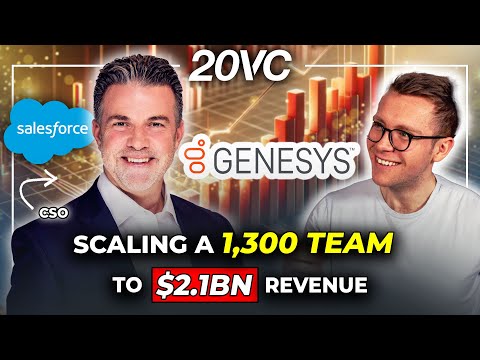
Larry Shurtz: How to Hire, Train & Retain the Best Vertical Teams | E1151
Larry Shurtz (guest), Harry Stebbings (host), Harry Stebbings (host)
In this episode of The Twenty Minute VC, featuring Larry Shurtz and Harry Stebbings, Larry Shurtz: How to Hire, Train & Retain the Best Vertical Teams | E1151 explores larry Shurtz Reveals How Elite Sales Leaders Build High-Performing Verticals Larry Shurtz, CRO at Genesys and former Salesforce leader, breaks down how to hire, train, forecast, and vertically organize sales teams that consistently hit their numbers. He emphasizes ruthless prioritization around people, the number, and customer success, and argues that EQ, empathy, and leadership “art” still separate the great from the merely good despite rising sales science and tooling. Shurtz details his philosophy on hiring rigor, onboarding, compensation, discounting, forecasting, and when to cut bad hires, as well as why verticalization must go far beyond just the AE. He also shares lessons from mistakes earlier in his career, especially around empathy, culture, and how great leaders handle tough customer situations.
Larry Shurtz Reveals How Elite Sales Leaders Build High-Performing Verticals
Larry Shurtz, CRO at Genesys and former Salesforce leader, breaks down how to hire, train, forecast, and vertically organize sales teams that consistently hit their numbers. He emphasizes ruthless prioritization around people, the number, and customer success, and argues that EQ, empathy, and leadership “art” still separate the great from the merely good despite rising sales science and tooling. Shurtz details his philosophy on hiring rigor, onboarding, compensation, discounting, forecasting, and when to cut bad hires, as well as why verticalization must go far beyond just the AE. He also shares lessons from mistakes earlier in his career, especially around empathy, culture, and how great leaders handle tough customer situations.
Key Takeaways
Ruthless prioritization around people, the number, and customer success is non-negotiable.
Sales leaders often try to do everything, which burns them out and overwhelms teams; Shurtz argues leaders must aggressively prioritize talent, hitting the number, and ensuring customers are successful, removing initiatives instead of endlessly adding more.
Get the full analysis with uListen AI
Hire slowly, with clarity, and never let ‘hot candidates’ compress your diligence.
He insists you must be crystal clear on the role, values, and comp structure early, avoid hostage-style “I’ve got three offers” pressure, use small interview loops, and favor depth of diligence over speed to prevent costly 12–18 month hiring mistakes.
Get the full analysis with uListen AI
EQ and empathy remain the ‘art’ that separates great sellers and leaders.
While tools, data, and frameworks have increased the ‘science’ of sales, Shurtz maintains that high-end EQ, genuine listening, and empathy are largely hard-wired and very hard to teach, and they meaningfully affect culture, loyalty, and customer trust.
Get the full analysis with uListen AI
Onboarding must be immersive, in-person where possible, and tied to real customer pain.
He advocates for early in-person cultural immersion, buddy/mentor systems, long-term enablement, and specifically having new hires listen to support calls to understand customer pain and build practical empathy rather than relying only on classroom training.
Get the full analysis with uListen AI
Accurate forecasting is a core part of a sales leader’s brand.
Consistent forecast misses usually indicate shallow deal diligence, insufficient pipeline, wrong stakeholder coverage, or poor questioning; Shurtz believes leaders must balance risk and commitment and that the entire investment plan of a company depends on reliable forecasts.
Get the full analysis with uListen AI
Verticalization only works when the entire go-to-market and delivery org is aligned.
True vertical sales isn’t just an AE label; SEs, CS, support, and professional services all need industry-specific knowledge, content, and reference implementations, and founders should start with one high-potential vertical and work backwards from clear outcomes and use cases.
Get the full analysis with uListen AI
Cut underperformers faster, but distinguish between mental and coachable ‘physical’ errors.
He urges leaders to trust their gut in the first 30 days, double-click on red flags, be candid in feedback, and separate non-negotiables like diligence, preparation, and interpersonal issues from skill gaps that can be improved through coaching; delaying decisions just extends an already-known outcome.
Get the full analysis with uListen AI
Notable Quotes
“There’s nothing more important than people. Your human capital is the most important thing.”
— Larry Shurtz
“If you can’t forecast accurately, either you don’t truly understand your business or you’re not doing enough diligence with customers and opportunities.”
— Larry Shurtz
“I don’t think you can train really good, high-end EQ. I firmly believe that’s in you.”
— Larry Shurtz
“Closing the deal is like the easy part. They have to be successful.”
— Larry Shurtz
“When quality people start leaving, comp is likely always an issue. I don’t think comp is always the issue.”
— Larry Shurtz
Questions Answered in This Episode
How can a sales leader practically assess EQ and empathy during an interview without relying only on intuition?
Larry Shurtz, CRO at Genesys and former Salesforce leader, breaks down how to hire, train, forecast, and vertically organize sales teams that consistently hit their numbers. ...
Get the full analysis with uListen AI
What specific questions and deal inspection methods does Shurtz use to significantly improve forecast accuracy?
Get the full analysis with uListen AI
For an early-stage startup, how do you decide which single vertical to bet on first—and when to add a second?
Get the full analysis with uListen AI
Where is the line between giving a struggling new hire enough coaching time and moving on quickly to protect the team?
Get the full analysis with uListen AI
How should founders structure sales and customer success ownership in a consumption or usage-based business model?
Get the full analysis with uListen AI
Transcript Preview
If you can't forecast accurately, either you don't truly understand your business, you aren't truly doing the amount of diligence with customers and opportunities. You don't have enough opportunities to be able to balance out some of the riskier things, or some of the things that look better. And we might not even be asking the right questions, and we're likely not talking to the right people.
Ready to go? Larry, listen, I've heard so many good things from the main man, Mr. Frank Feldman. So thank you so much for joining me today, first.
Harry, it's great to see you. Thank you. Um, this should be a ton of fun, so thanks for having me on.
Not at all. But listen, I wanna start with some context. Sales is often something that sales leaders love. I- I wanna dive into, when did you first discover your love of sales? Was there, uh, a critical inflection po- point?
Yeah. Well, so a little bit of background m- might give you some- some context. Um, when I graduated from high school, I went into college, I wanted to be an electrical engineer. Uh, more specifically, actually most specifically, I wanted to build robots, which is kinda crazy.
(laughs)
Um, and I went in, I took- took my first electro engineering courses. Uh, obviously heavy math, uh, some things that I had not really been prepared for, and realized that that was probably not the best spot for me. I quickly exited and got into marketing, and I- I did a lot of, even back then, a little bit of kinda just soul searching of, you know, what... It's a pretty dramatic miss (laughs) of what I wanted. I realize I actually didn't wanna, like, build the robots. I wanted to sell the robots. Like, I wanted to go on- on that journey of how cool robots could be for, um, for society and- and for people in general. So, you know, my- my love of sales really just came from my first job outta school. Um, I graduated with a, with a marketing and finance degree, and two companies came onto my campus. One was Eli Lilly, pharmaceutical company, um, and the other was E. J. Gallo, the- the wine company. So these are tough choices as- as a college graduate.
(laughs)
And I went, uh, I went Eli Lilly. I was at Eli Lilly for two years, um, and a really just an incredible company as far as just foundational sales methodology, and that's where I kinda got hooked, uh, was the- the early days in- in medical.
I mean, listen, I- I love that in terms of an origin story. Sadly, the robot career didn't happen.
(laughs)
I'm sorry for that, but I think it's turned out pretty well.
Absolutely.
Um, there's so many great companies though that you've f- like, bluntly been an instrumental part of. I wanted to start on actually the decade at Salesforce. I mean, when I looked at the numbers, you know, leading a 1,300 person team to 2.1 billion in revenue, I mean, these are insane numbers, Larry. What are one or two of your biggest takeaways from a decade at Salesforce in that trajectory?
Install uListen to search the full transcript and get AI-powered insights
Get Full TranscriptGet more from every podcast
AI summaries, searchable transcripts, and fact-checking. Free forever.
Add to Chrome