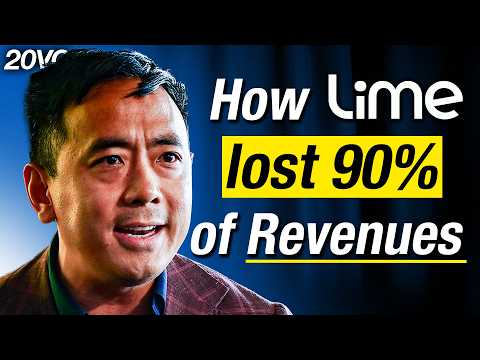
Wayne Ting, CEO @Lime: From Losing $3 on Every $1 to $90M in EBITDA | E1252
Wayne Ting (guest), Harry Stebbings (host)
In this episode of The Twenty Minute VC, featuring Wayne Ting and Harry Stebbings, Wayne Ting, CEO @Lime: From Losing $3 on Every $1 to $90M in EBITDA | E1252 explores lime’s CEO on Surviving Crisis, Mastering Ops, and Beating Cars Wayne Ting recounts taking over Lime when it was losing $3 for every $1 in revenue, with scooters lasting only 30 days, and explains how rigorous operational discipline and proprietary hardware turned it into a $600M+ revenue, $90M EBITDA business.
Lime’s CEO on Surviving Crisis, Mastering Ops, and Beating Cars
Wayne Ting recounts taking over Lime when it was losing $3 for every $1 in revenue, with scooters lasting only 30 days, and explains how rigorous operational discipline and proprietary hardware turned it into a $600M+ revenue, $90M EBITDA business.
He describes Lime’s ‘game of inches’ approach: thousands of small data‑driven optimizations in hardware design, warehouse operations, routing, and city relationships that compound into a defensible advantage over rivals.
The conversation covers navigating COVID (including an existential down round and the acquisition of Uber’s Jump), the dangers of VC hype cycles, and what it means to operate free‑cash‑flow positive without dependence on external capital.
Ting also opens up about suffering a stroke, the psychological challenge of reconciling his old and new self, and why he’s intentionally public about health struggles and LGBTQ+ identity to normalize vulnerability in leadership.
Key Takeaways
Fixing unit economics starts with hard, honest data and ground truth.
Ting’s first move was building an internal data platform to understand real profitability by city, fleet decay, and per‑trip economics; without accurate visibility, local leaders thought they were profitable when they were not.
Get the full analysis with uListen AI
Operational excellence is mostly about local leadership, visibility, and accountability.
The best warehouses had hands‑on GMs who knew mechanics by name, walked the floor, tracked output visibly, and held people accountable; Lime then encoded these behaviors into software to scale them globally.
Get the full analysis with uListen AI
Incremental hardware and process tweaks compound into major P&L impact.
By designing its own scooters and bikes (e. ...
Get the full analysis with uListen AI
Reliability and density create a demand flywheel in micromobility.
Contrary to intuition, increasing fleet size in a city raises per‑vehicle utilization because people adopt Lime as a primary mode only when they can reliably find a vehicle, reinforcing Lime’s market‑leader advantage.
Get the full analysis with uListen AI
In crises, swift, deep decisions beat delayed, incremental cuts.
During COVID, Lime’s revenue dropped ~90–95%; Ting argues that cutting costs quickly and deeply, and avoiding multiple layoff rounds, is crucial for preserving credibility and survival, even when every option feels bad.
Get the full analysis with uListen AI
VC hype can hide bad businesses and delay necessary discipline.
Ting believes easy capital lets poorly run competitors buy growth and mask weak operations; Lime’s true advantage only became obvious once funding tightened and operational excellence, not discounting, determined winners.
Get the full analysis with uListen AI
Leaders benefit from openly sharing health and identity struggles.
By speaking publicly about his stroke and being gay, Ting aims to reduce stigma, model vulnerability, and reassure other leaders that they’re not alone in navigating serious health issues and questions of belonging.
Get the full analysis with uListen AI
Notable Quotes
“When I first joined Lime, we were losing three dollars for every dollar of revenue.”
— Wayne Ting
“Great operations requires a hands-on approach. You gotta know what's happening to know what is going well, what is going poorly.”
— Wayne Ting
“It's a true game of inches, and when you do 1,000 little things better than your competitor, then you have a different business model.”
— Wayne Ting
“Lime wouldn't have survived if we did not do that deal.”
— Wayne Ting, on acquiring Uber’s Jump
“You gotta let that go. You can't spend your life worrying about how you're gonna be the person that you were. This is your new reality.”
— Mark Bertolini, as quoted by Wayne Ting
Questions Answered in This Episode
Which specific software tools or metrics turned out to be most critical in transforming Lime’s warehouse and field operations?
Wayne Ting recounts taking over Lime when it was losing $3 for every $1 in revenue, with scooters lasting only 30 days, and explains how rigorous operational discipline and proprietary hardware turned it into a $600M+ revenue, $90M EBITDA business.
Get the full analysis with uListen AI
How defensible is Lime’s hardware advantage if more competitors begin designing their own vehicles and batteries?
He describes Lime’s ‘game of inches’ approach: thousands of small data‑driven optimizations in hardware design, warehouse operations, routing, and city relationships that compound into a defensible advantage over rivals.
Get the full analysis with uListen AI
What cultural practices within Lime helped employees stay motivated through COVID, layoffs, and the shift to ruthless operational discipline?
The conversation covers navigating COVID (including an existential down round and the acquisition of Uber’s Jump), the dangers of VC hype cycles, and what it means to operate free‑cash‑flow positive without dependence on external capital.
Get the full analysis with uListen AI
How should founders decide when a down round is the right move versus cutting deeper or shrinking ambitions?
Ting also opens up about suffering a stroke, the psychological challenge of reconciling his old and new self, and why he’s intentionally public about health struggles and LGBTQ+ identity to normalize vulnerability in leadership.
Get the full analysis with uListen AI
In 20–30 years, what mix of policy, infrastructure, and technology does Ting believe is required to make micromobility truly replace urban car ownership?
Get the full analysis with uListen AI
Transcript Preview
When I first joined Lime, we were losing three dollars for every dollar of revenue. The daily decay rate was 3%, so in the course of 30 days, your entire fleet was gone, so the business was completely upside down. I would say my first four years as CEO, I was constantly worried about Lime going out of business. Lime wouldn't have survived if we did not do that deal.
Ready to go? Wayne, I am so excited for this, dude. Listen, I, I heard so many good things from Blake Byers, from Jeff Jordan, uh, from Sarah Smith, so thank you so much for joining me today.
Harry, thank you so much for having me. Very excited for the conversation.
Dude, I can't wait. I told you, listen, I come out of my f- apartment every day and there's, like, 50 Limes in front of my house, um, so I think of you every day in the most romantic of senses. Um, I want to start, though, you then worked for Dara at Uber, who has had the most incredible journey with Uber over the last few years. What did you learn from Dara through his mentorship?
Dara also, Dara came into Uber at a very difficult transition, and I think what was really amazing was how quickly he reset the tone at the top. And re- one of the first things he did was he wanted to put out new values for Uber. There was a lot of criticisms about kind of the way Uber was acting or the way Uber was competing and I remember the one value that he put out that was, that resonated the most was, "Do the right thing." It sounds cliché and shallow, but I can't tell you how much it resonated with people all throughout the company. We don't... Winning is not enough. We win while doing the right thing, we win while doing the ethical thing, we win while treating each other with respect. And what I saw was that there was, there was different paths to success and Dara brought a very unique set of leadership traits that in many ways challenged Uber to think about how, how can we be a better company and a better team?
Can I ask you, how do you think about doing the right thing in a multi-participant economy? And what I mean by that is, if we think about, say, Uber in that case, raising prices is s- doing the right thing maybe for supply and demand, it may be doing the right thing for drivers. It's not doing the right thing for consumers, and so doing the right thing is always held in the context of the beholder. How do you think about that?
We have a similar debate here. I would say it's really important not to make business decisions, moral decisions. I would actually take pricing out of a moral context. Companies throughout the world raise prices, lower prices millions of times a day. Amazon probably does it a million times in one day just on their own platform. Raising prices, lowering prices is not a moral decision. It's a business judgment call, and I think when we bring moral dimensions to business judgment calls, we actually shut down debate prematurely. Because if I'm saying, "I'm, I'm not gonna raise prices because I'm doing the right thing," then that assumes the person arguing for raising prices is doing the wrong thing, so it's very dangerous, I think, to, to, to put immoral consequences into a regular business decision. And so, (clears throat) I think there are good arguments for why companies may need to raise prices.
Install uListen to search the full transcript and get AI-powered insights
Get Full TranscriptGet more from every podcast
AI summaries, searchable transcripts, and fact-checking. Free forever.
Add to Chrome