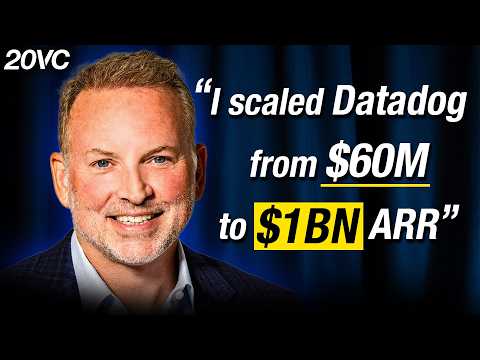
Dan Fougere, CRO @Datadog: Why Discounting is Dangerous and Contract Sizes are Misleading | E1229
Dan Fougere (guest), Harry Stebbings (host)
In this episode of The Twenty Minute VC, featuring Dan Fougere and Harry Stebbings, Dan Fougere, CRO @Datadog: Why Discounting is Dangerous and Contract Sizes are Misleading | E1229 explores datadog CRO Dan Fougere: Discipline, Pricing Power, And Sales Culture Dan Fougere, former CRO of Datadog and Medallia, breaks down how to build rigorous, scalable sales machines on top of great products, especially in PLG-driven companies.
Datadog CRO Dan Fougere: Discipline, Pricing Power, And Sales Culture
Dan Fougere, former CRO of Datadog and Medallia, breaks down how to build rigorous, scalable sales machines on top of great products, especially in PLG-driven companies.
He explains MEDDIC qualification, why tight discount control and small initial contracts can unlock massive long‑term value, and why AEs must own pipeline generation.
Fougere dives into crafting effective demos, hiring and testing reps, structuring CS, and building a high-accountability, high-fun sales culture.
He also shares candid personal stories about being passed over for a CRO role, financial stress, life‑changing exits, and how those experiences shaped his leadership philosophy.
Key Takeaways
Qualification must ruthlessly seek the bad news, not confirm happy ears.
Using MEDDIC and the “three whys” (why do anything, why us, why now), great reps deliberately look for risk and gaps early so they don’t waste cycles on weak deals or over-forecasted pipe.
Get the full analysis with uListen AI
AEs cannot outsource pipeline generation; PG is everyone’s job.
Fougere compares asking SDRs to ‘do PG for you’ to asking someone to go to the gym for you; top cultures expect leaders, AEs, and SDRs all to create new opportunities with researched, value‑first outbound.
Get the full analysis with uListen AI
Small initial contracts can be huge if they’re real projects in expanding domains.
At Datadog, $600 ARR accounts like Capital One grew into seven‑figure enterprise deals; the key is to land in genuine, strategic projects (e. ...
Get the full analysis with uListen AI
Discounting is dangerous if decentralized; keep pricing power centralized and data‑driven.
Left alone, reps will push to max discount; Fougere insists on tight CRO/CPO control, clear discount ceilings, and resisting ‘frictionless’ approvals to protect long‑term unit economics and future upsell leverage.
Get the full analysis with uListen AI
Great demos start with discovery and a story, not a feature firehose.
He stresses doing discovery beforehand, mapping the product to the customer’s specific pains, and telling a narrative where the buyer clearly sees themselves, their environment, and their personal win in the solution.
Get the full analysis with uListen AI
Customer success design depends on product and motion; don’t default to one model.
Datadog used CS differently across segments—commercial CS as quasi‑sales to manage growth, and enterprise CS for implementation help—showing that CS comp and remit must match product complexity and market maturity.
Get the full analysis with uListen AI
Discipline and long-term stickiness matter more than polished resumes in sales hiring.
He looks for evidence of hard things done over time (e. ...
Get the full analysis with uListen AI
Notable Quotes
“Asking somebody else to do pipeline generation for you is like asking them to go to the gym for you.”
— Dan Fougere
“Discounting should have as tight a control as possible. Left to their own devices, salespeople will peg at maximum discount 100% of the time.”
— Dan Fougere
“We will have a legendary sales team, making life-changing money, being best in class, and having fun.”
— Dan Fougere
“Very junior people can do very big deals with the right training and the right leadership.”
— Dan Fougere
“Old school is the new school and it’s the good school, because humans don’t change.”
— Dan Fougere
Questions Answered in This Episode
How can an early-stage PLG startup practically know when it’s ‘time’ to invest in a serious sales leader versus waiting longer?
Dan Fougere, former CRO of Datadog and Medallia, breaks down how to build rigorous, scalable sales machines on top of great products, especially in PLG-driven companies.
Get the full analysis with uListen AI
What specific guardrails and approval flows should a founder put around discounting to avoid eroding pricing power as they scale?
He explains MEDDIC qualification, why tight discount control and small initial contracts can unlock massive long‑term value, and why AEs must own pipeline generation.
Get the full analysis with uListen AI
How would Fougere adapt his MEDDIC-driven, outbound-heavy playbook in a world where AI can generate infinite, personalized outreach?
Fougere dives into crafting effective demos, hiring and testing reps, structuring CS, and building a high-accountability, high-fun sales culture.
Get the full analysis with uListen AI
For a technical founder with no sales background, what’s the minimum viable sales playbook they should build before hiring their first sales leader?
He also shares candid personal stories about being passed over for a CRO role, financial stress, life‑changing exits, and how those experiences shaped his leadership philosophy.
Get the full analysis with uListen AI
How should companies decide whether customer success should be a cost center focused on adoption or a quota-carrying expansion engine?
Get the full analysis with uListen AI
Transcript Preview
We will have a legendary sales team, making life-changing money, being best in class, and having fun. You will learn more and become better at your job working on my team than you would have at any other team during that same amount of time. And you will never have to look for a job again because the halo of our success will be over your head for the rest of your career and people will seek you out. I said that to everybody in- on the team. That was my first day.
Ready to go? (upbeat music) Dan, I am so excited for this, dude. I've wanted to make this one happen for a while. I'm in awe of the Datadog journey and your role in it, so thank you so much for joining me today.
Man, I'm so happy to be here. Uh, longtime listener, first time caller. I have enjoyed your podcast for years and I'm fired up for today.
That is very, very kind of you, but I just spoke to Carlos at Harness beforehand, and he said that I had to start with the mechanical engineering part. He said, "Why did you make the move from engineering to sales?"
Well, I ended up doing mechanical engineering, t- just engineering in general because I didn't have a lot of money growing up. I read a magazine in 1987 called US News & World Report. The five or seven top earning degrees all were engineering, and I was like, "I don't know any engineers." I was living... I grew up in New York City and my dad was a cop. We were living in the country at the time, very rural place. And so, uh, I seemed pretty good at math and science and I got into it. I love technology. I always admired Steve Jobs and Bill Gates, and those guys were kinda heroes from my childhood, and I got a, uh, a design job in Detroit using CAD/CAM software. And so I got pretty good at it, I went on to go work for the company and it was, turned out to be this company Parametric Technology Corporation, or PTC. And I went there for the technology, not realizing that they kind of possibly are the greatest sales team that's ever been put together. So this qualification methodology, MEDDIC, that everybody uses, it was invented there while I was there. Company was doing about 200 million a year, so they still had the DNA of a startup. And so I talked with them about just how they built an amazing qualification machine, uh, pipeline generation machine, sales process machine, and I just happened into that as an engineer.
How do you build a really, really good qualification machine?
You gotta expect that bullshit is there. You have to realize that human nature is such that you want to have the rose-colored glasses on, you wanna believe the deal is good, and you need to know that the opposite is probably true, and you've gotta look for the dirt and you've gotta build that into every time you're looking at a deal, you should be thinking about it. And now MEDDIC is a nice way to have a structure, a framework for this, versus some meandering conversation that may or may not get to the answer, right? So your metrics, your economic buy, your decision process, decision criteria, identify pain, champion, competition. That's the way I look at MEDDIC. And so in that way, I can have a conversation in possibly even 15 minutes, but m- max 30 minutes, and I'm gonna be able to qualify this deal, we're gonna be able to co- look for the- for the weaknesses and strengths, yes.
Install uListen to search the full transcript and get AI-powered insights
Get Full TranscriptGet more from every podcast
AI summaries, searchable transcripts, and fact-checking. Free forever.
Add to Chrome