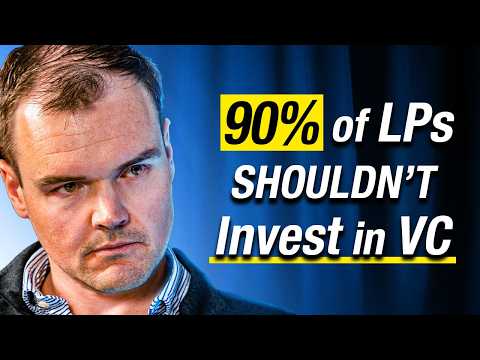
Miles Dieffenbach: Inside Carnegie Mellon’s $4BN Endowment & The Math Behind DPI, TVPI, Illiquidity
Miles Dieffenbach (guest), Harry Stebbings (host)
In this episode of The Twenty Minute VC, featuring Miles Dieffenbach and Harry Stebbings, Miles Dieffenbach: Inside Carnegie Mellon’s $4BN Endowment & The Math Behind DPI, TVPI, Illiquidity explores inside CMU’s Endowment: Why Most LPs Should Avoid Venture Capital Carnegie Mellon’s Myles Dieffenbach explains how the university runs its $4B endowment, with an 85/15 equity–fixed income split and roughly 50% in private markets, and why he believes most LPs are not being adequately compensated for the risk they take in venture capital.
Inside CMU’s Endowment: Why Most LPs Should Avoid Venture Capital
Carnegie Mellon’s Myles Dieffenbach explains how the university runs its $4B endowment, with an 85/15 equity–fixed income split and roughly 50% in private markets, and why he believes most LPs are not being adequately compensated for the risk they take in venture capital.
He walks through the math behind TVPI, DPI, and public market equivalents (PMEs), arguing that only top‑decile venture funds outperform public tech indices like the QQQs, and that mega‑funds’ sheer AUM makes repeat 4x net outcomes mathematically implausible.
The conversation dissects GP behavior, fund sizing, fee structures, LP churn, secondaries, and the rise of multi‑stage platforms, while also covering illiquidity, the broken IPO market, and why 2026+ could finally see a wave of liquidity.
Interwoven are candid views on manager selection—access vs picking, reference checks, alignment, GP commits—and broader themes like AI bubbles, NVIDIA, OpenAI’s risk profile, and what ‘founder‑friendly’ really should mean.
Key Takeaways
Only top‑decile venture funds consistently beat public tech benchmarks.
Cambridge data shows median net IRR in venture around 8%, with top‑quartile DPI only ~1. ...
Get the full analysis with uListen AI
Most LPs should not be in venture unless they have true top‑decile access.
Dieffenbach argues 90% of LPs lack the relationships and selection skill to access the few managers that create outsized value, making public tech exposure a better risk‑adjusted choice for most allocators.
Get the full analysis with uListen AI
Mega venture funds are structurally misaligned with LPs’ return targets.
When a platform raises, say, $7B across vehicles with ~5% average entry ownership, it must underwrite ~$800B of eventual market cap to deliver a 4x net—a scale of outcomes the historical IPO/M&A data simply doesn’t support.
Get the full analysis with uListen AI
Fund size discipline and fee structure design are now crucial edge factors.
Firms like Index are praised for resisting AUM bloat and prioritizing performance; Dieffenbach advocates full‑fat fees (even 2. ...
Get the full analysis with uListen AI
LPs must underwrite illiquidity explicitly and build new muscles on marks.
CMU now re‑underwrites the top 10 NAV positions in every fund, tests manager marks, and is acutely aware of tail outcomes (e. ...
Get the full analysis with uListen AI
Alignment is more about behavior and economics than brand or narrative.
Dieffenbach focuses on GP commit as a % of personal wealth, partnership health, and whether economics have ‘broken the bond’—e. ...
Get the full analysis with uListen AI
The liquidity cycle will shape venture fundraising for years.
After years of minimal IPOs and distributions, CMU’s venture book is only now becoming self‑funding again thanks to secondaries and a handful of large outcomes; Dieffenbach expects 2026+ to be better for liquidity but believes it will take multiple strong years to normalize LP appetite.
Get the full analysis with uListen AI
Notable Quotes
“My question to any new allocator or an investor is, do you think you're going to have access to top decile managers? Because at that point, top decile, you are achieving returns above the PME consistently. But below that, even top quartile, you're not.”
— Myles Dieffenbach
“I study, I live, I eat, I breathe investing. These business models these GPs are creating are some of the best high-margin businesses ever created.”
— Myles Dieffenbach
“For the longest period of time, private market capital was cheaper than public market capital, which is the most mind-boggling statement as, like, a fundamental investor ever.”
— Myles Dieffenbach
“The median IRR is about 8% net for [venture] and top quartile DPI from 1998 to 2015 is 1.8x. You don’t look at that data on a $7 billion fund and think, ‘We will pay whatever we need to get into those funds.’”
— Myles Dieffenbach
“This fund was essentially going to do an extra three turns on the fund in its thirteenth year. That’s the risk of selling secondaries as a long-term venture investor.”
— Myles Dieffenbach
Questions Answered in This Episode
If only top‑decile managers truly outperform, how can a new LP realistically build access to them without years of relationships or brand?
Carnegie Mellon’s Myles Dieffenbach explains how the university runs its $4B endowment, with an 85/15 equity–fixed income split and roughly 50% in private markets, and why he believes most LPs are not being adequately compensated for the risk they take in venture capital.
Get the full analysis with uListen AI
Given the math Myles outlines on mega‑funds, what concrete signals should LPs use to decide when a historically great manager has simply become too big?
He walks through the math behind TVPI, DPI, and public market equivalents (PMEs), arguing that only top‑decile venture funds outperform public tech indices like the QQQs, and that mega‑funds’ sheer AUM makes repeat 4x net outcomes mathematically implausible.
Get the full analysis with uListen AI
How should GPs redesign fee structures and product mixes to restore GP–LP alignment while still building durable businesses themselves?
The conversation dissects GP behavior, fund sizing, fee structures, LP churn, secondaries, and the rise of multi‑stage platforms, while also covering illiquidity, the broken IPO market, and why 2026+ could finally see a wave of liquidity.
Get the full analysis with uListen AI
What specific governance and analytical practices should smaller endowments or family offices adopt to replicate CMU’s ‘new muscles’ around marks and DPI/TVPI analysis?
Interwoven are candid views on manager selection—access vs picking, reference checks, alignment, GP commits—and broader themes like AI bubbles, NVIDIA, OpenAI’s risk profile, and what ‘founder‑friendly’ really should mean.
Get the full analysis with uListen AI
In AI, where capex and burn are enormous, how should LPs distinguish between companies like SpaceX (self‑funding) and OpenAI‑style entities that may be vulnerable when the cycle inevitably turns?
Get the full analysis with uListen AI
Transcript Preview
So my message here to all venture capitalists, now is the time. Please, take your companies public. I breathe investing. These business models these GPs are creating are some of the best high-margin businesses ever created. My question to any new allocator or an investor is, do you think you're going to have access to top decile managers? Because at that point, top decile, you are achieving returns above the PME consistently. But below that, even top quartile, you're not.
Ready to go? (instrumental music plays) Myles, dude, I'm so excited for this. Listen, we've been friends for a while. I'm so excited that we could also make it happen in person. What no one knows is I dragged you round London for a walk last night and it poured with rain. You were so patient and great, but thank you for joining me, man.
Thank you for having me. It's a, uh, pleasure to be here, uh, you've had some incredible, uh, guests on, on the podcast and I'm honored to be one of them.
You know what, dude, it's, it's amazing given the fact that I've known you for a while and then also, like, in the research for this, learning more and more about you, because I didn't actually realize this but at 26, you, uh, kind of went through a cancer experience and, you know, you're a cancer survivor now. Pretty unbearable to think about given the fact that I'm 29, like just the most incredible strength. How did having cancer and facing your own mortality change your mindset? And I've never asked that question to start a show before. (laughs)
Well, let's dive into it. We'll dive into the, into the heavy and hot. I mean, it's a surreal moment when that happens, you know, I think everyone at that age thinks you're invincible. I did, right, uh, and you get that news and you're in a bit of shock, right? And it was, it was so abnormal to me when they told me I had lymphoma. I said, "Oh great, what's lymphoma?" I thought it was like a, a cold. I didn't even know what it was. And they said it's, uh, it's, it's cancer and it's progressed, you know, quite substantially and, and we need to, you know, start a chemo process here within the week. Um, and so like I'd say most all people I, I sulked for about 12 hours, went home, uh, was, was mad at the world, didn't wanna speak to anybody. Why me? Um, and, and I woke up that next morning and one of my college football coaches had a, had a great quote that, that really stuck with me which was, you know, "Success in life is, you know, 10% what happens to you and 90% how you react when it happens to you." And so, uh, you know, I took that running that next day, I said, "I'm gonna attack this. I can't change the situation I'm in, but I can change, you know, how I react to it moving forward." And so I basically said, you know, "Cancer can't kill me if I don't stop moving," so I basically started, you know, the, uh, a pretty insane regiment of, of workouts, uh, and when I would go in and get my chemo, uh, that was like my RnR, that was my recovery period. I'd get out, I'd, I'd, I'd start that again and flash forward four months, I was, uh, cancer-free and have been so ever since.
Install uListen to search the full transcript and get AI-powered insights
Get Full TranscriptGet more from every podcast
AI summaries, searchable transcripts, and fact-checking. Free forever.
Add to Chrome