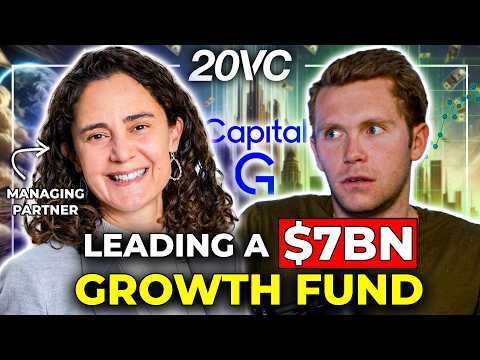
Laela Sturdy: Life Inside Alphabet's $7BN Growth Fund | E1190
Laela Sturdy (guest), Harry Stebbings (host)
In this episode of The Twenty Minute VC, featuring Laela Sturdy and Harry Stebbings, Laela Sturdy: Life Inside Alphabet's $7BN Growth Fund | E1190 explores inside CapitalG: Laela Sturdy on Growth, Second Acts, And Power Laws Laela Sturdy, General Partner at Alphabet’s $7B CapitalG, discusses how she evaluates growth-stage companies, balancing pattern recognition, hard-earned operator insights, and an open mind to anomalies. She emphasizes underwriting primarily on the strength of the core business, treating second and third product acts as upside unless there is concrete evidence of execution. The conversation covers IPO readiness, the fate of overvalued and slower-growth companies, the realities of AI investing, and why venture outcomes follow a power-law where a few big decisions matter most. Throughout, she frames venture as a deeply people-centric business, focused on outlier founders, team construction, and durable followership—especially in difficult times.
Inside CapitalG: Laela Sturdy on Growth, Second Acts, And Power Laws
Laela Sturdy, General Partner at Alphabet’s $7B CapitalG, discusses how she evaluates growth-stage companies, balancing pattern recognition, hard-earned operator insights, and an open mind to anomalies. She emphasizes underwriting primarily on the strength of the core business, treating second and third product acts as upside unless there is concrete evidence of execution. The conversation covers IPO readiness, the fate of overvalued and slower-growth companies, the realities of AI investing, and why venture outcomes follow a power-law where a few big decisions matter most. Throughout, she frames venture as a deeply people-centric business, focused on outlier founders, team construction, and durable followership—especially in difficult times.
Key Takeaways
Underwrite mainly on the core business; treat expansions as upside.
Sturdy now assumes only the existing, proven product and market in her base case, and only credits second/third acts (new products, geographies, or categories) when there is real evidence the team can execute beyond the core.
Get the full analysis with uListen AI
Second and third acts are much rarer and slower than decks suggest.
Most companies talk about international expansion or multi-product plays for years without meaningful progress; she looks for outlier signals (e. ...
Get the full analysis with uListen AI
IPO readiness is about predictability and discipline, not just revenue scale.
Companies can go public at $100M or $500M+ in revenue; what matters most is the ability to clearly articulate a plan and then reliably hit it within the quarterly cadence of public markets.
Get the full analysis with uListen AI
Many $30–100M ARR, 15–30% growth companies will struggle to remain independent.
These often signal smaller-than-expected markets or decaying growth curves; they will need to reach real profitability, explore combinations/roll-ups, or accept more constrained outcomes.
Get the full analysis with uListen AI
Venture success is driven by a few big, high-conviction decisions.
Sturdy highlights the power law: only ~6–8 truly important decisions per year matter, so investors must be willing to feel uncomfortable, go against consensus, and still underwrite 3–5x money-on-money in growth.
Get the full analysis with uListen AI
Exceptional companies require both spiky founders and strong teams as they scale.
Zero-to-one can hinge on one founder’s “spiky” genius, but sustained large-scale success demands a team sport—diverse executive capabilities, strong boards, and leaders who create genuine followership through good and bad times.
Get the full analysis with uListen AI
AI growth investing has been tricky, but opportunities are emerging.
The last 18 months were heavily bid up by strategics and corporates, so CapitalG focused earlier-stage AI; now, as some AI companies reach real scale, she sees a coming wave of more rational, growth-stage AI opportunities.
Get the full analysis with uListen AI
Notable Quotes
“If you rely entirely on the past predicting the future, you'll never be a great investor.”
— Laela Sturdy
“My base case is, I'm only gonna underwrite what exists today.”
— Laela Sturdy
“Venture is a business of 80/20 outsize returns… you have to make a few big, big decisions right.”
— Laela Sturdy
“The best founders will only be better if they have a really strong board.”
— Laela Sturdy
“If you feel nervous and you're advocating for something so hard that others are telling you no… you're exactly where you should be.”
— Laela Sturdy
Questions Answered in This Episode
How can a founder realistically assess whether their second or third act is truly executable, versus just a boardroom narrative?
Laela Sturdy, General Partner at Alphabet’s $7B CapitalG, discusses how she evaluates growth-stage companies, balancing pattern recognition, hard-earned operator insights, and an open mind to anomalies. ...
Get the full analysis with uListen AI
What specific leading indicators should companies watch to know they’re ready for public market predictability and scrutiny?
Get the full analysis with uListen AI
If you’re a $30–100M ARR company with slowing growth, how do you decide between pushing for re-acceleration, focusing on profitability, or seeking strategic combinations?
Get the full analysis with uListen AI
How should founders think about their own evolution—when to double down on scaling themselves vs. when to bring in a non-founder CEO?
Get the full analysis with uListen AI
In AI, how can growth-stage investors distinguish between companies riding a hype multiple and those with durable, defensible technical and commercial moats?
Get the full analysis with uListen AI
Transcript Preview
One of the early lessons I got in pattern recognition in investing was believing more in the second and third act than I think really would transpire for most companies. So, I would let- uh, invest in a non-founder led company. You point out Satya. I know dozens of incredible CEOs that were not founders, and have same but different mix of special sauce that makes them the right person to lead that company, and often to lead the company through different stages.
Ready to go? (instrumental music plays) Layla, I am so excited for this. This is, I can't actually remember the last time we did this, but it was like years and years ago. So first, thank you so much for putting up with me for a second time.
Harry, I'm so happy to be back. It has been too long, but it is great to see you.
Venture is always categorized as this pattern recognition business, and to some extent I agree, and to some extent I wildly disagree. And I'd love to hear your thoughts. How do you think about whether this is a pattern recognition business, versus when it should be disregarded and we should see the Daniel Dynes and go, "You're a slight anomaly." How do you think about that?
Pattern recognition is certainly important in this business, and I think that, um, I look at my own career and, and as I've, uh, been able to see more businesses both as an investor, and then I spent many years as an operator, so I think I developed some of my, uh, deepest pattern recognition, um, from the years that, that I spent operating and building teams. So, I certainly think it is important. Um, and I think to some of my earliest investments, like, uh, um, I led the series B in Gusto. That was one of my first investments more than 10 years ago, and the pattern recognition there was that I had spent, um, well, many years as an operator building SMB businesses, so I knew just how hard it was. I wasn't somebody that you could just give a pitch to about how you could scale this and that because the, the TAM was so large. I knew that the nitty-gritty was in the, um, the operating details of how you scale channels and what the marginal CACs were, and what, uh, (laughs) you know, what, um, the- the devil was in the details. So, I don't know if that's pattern recognition or an insight, um, but I think some of the best investors, that's what they have. They have insights across industries that they bring together to make the right type of bets and lean into the right type of risk. Um, so I- I think of that more as even more important than, than pattern recognition.
Do you think those insights have a shorter life than ever before today given the fast-moving nature of our business? AI has changed so much, but it will continue to change so much, but PLG has changed in many ways. It is moving so much faster than it has ever moved. To what extent does insights decay?
Install uListen to search the full transcript and get AI-powered insights
Get Full TranscriptGet more from every podcast
AI summaries, searchable transcripts, and fact-checking. Free forever.
Add to Chrome