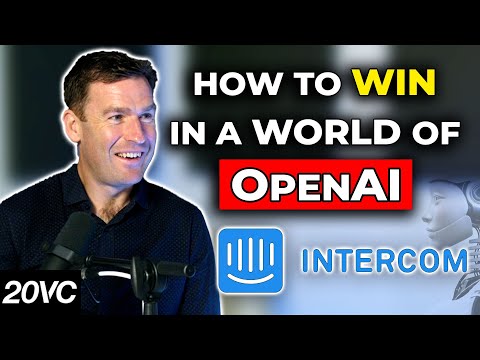
Des Traynor: How to Survive and Thrive in a World of OpenAI | E1082
Des Traynor (guest), Harry Stebbings (host), Narrator, Narrator
In this episode of The Twenty Minute VC, featuring Des Traynor and Harry Stebbings, Des Traynor: How to Survive and Thrive in a World of OpenAI | E1082 explores des Traynor on AI Moats, Thick Wrappers, and Surviving OpenAI Des Traynor, co-founder of Intercom, explains how AI is fundamentally reshaping customer support and why many “AI-first” claims are superficial if they don’t change the underlying workflow. He distinguishes “thin wrappers” around LLMs from “thick wrappers” that solve an entire user workflow end-to-end, arguing that the latter will capture durable value. Traynor discusses Intercom’s AI chatbot Fin, how they evaluate and switch between LLMs, and why commoditization of models would actually benefit application-layer companies. He also explores who wins in an AI world (startups vs incumbents), how pricing, margins, culture, and marketing must adapt, and why most B2B marketing and AI features are still largely bullshit.
Des Traynor on AI Moats, Thick Wrappers, and Surviving OpenAI
Des Traynor, co-founder of Intercom, explains how AI is fundamentally reshaping customer support and why many “AI-first” claims are superficial if they don’t change the underlying workflow. He distinguishes “thin wrappers” around LLMs from “thick wrappers” that solve an entire user workflow end-to-end, arguing that the latter will capture durable value. Traynor discusses Intercom’s AI chatbot Fin, how they evaluate and switch between LLMs, and why commoditization of models would actually benefit application-layer companies. He also explores who wins in an AI world (startups vs incumbents), how pricing, margins, culture, and marketing must adapt, and why most B2B marketing and AI features are still largely bullshit.
Key Takeaways
Being truly “AI-first” requires reimagining the workflow, not sprinkling features.
Traynor argues most products claiming to be AI-first are unchanged at their core; real AI-first products redesign the job-to-be-done (like customer support) so that AI performs core workflows rather than just assistive add-ons.
Get the full analysis with uListen AI
Thick wrappers around LLMs will capture more value than thin wrappers.
A thin wrapper is a quick demo (e. ...
Get the full analysis with uListen AI
Don’t build where OpenAI (or platforms) will hit “minimum viable good enough.”
Traynor likens chasing small gaps in a platform to picking coins on train tracks; anything that looks like a generic capability—simple chatbots, basic wealth advice, generic tools—will eventually be absorbed by foundational providers.
Get the full analysis with uListen AI
AI will increase startup mortality and also kill many incumbents’ products.
Many AI startups will die either because they’re thin wrappers or because margins are eaten by LLM costs, while incumbents whose workflows are easily automated (e. ...
Get the full analysis with uListen AI
Future SaaS pricing will shift from per-seat to pricing on work done.
As AI replaces or augments human work, Traynor expects pricing models to move toward value-based or consumption models tied to outcomes (e. ...
Get the full analysis with uListen AI
Marketing must be unique, simple, and genuinely valuable to the right audience.
Most B2B marketing fails because it’s generic, over-polished, and aimed at the wrong people; Traynor stresses clear product marketing, authenticity of voice, and aligning content with the actual buyer, not just maximizing audience size.
Get the full analysis with uListen AI
Founders should resist over-hiring and the vanity of headcount growth.
He views many layoffs as the inevitable result of earlier undisciplined hiring in easy capital markets, arguing that seasoned founders hire slower, keep the office and workload a bit ‘too small,’ and avoid planting the seeds of future riffs.
Get the full analysis with uListen AI
Notable Quotes
“OpenAI will hit some sort of minimum viable ‘what’s good enough for everyone.’ You’re never gonna make money filling in the gaps in a platform.”
— Des Traynor
“There’s a massive difference between a thin science-fair tech demo and an actual fully commercialized product.”
— Des Traynor
“If you were to build a customer support solution today, you’d build it totally different than when Zendesk was started in 2007.”
— Des Traynor
“Advice is almost out of date by the time it’s ‘best practice.’”
— Des Traynor
“You can’t listen to your customers if they’re using your competitor.”
— Des Traynor
Questions Answered in This Episode
How can a startup rigorously test whether it’s building a ‘thick wrapper’ around AI or just a fragile thin layer that OpenAI will eventually obsolete?
Des Traynor, co-founder of Intercom, explains how AI is fundamentally reshaping customer support and why many “AI-first” claims are superficial if they don’t change the underlying workflow. ...
Get the full analysis with uListen AI
What concrete criteria should product teams use to decide when AI truly merits reimagining a category versus being a small additive feature?
Get the full analysis with uListen AI
How should founders model unit economics and margins in AI-heavy products where LLM costs are a substantial share of revenue?
Get the full analysis with uListen AI
In an AI-driven world, what new moats (beyond data and distribution) will matter most for application-layer companies?
Get the full analysis with uListen AI
How can a company practically realign its content and marketing so the audience it builds actually matches its ideal buyers, without sacrificing top-of-funnel reach?
Get the full analysis with uListen AI
Transcript Preview
(instrumental music plays) ... OpenAI will hit some sort of minimum viable kind of what's good enough for everyone. You're never gonna make money (cash register rings) filling and in the gaps in a platform. I liken what we're going through right now to like the (cash register rings) beginning of the internet. It's very big what's happening to both our world of customer service, technology in general. We don't have the luxury of sitting back and watching. There's gonna be a lot of winners and losers and there's gonna be a lot of market share up for grabs, so people are gonna be looking for who's got the good shit.
If you are CEO of Google, what would you change?
I kinda hate what I'm about to say. I'd be-
Des, I am so excited for this. Dude, when, when we did our last one, I remember, it was the first one to break an hour and 15. And I was like, "Fuck, the reasons like this show is why I love doing what I do, and I'd love to do it in person." So I'm thrilled that you're here in person.
I'm happy to be here. I love London and it's awesome to actually do this in person and see the three-dimensional Harry.
(laughs) Most people are like, "Wow, you're actually quite old."
(laughs)
I'm like, "Thank you, yeah."
Yeah.
Age is this kind of strange thing that happens.
Yeah.
Uh, before we dive in, Des, what did you want to be when you were younger? When you were growing up in Ireland as a kid, what did you want to be?
I think it was either a, a professional video games tester, but I kinda knew that wasn't a career, or at least definitely wasn't in the '80s. A sports journalist. I loved soccer and I loved writing, so I really wanted to like write about soccer. I just thought like if I could do that, that would be like the, genuinely the easiest job. I used to actually do it. I used to like, I'd watch a game and I'd write down my match report and I'd get my mom to read it and she'd be like, "Oh, it's very good." I was just passionate about like, I, I think, I love soccer, watching it, and then I literally love writing as well. And I love to, like, I'd always read all of the cover to cover, every sports newspaper, everything, just trying to get a sense of what's the language, how you're supposed to talk, all that sort of stuff.
(laughs) When your mother was like, "You know, that's amazing, darling." And more or less like, "Ah, thanks, Mom." (laughs)
Yeah, yeah, well totally. I mean, thankfully I didn't end up doing that 'cause I have friends who are sports journalists and it doesn't pay as well as they thought it might.
Install uListen to search the full transcript and get AI-powered insights
Get Full TranscriptGet more from every podcast
AI summaries, searchable transcripts, and fact-checking. Free forever.
Add to Chrome