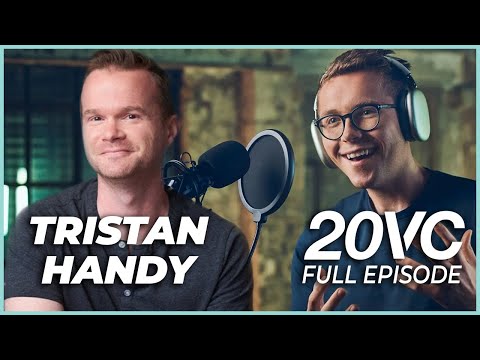
Tristan Handy: Why The CEO Should Make As Few Decisions As Possible | 20VC #937
Harry Stebbings (host), Tristan Handy (guest), Narrator
In this episode of The Twenty Minute VC, featuring Harry Stebbings and Tristan Handy, Tristan Handy: Why The CEO Should Make As Few Decisions As Possible | 20VC #937 explores tristan Handy on Slow-Moats, Community Power, and Decision-Light Leadership Tristan Handy, founder and CEO of dbt Labs, explains how he built dbt by intentionally delaying monetization and fundraising to focus on product quality, community, and defensibility. He argues that startups should move fast in product iteration but slow in turning on revenue and institutional capital, using time as a strategic moat. Handy details his philosophy on hiring for traits over experience, running a highly transparent, asynchronous distributed company, and designing rigorous performance and feedback systems. He also discusses founder–investor alignment, secondaries, and why his job as CEO is to make as few decisions as possible while creating conditions for the team to perform.
Tristan Handy on Slow-Moats, Community Power, and Decision-Light Leadership
Tristan Handy, founder and CEO of dbt Labs, explains how he built dbt by intentionally delaying monetization and fundraising to focus on product quality, community, and defensibility. He argues that startups should move fast in product iteration but slow in turning on revenue and institutional capital, using time as a strategic moat. Handy details his philosophy on hiring for traits over experience, running a highly transparent, asynchronous distributed company, and designing rigorous performance and feedback systems. He also discusses founder–investor alignment, secondaries, and why his job as CEO is to make as few decisions as possible while creating conditions for the team to perform.
Throughout, he contrasts traditional blitzscaling dogma with a more measured, principle-driven approach that prioritizes community needs, long-term trust, and efficiency over headline growth metrics.
Key Takeaways
Use time as a weapon: move fast on product, slow on monetization.
dbt Labs iterated quickly on open-source dbt but intentionally waited years to monetize, funding work via consulting. ...
Get the full analysis with uListen AI
Hire for traits and shared mental models, not resumes and prior titles.
Handy looks for people he can “lock in” with intellectually—clear thinkers who are direct, hardworking, and values-aligned—rather than insisting on prior experience running a function at scale. ...
Get the full analysis with uListen AI
Design formal, honest performance reviews that surface discomfort on purpose.
dbt Labs runs quarterly, hour-long reviews with the employee, manager, and a third person, with the explicit goal that something uncomfortable must be said. ...
Get the full analysis with uListen AI
Separate ‘distributed and async’ from ‘fully remote’ and invest in human connection.
Handy thinks working alone at home is “lonely and dehumanizing,” but distributed, asynchronous companies can be great if they provide out-of-home work budgets, thoughtfully designed satellite offices, and cultural norms that privilege written communication and minimal meetings.
Get the full analysis with uListen AI
Delay fundraising and be clear-eyed about what you trade for VC money.
He frames fundraising as trading founder freedom and smaller-but-certain outcomes for the possibility of much larger scale, especially when serving Fortune 500 customers. ...
Get the full analysis with uListen AI
Build real transparency, especially around financing, within privacy limits.
After employees were frustrated by learning about a Series B only after closing, dbt shifted to pre-announcing likely fundraises and holding a 30-day no-term-sheet window so staff could make informed decisions about exercising options, while still protecting individual privacy around exits and compensation.
Get the full analysis with uListen AI
A high-performing CEO minimizes personal decision-making and maximizes system design.
Handy explicitly tries to make as few decisions as possible, focusing instead on setting principles, aligning stakeholders, and building processes (like async norms and feedback systems) that let the organization make good decisions without him as the bottleneck.
Get the full analysis with uListen AI
Notable Quotes
“I don't think that a lot of our jobs, including my job, are that hard.”
— Tristan Handy
“One of the strategic levers I've tried to use is to use time as a weapon.”
— Tristan Handy
“You should take a really long time to get on that treadmill, because you can't really get off once you do.”
— Tristan Handy
“Working remotely is terrible, but distributed companies are amazing.”
— Tristan Handy
“I try to make as few decisions as possible.”
— Tristan Handy
Questions Answered in This Episode
How can an early-stage founder practically decide how long to delay monetization and fundraising without missing a market window?
Tristan Handy, founder and CEO of dbt Labs, explains how he built dbt by intentionally delaying monetization and fundraising to focus on product quality, community, and defensibility. ...
Get the full analysis with uListen AI
What concrete signals should you look for in an interview to detect the kind of ‘clear mind and willingness to speak it’ that Handy values over direct experience?
Throughout, he contrasts traditional blitzscaling dogma with a more measured, principle-driven approach that prioritizes community needs, long-term trust, and efficiency over headline growth metrics.
Get the full analysis with uListen AI
How do you prevent radical transparency about company finances and fundraising from causing anxiety, rumors, or misinterpretation among employees?
Get the full analysis with uListen AI
What are the first three policy or process changes a colocated company should make if it seriously wants to become asynchronous-first?
Get the full analysis with uListen AI
In practice, how does a CEO know whether they’re successfully delegating decisions versus simply abdicating responsibility and becoming disconnected from key calls?
Get the full analysis with uListen AI
Transcript Preview
Tristan, this is such a joy to do. As I said to you beforehand, uh, I was sitting with Matt in a restaurant in London, and I said, "Who must I have on the show?" Immediately, Tristan. Uh, and so I'm so excited that we made this happen, and thank you so much for joining me today.
Yeah, absolutely. Um, M- Matt, thank you for always being a cheerleader.
A fantastic cheerleader, by the way. I think I was distracted by the, the steak in front of me. But, uh-
(laughs)
... I would love to start (laughs) with a little bit on you. How did you make your way into the world of startups first? And then how did you come to found DBT most recently?
I was a lost soul, went to, uh, undergrad business school, um, went to work for Deloitte Consulting. I didn't really have any idea what I wanted to do. I spent five years there. Uh, I, you know, still lost, went to, to get my MBA, um, and then I, I had a, a lucky break. Uh, my... One of my good friends from high school and college is Anthony Casalena, and Anthony had founded Squarespace, I don't know, some five or so years before. Things were moving quickly, um, and I ended up spending a year there, um, to, to, uh, to do a bunch of things, but partially to help them raise their Series A. Um, and, uh, it was an environment that I had never seen before. I mean, ju- just the whole concept that I could wear jeans and a T-shirt to work-
(laughs)
... coming from a Deloitte background, was just... I, I, I loved it. I loved that, like, you could just sit down and do the work, and not make PowerPoint slides about doing the work. Um-
(laughs)
... and so I, I just, like, decided that I was never going back. And then, and then the hard thing, honestly, for a, a consultant was to figure out, like, how to make myself useful in this context, because, um, m- the majority of the skills that I had learned to this point in my professional career, uh, were, like, not that useful. Like, I, I wasn't the person who built the product. Um, I wasn't, uh, the person who was going to sell the product. And so I really, uh, doubled down on my data skillset, which had been something that I'd, I'd, uh, been good at for a long time. But, um, I had to figure out ways of making that useful. Um, and for me, that was, was marketing. I, like, learned how to do, uh, performance marketing. I learned how to, like, do... Y- you know, early-stage marketing is, like, highly quantitative. And so I spent my s- um, seven, my first seven years in startups, uh, doing, doing marketing in various shapes and forms.
Install uListen to search the full transcript and get AI-powered insights
Get Full TranscriptGet more from every podcast
AI summaries, searchable transcripts, and fact-checking. Free forever.
Add to Chrome