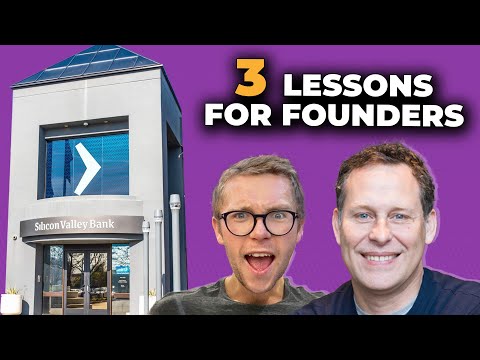
Mike Maples: Lessons from SVB; Crisis Management Tips; USD's Status as the Reserve Currency | E993
Mike Maples (guest), Harry Stebbings (host)
In this episode of The Twenty Minute VC, featuring Mike Maples and Harry Stebbings, Mike Maples: Lessons from SVB; Crisis Management Tips; USD's Status as the Reserve Currency | E993 explores mike Maples on Crisis-Proof Startups, Financial Agility, and Dollar Risk Mike Maples, an early seed investing pioneer, shares concrete lessons founders should take from the Silicon Valley Bank crisis and other shocks like COVID and 2008. He emphasizes scenario planning, financial agility, and disciplined crisis communications as core capabilities, not one-off reactions. Maples argues founders must avoid macro distractions, focus relentlessly on product-market fit, and design systems—banking, capital allocation, and decision-making—that preserve agility under uncertainty. He also voices concern about irresponsible monetary policy and the long-term risk to the U.S. dollar’s reserve status, while outlining how AI is reshaping startup risk profiles.
Mike Maples on Crisis-Proof Startups, Financial Agility, and Dollar Risk
Mike Maples, an early seed investing pioneer, shares concrete lessons founders should take from the Silicon Valley Bank crisis and other shocks like COVID and 2008. He emphasizes scenario planning, financial agility, and disciplined crisis communications as core capabilities, not one-off reactions. Maples argues founders must avoid macro distractions, focus relentlessly on product-market fit, and design systems—banking, capital allocation, and decision-making—that preserve agility under uncertainty. He also voices concern about irresponsible monetary policy and the long-term risk to the U.S. dollar’s reserve status, while outlining how AI is reshaping startup risk profiles.
Key Takeaways
Build explicit scenario plans before crises hit.
Top founders map concrete options (cuts, bridge capital, survival plans) against multiple outcomes (e. ...
Get the full analysis with uListen AI
Design financial agility, not financial sophistication.
Founders shouldn’t become bond or macro experts; instead, they should maintain at least three uncorrelated banking relationships, keep a few months’ runway in each, and pre-set wiring rails and authorizations so money can be moved within minutes when needed.
Get the full analysis with uListen AI
Use a four-part crisis communication playbook.
Leaders should (1) overcommunicate and never hide, (2) be radically transparent about what they know and don’t know, (3) be radically human and meet stakeholders’ fears head-on, and (4) keep everyone focused on forward momentum rather than blame.
Get the full analysis with uListen AI
Adopt a ‘shaper, not reactor’ operating stance.
Borrowing from fighter pilot John Boyd, Maples argues that startups win by making and adjusting decisions faster than the environment or competitors, enabling founders to “get inside the decision loop” of events rather than passively absorbing shocks.
Get the full analysis with uListen AI
Treat product-market fit as the only job in zero-to-one.
Maples and YC’s Michael Seibel observe that truly achieving deep, non-transient product-market fit almost always leads to strong outcomes, while startups that never get it fail regardless of how well they execute on everything else.
Get the full analysis with uListen AI
Structure VC reserves and governance to play offense, not charity.
Floodgate uses a 70/30 initial/reserves split and a dedicated follow-on partner who is independent from the original deal lead, ensuring reserves are concentrated into the best-performing companies rather than emotionally supporting laggards.
Get the full analysis with uListen AI
Prepare for a world of both ‘big T’ technical risk and ‘big M’ market risk in AI.
AI creates startups that require massive compute to solve unambiguously valuable technical problems, while also enabling many teams to build similar products cheaply—forcing founders to pick problems with clear demand and develop strong value-capture strategies.
Get the full analysis with uListen AI
Notable Quotes
“Startups start out dead and have to prove they’re alive.”
— Mike Maples
“Product-market fit isn’t everything, it’s the only thing in a zero-to-one startup.”
— Mike Maples
“What you want is not to become an expert at finances. What you want is to create the conditions where you can move quickly, no matter what happens.”
— Mike Maples
“Are you going to be a shaper or are you going to be a reactor?”
— Mike Maples
“It’s inevitable that the dollar will not be the reserve currency if we are not more responsible with the stewardship of our money.”
— Mike Maples
Questions Answered in This Episode
How should an early-stage founder practically implement scenario planning without overwhelming a small team?
Mike Maples, an early seed investing pioneer, shares concrete lessons founders should take from the Silicon Valley Bank crisis and other shocks like COVID and 2008. ...
Get the full analysis with uListen AI
What specific metrics or signals does Maples use to distinguish true, durable product-market fit from temporary ‘COVID market fit’?
Get the full analysis with uListen AI
In an AI-heavy world where many teams can build similar products, what concrete strategies help a startup capture value rather than see it all flow to customers?
Get the full analysis with uListen AI
How can founders balance the need for radical transparency in crises with legal, regulatory, or reputational constraints on what they can disclose?
Get the full analysis with uListen AI
Given Maples’ concerns about monetary policy and the dollar, should founders change how they think about cash holdings, fundraising timing, or international exposure?
Get the full analysis with uListen AI
Transcript Preview
The Western world has not been adequately responsible with how it treats its money. The solution to every problem has always been, print more money. At some point, that's not gonna work. You know, some people are extreme in their predictions and think that something really catastrophic is gonna happen very soon, other people think not. But it's inevitable that the dollar will not be the reserve currency if we are not more responsible with the stewardship of our money.
(intro music) Mike, I am so excited for this. I always learn so much from our discussions. I'm worried that you're gonna invoice me one day, and I'm gonna get this massive-
(laughs)
... shock from your advice and the bill that comes. But thank you so much for joining me today.
Well, thanks for having me. It's fun to talk to you.
Now, I would love to start, we're gonna focus on actually the lessons that founders can take from what's been happening in the last few weeks with SVB. But I just wanna start, tell us a little bit about yourself, and bluntly, why you're so well-placed to advise early-stage founders on the lessons that they can take from the last few weeks?
Yeah, well, I suppose that you could regard me as one of the OG seed investors. And so, I've been seed investing since, uh, 2005, and, uh, some things have changed a lot, but some things remain the same. And I think that one of the things that I've seen in this situation, and I've seen in other situations like it with COVID or with, uh, the financial crisis of 2008, is that you have a choice about how you want to respond to a crisis, both in the moment and in terms of how you want to get better in the future. And so, uh, to me, that's w- what probably places me well in this situation is that, um, you know, I've seen this movie a few times before, and I've learned, uh, what the best founders do, you know, in response to these different situations and how it makes them better in the future.
I remember when I was 17, I failed all my school exams and I was just a complete failure in my own mind, and my stepfather told me, "It's not that you fail, it's how you respond to failure that determines the type of person you are." And I always remember that one.
Yep, I agree.
Now, I wanna start, now, there's been a lot of, like, analysis on what went wrong, finger-pointing, who to blame, that's not what we're doing today. We're doing the takeaways and the practical lessons that founders can incorporate into their daily roles. So, when we think about lesson number one, you said to me crisis lesson number one is scenario planning. Mike, can you walk me through, what is the scenario planning lessons that founders can and should take away?
Install uListen to search the full transcript and get AI-powered insights
Get Full TranscriptGet more from every podcast
AI summaries, searchable transcripts, and fact-checking. Free forever.
Add to Chrome