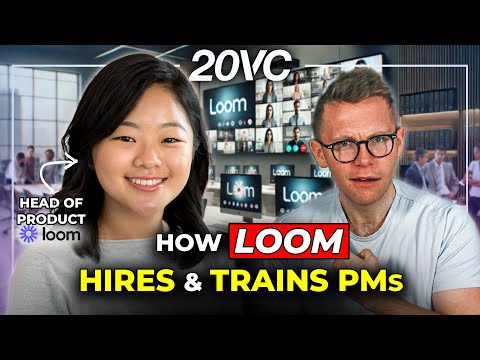
Janie Lee: Three Core Skills that Make the Best PMs | E1165
Janie Lee (guest), Harry Stebbings (host), Narrator
In this episode of The Twenty Minute VC, featuring Janie Lee and Harry Stebbings, Janie Lee: Three Core Skills that Make the Best PMs | E1165 explores janie Lee Reveals Core Product Skills, Talent Density, and Enterprise Shifts Janie Lee, Head of Product at Loom (now within Atlassian), unpacks the skills and mindsets that differentiate great product managers, emphasizing business acumen, product taste, writing, and question-asking. Drawing on experience at Opendoor and Rippling, she explains how low-margin businesses sharpen pricing discipline, why talent density accelerates careers, and what makes a visionary product leader. She breaks down Loom’s transition from pure PLG to enterprise, including pricing, packaging, and making revenue growth a conscious North Star without sacrificing engagement. Throughout, she offers tactical frameworks for hiring PMs, running product reviews, developing product intuition, and using AI as a tool—not a goal—in product strategy.
Janie Lee Reveals Core Product Skills, Talent Density, and Enterprise Shifts
Janie Lee, Head of Product at Loom (now within Atlassian), unpacks the skills and mindsets that differentiate great product managers, emphasizing business acumen, product taste, writing, and question-asking. Drawing on experience at Opendoor and Rippling, she explains how low-margin businesses sharpen pricing discipline, why talent density accelerates careers, and what makes a visionary product leader. She breaks down Loom’s transition from pure PLG to enterprise, including pricing, packaging, and making revenue growth a conscious North Star without sacrificing engagement. Throughout, she offers tactical frameworks for hiring PMs, running product reviews, developing product intuition, and using AI as a tool—not a goal—in product strategy.
Key Takeaways
Join high talent-density teams early; later, your job is to create them.
Early in your career, seek environments where you feel like the least knowledgeable person in the room, as that accelerates growth. ...
Get the full analysis with uListen AI
Own the business, not just the feature—learn the full P&L.
At Opendoor, one mispriced house could erase profits from dozens, forcing PMs to deeply understand margins, outliers, and pricing algorithms. ...
Get the full analysis with uListen AI
Treat product as 60% art (diagnosis) and 40% science (execution).
Frameworks and toolkits are the ‘science’, but the ability to read context—team health, timing, user nuance, and what’s actually needed now—is largely art. ...
Get the full analysis with uListen AI
Systematically build product taste with structured questions and reps.
To improve intuition, repeatedly ask: is the experience as simple as possible, how does it make users feel, does it fit the whole product, and what extra 5–10% would make it delightful? ...
Get the full analysis with uListen AI
Use writing to clarify thinking and scale context, not just document decisions.
Strong PM writing distills the what/why/how so others can make aligned micro-decisions without you in the room. ...
Get the full analysis with uListen AI
Revenue can be a powerful North Star—if you tie it to real value.
Loom’s shift from engagement metrics to revenue growth as the primary North Star forced teams to explicitly connect engagement to monetization and build products important enough that customers will pay for them. ...
Get the full analysis with uListen AI
The PLG-to-enterprise journey requires deliberate organizational and product shifts.
You can’t casually ‘dabble’ in enterprise: you must either commit staffing and roadmap to meet complex requirements (security, compliance, data residency) or stay focused on smaller segments. ...
Get the full analysis with uListen AI
Notable Quotes
“One of the most impactful things you can do is to join companies where there's high talent density—and it's probably the single biggest predictor of career acceleration.”
— Janie Lee
“There is an art in diagnosis and science in how to execute.”
— Janie Lee
“Product leaders often hyper‑optimize for the thing they own; forcing people to think about the entire experience can change the outcome of their solution.”
— Janie Lee
“Questions are cheap, answers are expensive, and the exec review should not try to get through all questions.”
— Janie Lee (quoting a former Opendoor colleague)
“I want users to feel like superheroes… ultimately our job as product people is to make people better than they were before.”
— Janie Lee
Questions Answered in This Episode
How can an early-career PM practically identify and join truly talent-dense teams rather than just ‘brand-name’ companies?
Janie Lee, Head of Product at Loom (now within Atlassian), unpacks the skills and mindsets that differentiate great product managers, emphasizing business acumen, product taste, writing, and question-asking. ...
Get the full analysis with uListen AI
What concrete signals differentiate a visionary product leader like Parker Conrad from a merely competent one—especially before the outcomes are obvious?
Get the full analysis with uListen AI
How should a PLG company decide when to fully commit to enterprise versus deepening its self-serve motion, and what metrics indicate that tipping point?
Get the full analysis with uListen AI
In your own team, how would you measure improvement in ‘product taste’ and intuition over time, beyond subjective impressions?
Get the full analysis with uListen AI
Where is the line between using revenue as a healthy North Star and slipping into short-term, engagement-harming monetization decisions?
Get the full analysis with uListen AI
Transcript Preview
Parker was one of the best product visionaries I've ever had the privilege of working with. He understood the customer like no one could. I think one of the most impactful things you can do is to join companies where there's high talent density, and I think it's probably the single biggest predictor of career acceleration.
Ready to go? Janey, I am so excited for this. I heard so many good things from many different people before, but thank you so much for joining me today.
Of course, and thanks for having me here. I think feeling is mutual. Some of my favorite people have been on the show, and I think I've learned so much, and so, excited to just get into it today.
Honestly, I think it's a joke that this is even my job, but, uh, no one's caught me yet.
(laughs)
I wanna start, though, on, like, the love of product. How did you fall in love with product, and when did you realize that actually-
Oh, yeah.
... this was the thing you really wanted to devote your career to?
I think, taking a way step back, I know you're not asking for my life story, but growing up, I think I just had a lot of the- the innate qualities of- of a PM, I think. On one end, I was just, like, a weird kid growing up that loved leadership. I was the type of middle schooler or high schooler who went to leadership camp. I, uh, actually worked on a statewide nonprofit, trying to- to lead teams of- of teenagers, and I think if you can lead a group of hormonal teenagers, you're- you're on a pretty good (laughs) track for the real world. Um, I was also a humanities, and very much a multidisciplinary background person. I studied public policy, African American studies. And so, I think everything I did in college was writing and- and clarity to thought. I might have taken, maybe, two multiple-choice exams, but I was pretty much writing straight every day. And, I think, just generally, a- a really curious person. And so, when I got into the real world, I was really fortunate to jump into a rotational program at Box, and my last rotation was on product, and I was like, "Oh, my God. I can do all of these things without sacrificing on- on any one of them?" And knew immediately that this was, like, the- the kind of dynamic job that- that I wanted.
I mean, listen, there- there's many elements that I wanna unpack-
Yeah.
... kind of later on, especially the element of rising. I do wanna just ask, you've worked at some incredible places-
Mm-hmm.
... kind of throughout your years now, and some of them include, obviously, Opendoor and Rippling. And I was told specifically by some people to focus on Opendoor. And first, what was your biggest lessons on pricing from Opendoor?
Install uListen to search the full transcript and get AI-powered insights
Get Full TranscriptGet more from every podcast
AI summaries, searchable transcripts, and fact-checking. Free forever.
Add to Chrome