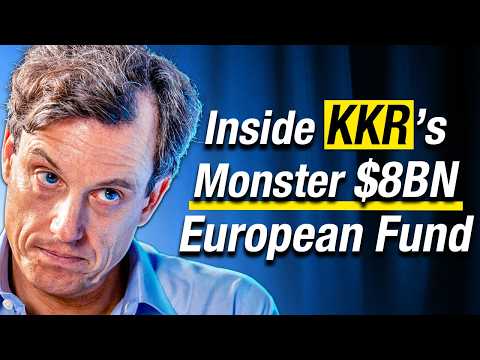
KKR's Head of European PE, Philipp Freise: Do Andreessen & General Catalyst Scare KKR?
Philipp Freise (guest), Harry Stebbings (host)
In this episode of The Twenty Minute VC, featuring Philipp Freise and Harry Stebbings, KKR's Head of European PE, Philipp Freise: Do Andreessen & General Catalyst Scare KKR? explores kKR’s Philipp Freise on Discipline, Liquidity, AI, and Europe’s Future Philipp Freise, Head of European Private Equity at KKR, reflects on lessons from the dot-com era, emphasizing investor selection, humility in bull markets, and rigorous post-mortems on failures. He explains how KKR approaches disciplined capital deployment, concentration, and partnership-style buyouts while navigating extreme macro volatility, AI disruption, and geopolitical risk.
KKR’s Philipp Freise on Discipline, Liquidity, AI, and Europe’s Future
Philipp Freise, Head of European Private Equity at KKR, reflects on lessons from the dot-com era, emphasizing investor selection, humility in bull markets, and rigorous post-mortems on failures. He explains how KKR approaches disciplined capital deployment, concentration, and partnership-style buyouts while navigating extreme macro volatility, AI disruption, and geopolitical risk.
Freise argues that despite liquidity crunches and structural shifts in public markets, private equity remains central to solving demographic and pension funding challenges, especially as retail and insurance capital increasingly enter alternatives. He is bullish on Europe’s potential in defense, space, and innovation, but critical of over-regulation (e.g., EU AI rules) and Europe’s weak capital markets and pension structures.
Throughout, he stresses long-term thinking, owner mindset, and trust over short-term gains, while addressing concerns about AI’s impact on productivity, jobs, wealth concentration, and the future of the US dollar as reserve currency.
Key Takeaways
Investor selection is as critical as idea selection for founders.
Freise’s Venture Park experience showed that misaligned investors (short-term IPO chasers vs long-term corporates) can consume a founder’s energy and derail businesses; he now prioritizes backers who share long-duration, business-building mindsets.
Get the full analysis with uListen AI
Maintain disciplined, roughly linear capital deployment even in crises or bubbles.
KKR targets steady pacing over 4–7 years, slightly leaning in (e. ...
Get the full analysis with uListen AI
Stay within controllable risk; avoid combining operational risk with opaque political risk.
Large losses in Turkey and Ethiopia led KKR Europe to largely avoid emerging-market political and rule-of-law risk, focusing instead on Western Europe where they can better understand and influence outcomes.
Get the full analysis with uListen AI
Owner mindset and capital scarcity discipline drive better decisions than abundant money.
By making executives true equity owners and tying large capex decisions to their own capital at risk, KKR forces hard trade-offs (e. ...
Get the full analysis with uListen AI
Private equity must still produce outliers, not just steady doubles.
Although PE cannot rely on a pure power law like early-stage venture, Freise argues that funds still need a subset of true compounders and must be willing to sell “good but not great” assets when offers are attractive.
Get the full analysis with uListen AI
The future of alternatives depends on broadening access beyond institutions.
Freise believes long-term stability and fairness require retail and 401(k)-style investors to allocate 5–10% to alternatives, so pension savers can benefit from value creation in private markets rather than a small elite.
Get the full analysis with uListen AI
AI will likely boost productivity but can worsen inequality without policy fixes.
He expects AI to create massive value and displace many white-collar roles; unless pension systems and ownership vehicles (like Norway’s sovereign wealth model) spread equity in AI winners widely, social tensions and inequality will intensify.
Get the full analysis with uListen AI
Notable Quotes
“In bull markets, you just gotta keep perspective and humility, and not take yourself for a genius.”
— Philipp Freise
“As a founder, the investors you choose are so important.”
— Philipp Freise
“Arrogance kills.”
— Philipp Freise, recalling a lesson from Henry Kravis
“We are investing against an unbelievable backdrop of risk and volatility and uncertainty, but especially in times like this, you gotta focus on what you can control.”
— Philipp Freise
“The answer is broad-based participation in the alternatives industry.”
— Philipp Freise
Questions Answered in This Episode
How should founders practically evaluate whether potential investors will behave as true long-term partners when markets inevitably turn?
Philipp Freise, Head of European Private Equity at KKR, reflects on lessons from the dot-com era, emphasizing investor selection, humility in bull markets, and rigorous post-mortems on failures. ...
Get the full analysis with uListen AI
Given AI’s speed of value creation, should PE and growth investors reconsider traditional concentration limits to fully capitalize on rare winners?
Freise argues that despite liquidity crunches and structural shifts in public markets, private equity remains central to solving demographic and pension funding challenges, especially as retail and insurance capital increasingly enter alternatives. ...
Get the full analysis with uListen AI
What concrete policy steps would most effectively transition European pension systems toward Norway-style capital accumulation without triggering political backlash?
Throughout, he stresses long-term thinking, owner mindset, and trust over short-term gains, while addressing concerns about AI’s impact on productivity, jobs, wealth concentration, and the future of the US dollar as reserve currency.
Get the full analysis with uListen AI
How can societies mitigate the near-term employment shock from AI while ensuring the resulting wealth is distributed beyond a small group of shareholders?
Get the full analysis with uListen AI
Will expanded retail access to alternatives genuinely democratize wealth, or simply shift more risk onto less sophisticated investors if regulation and education lag?
Get the full analysis with uListen AI
Transcript Preview
I'm a free marketeer. I think tariffs are not the answer. (mouse clicking) We need to work on the underlying issues in our Western democracies. To try to raise money through tariffs is not the right approach. In Turkey, I think we lost around 500 million. What we didn't see was rule of law was a bit of a flexible concept there, and quite frankly, we have so much going on in Western Europe, we just don't take the risk. We stay close to what we can control.
Do you believe the US dollar will be the reserve currency of the world in 10 years? Ready to go? (upbeat music) (mouse clicking) Philipp, I'm so excited for this, dude. Listen, I've wanted to make this one happen for a while. I've heard many good things from Henry and from Johannes at Get Your Guide, so thank you for joining me.
Harry, it's great to be here. Thank you for having me.
Now, when I was chatting to you, Johannes, he was like, "You gotta start with the Venture Park days." Uh, I was about probably four or five years old, uh, not to age you. (laughs) That's a really unfair start. But, um, it was before the SAMwas, and so I had to start here. What are your biggest takeaways from the Venture Park days and that really early Web 1.0?
Yeah, just for your listeners, to put this in context, you're absolutely right, Harry. This was 1999, so this was rock and roll days, the Wild West of venture investing in Europe, really. And I had been a young kid at McKinsey in New York, and I had encountered Thomas Midelhoff, who was that very visionary CEO at that time at Bertelsmann, who loved IdeaLab, you remember, which is still-
I do.
Bill Gross's still going strong today. And really wanted somebody to back, to bring that to Europe. There hadn't been anything like this in Europe, and there wasn't anything. And so we went there in '99, 2000. We raised a pretty big round. Uh, uh, Goldman was our lead investors. There was a lot of people involved. And if you ask me today, what's the lesson, I think... I'm sure Johannes will have, uh, spoken to you about this, because he embodies it perfectly. In bull markets, you just gotta keep perspective and humility, and not take yourself for a genius. So many of us back then, once we had raised, whatever it was, 100 million, thought that was the end of it. I learned very quickly, a few months later, when the dot-com, uh, bubble crashed, and the new n- new market in Germany crashed, that the most important thing, really, was the investors I had, uh, in, on my board. 'Cause there were two camps. One did this to have a quick turnaround, to have a quick IPO, and the other ones wanted to do it literally for eternity, the big corporates, Telefónica, Bertelsmann. They just wanted this to be their window into venture and innovation. And I spent, as a young founder, I think I was 26 at that time, um, all my time intermediating between these two camps. So, my lesson learned is this, and I'm applying it manically in everything I do, and I know Johannes does. As a founder, the investors you choose are so important. So, of course, it makes a huge difference, you know, if you're the founder of Helsing and you choose Daniel Ek, because Daniel Ek understands what long-term business building means. You know, and you don't want those kind of fast buck, financial-orientated, early-stage VCs that, you know, when the shit hits the fan, that drop you very quickly. And I learned that lesson very quickly.
Install uListen to search the full transcript and get AI-powered insights
Get Full TranscriptGet more from every podcast
AI summaries, searchable transcripts, and fact-checking. Free forever.
Add to Chrome