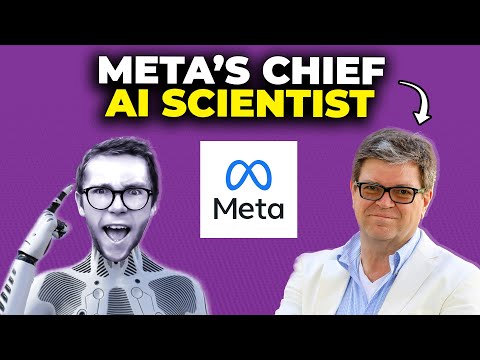
Yann LeCun: Meta’s New AI Model LLaMA; Why Elon is Wrong about AI; Open-source AI Models | E1014
Yann LeCun (guest), Harry Stebbings (host)
In this episode of The Twenty Minute VC, featuring Yann LeCun and Harry Stebbings, Yann LeCun: Meta’s New AI Model LLaMA; Why Elon is Wrong about AI; Open-source AI Models | E1014 explores yann LeCun Predicts AI Renaissance, Dismisses Doom, Champions Open Source Yann LeCun traces his decades-long journey in neural networks, from early work on backpropagation and convolutional nets through the ‘AI winters’ to today’s transformer-based language models. He argues that current large language models are impressive but fundamentally limited: they lack true world understanding, planning, and non-linguistic common sense, and will be superseded by more structured, goal-driven systems.
Yann LeCun Predicts AI Renaissance, Dismisses Doom, Champions Open Source
Yann LeCun traces his decades-long journey in neural networks, from early work on backpropagation and convolutional nets through the ‘AI winters’ to today’s transformer-based language models. He argues that current large language models are impressive but fundamentally limited: they lack true world understanding, planning, and non-linguistic common sense, and will be superseded by more structured, goal-driven systems.
LeCun strongly rejects AI doomerism and the notion of inevitable superintelligent takeover, calling such views a fallacy that confuses intelligence with a desire to dominate and ignores how controllable, objective-driven systems will actually be designed. He believes AI will usher in a new renaissance by augmenting human intelligence, creating at least as many jobs as it displaces, and enabling new forms of creativity and productivity.
He makes a sustained case that open-source AI will outcompete closed, proprietary approaches, citing Linux, Apache, PyTorch, and LLaMA as examples of how shared infrastructure attracts global talent and accelerates progress. LeCun also discusses incentive structures in global research ecosystems, the innovator’s dilemma for incumbents like Google and Meta, and why regulation should target AI products rather than slowing fundamental research.
Key Takeaways
Current large language models are powerful but structurally limited.
Autoregressive LLMs trained only on text lack grounded world models, robust planning, and non-linguistic knowledge, so their ‘intelligence’ is shallow and template-driven rather than truly understanding physical reality and complex action sequences.
Get the full analysis with uListen AI
Future AI systems will be objective-driven planners, not pure next-word predictors.
LeCun envisions architectures that plan actions (including language) to satisfy explicit, multi-objective constraints (e. ...
Get the full analysis with uListen AI
AI doom scenarios rely on flawed assumptions about intelligence and domination.
He argues that wanting to dominate is not an automatic consequence of intelligence—it's an evolved social trait in some species—and that superintelligent systems would only be dangerous if we deliberately gave them both unconstrained agency and domination-like objectives.
Get the full analysis with uListen AI
Open-source AI infrastructure is strategically advantaged over closed platforms.
By opening code and models, organizations can harness the world’s collective ingenuity—students, independent researchers, small teams—to improve, compress, and adapt systems in ways no single firm with finite staff and resources could match, as seen with Linux, Apache, and PyTorch.
Get the full analysis with uListen AI
Smaller, more efficient models will matter as much as massive ones.
LLaMA demonstrated that well-trained, relatively compact models can rival larger proprietary ones, and LeCun expects future architectures with better learning efficiency and planning to require less data and compute while achieving richer intelligence.
Get the full analysis with uListen AI
AI will shift and create jobs rather than eliminate work altogether.
Drawing parallels to agriculture, manufacturing, and PCs, he notes that economists overwhelmingly do not expect a net end to work; instead, productivity gains and new creative and service-oriented professions will emerge, with policy determining how gains are distributed.
Get the full analysis with uListen AI
Regulation should target high-stakes AI products, not basic research.
LeCun supports oversight for applications in areas like healthcare and transportation but calls blanket moratoria or research slowdowns ‘obscurantism,’ likening them to historical opposition to the printing press or jet engines before their benefits were realized.
Get the full analysis with uListen AI
Notable Quotes
“AI is going to bring a new renaissance for humanity, a new form of enlightenment, because AI is going to amplify everybody's intelligence.”
— Yann LeCun
“Those systems do not have anywhere close to human-level intelligence. We are kind of fooled into thinking it because those systems are very fluent with language.”
— Yann LeCun
“My prediction is that within a few years, nobody in their right mind would use autoregressive LMs. They'll go away in favor of something more sophisticated and controllable.”
— Yann LeCun
“Even within the human species, it is not the smartest among us that want to dominate the others.”
— Yann LeCun
“Regulating or slowing down research is complete nonsense, and it's just obscurantism—like people who wanted to stop the printing press.”
— Yann LeCun
Questions Answered in This Episode
What concrete architectural designs or prototypes exist today for the objective-driven, planning-based AI systems LeCun envisions as successors to LLMs?
Yann LeCun traces his decades-long journey in neural networks, from early work on backpropagation and convolutional nets through the ‘AI winters’ to today’s transformer-based language models. ...
Get the full analysis with uListen AI
How can we practically encode and validate ‘safe’ objectives in AI systems at scale, given differing cultural and political values across societies?
LeCun strongly rejects AI doomerism and the notion of inevitable superintelligent takeover, calling such views a fallacy that confuses intelligence with a desire to dominate and ignores how controllable, objective-driven systems will actually be designed. ...
Get the full analysis with uListen AI
If open-source AI infrastructure becomes dominant, what sustainable business models will support the costly training and maintenance of foundational models?
He makes a sustained case that open-source AI will outcompete closed, proprietary approaches, citing Linux, Apache, PyTorch, and LLaMA as examples of how shared infrastructure attracts global talent and accelerates progress. ...
Get the full analysis with uListen AI
How should policymakers distinguish between AI research that should remain unconstrained and AI products that warrant strict regulation and testing?
Get the full analysis with uListen AI
What education and workforce strategies are needed now to ensure workers can transition into the new creative and service-oriented roles AI will help enable?
Get the full analysis with uListen AI
Transcript Preview
AI is going to bring a new renaissance for humanity, a new form of enlightenment, if you want. Because AI is going to amplify everybody's intelligence. It's like every one of us will have a staff of people who are smarter than us and know most things about most topics. So it's going to empower every one of us.
Yann, I am so excited for this. I heard so many great things from our mutual friends, obviously David Marcus and then Matthieu at PhotoRoom. So thank you so much for joining me today.
It's a pleasure.
Now, I would love to start, I heard some of the early stories, but I want to start with one from David Marcus. How did you first enter the world of AI and make that first foray?
I was still an undergraduate, uh, engineering student in France, and I stumbled on a philosophy book which was a debate between, uh, Jean Piaget, you know, the cognitive psychologist, and, uh, Noam Chomsky, the famous linguist. And they were arguing about nature versus nurture for lang- for language, whether language is acquired or innate. So Chomsky was on the side of innate and Piaget on the side of acquired with, you know, some innate structure. And on the side of Piaget was, uh, a guy called Seymour Papert, who was a professor at MIT. In his argument, he talked about something called a Perceptron, which was an early, uh, machine learning system. And I- I read this and discovered that people had been working on, uh, machines that could learn and I was fascinated, and I started digging the literature. Soon discovered that much of that literature was in the 1950s and '60s and basically stopped in the late '60s because of a book, that they killed it, and Seymour Papert was a co-author of that book. Um, so strangely enough. And- and here he was 10 years later actually, uh, praising the Perceptron as kind of a- a amazing concept. So I was hooked. I had s- you know, started getting interested in what was not yet called machine learning, but eventually became neural nets and now deep learning.
Can I ask you? David asked this as well. How long did it take to get... uh, in terms of, like, the major breakthroughs, how long did it take you to get to the major breakthroughs that you're at the origin of when you look back over that time to get to those major breakthroughs?
Well, so there's a- a few breakthroughs. So the first one was, uh, in- in the... when I was still an undergrad basically finishing my engineering studies, uh, I figured out that the- the way forward to kind of lift the limitations of the old systems that were abandoned in the '60s was to find learning algorithms that could train multi-layer neural nets essentially. And people had all but abandoned this, uh, type of research except for a handful of people in Japan.
Install uListen to search the full transcript and get AI-powered insights
Get Full TranscriptGet more from every podcast
AI summaries, searchable transcripts, and fact-checking. Free forever.
Add to Chrome