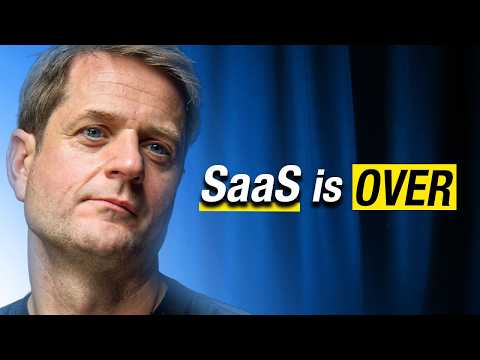
Klarna CEO: SaaS is Dead: Why Systems of Record Will Die in an Agentic World
Sebastian Siemiatkowski (guest), Harry Stebbings (host)
In this episode of The Twenty Minute VC, featuring Sebastian Siemiatkowski and Harry Stebbings, Klarna CEO: SaaS is Dead: Why Systems of Record Will Die in an Agentic World explores klarna CEO on AI reshaping SaaS, banks, and workforces Siemiatkowski’s core claim is that software creation is trending toward near-zero cost, and the next major disruption is AI dramatically reducing data migration friction—breaking the lock-in that underpins many SaaS businesses.
Klarna CEO on AI reshaping SaaS, banks, and workforces
Siemiatkowski’s core claim is that software creation is trending toward near-zero cost, and the next major disruption is AI dramatically reducing data migration friction—breaking the lock-in that underpins many SaaS businesses.
He predicts SaaS “systems of record” are threatened not because enterprises will hand-roll everything, but because agents will make switching and re-composition of tooling far easier, pushing software toward modular “Lego blocks” and broader, bundled “company-in-a-box” experiences.
Klarna is executing an AI-first operating model: consolidating context across the stack, building key AI capabilities in-house (notably customer support), and shrinking headcount roughly 50% largely via attrition while increasing pay per employee.
Strategically, he frames Klarna’s long-term mission (since 2015) as becoming a digital financial assistant and retail-bank-like platform, leveraging proprietary purchase/receipt-level data and US scale to compete more with incumbent banks than with other fintechs.
Key Takeaways
The real SaaS threat is falling data switching costs, not just cheaper code.
He argues AI will soon enable “one-click” migration of data locked in CRMs/ERPs by mapping vendor-specific data models and moving processes automatically, removing a core moat of SaaS: lock-in.
Get the full analysis with uListen AI
SaaS may re-rate toward utility-like multiples in an agentic world.
If switching becomes easy and differentiation erodes, he expects price-to-sales multiples could drift from ~5–10 toward ~1–2 (utility territory), though he views extreme collapses (e. ...
Get the full analysis with uListen AI
“Systems of record” will be rebuilt as AI-first operating systems, not just layered with copilots.
Klarna reduced SaaS usage because siloed tools degrade AI performance; consolidating context and mixing deterministic software with probabilistic AI enables an “operating system of the bank” optimized for agents.
Get the full analysis with uListen AI
Large tech-led companies will often need to build customer support AI in-house.
For Klarna, support quality ultimately requires reading source code and reflecting “truth” versus stale docs; that deep coupling turns customer support AI into part of the core stack, making off-the-shelf tools insufficient at the frontier.
Get the full analysis with uListen AI
AI customer service first removes simple work; premium human service becomes a designed product.
Early gains came from handling basic queries (e. ...
Get the full analysis with uListen AI
Klarna is using AI to grow scope without raising costs—by shrinking the org while expanding roadmap.
He describes cutting from ~7,000 to <3,000 people (mostly attrition), expecting potentially <2,000 by 2030, while launching more banking features without asking the board for incremental budget; employee comp per head rose ~50% as part of sharing productivity gains.
Get the full analysis with uListen AI
AI is a compression technology, which could reduce enterprise compute needs.
He claims enterprises will push toward “one source of truth” (Wikipedia-like discipline) because duplication is economically irrational; this may counterbalance compute demand growth, though entertainment-generation use cases could pull the other way.
Get the full analysis with uListen AI
Notable Quotes
“Software—cost of creating software is going down to zero.”
— Sebastian Siemiatkowski
“The next thing that’s gonna hit everyone bad is the switching cost of data.”
— Sebastian Siemiatkowski
“We need to provide our AI the best context… if your data is separated in these silos… it’s just harder to provide the appropriate context.”
— Sebastian Siemiatkowski
“We’ve gone from seven thousand people… now below three thousand… and I didn’t ask for a single dime to do all this.”
— Sebastian Siemiatkowski
“AI is a compression technology.”
— Sebastian Siemiatkowski
Questions Answered in This Episode
What would “one-click” AI-driven data migration actually require (data model mapping, permissions, audit logs), and who is best positioned to deliver it—incumbents or new entrants?
Siemiatkowski’s core claim is that software creation is trending toward near-zero cost, and the next major disruption is AI dramatically reducing data migration friction—breaking the lock-in that underpins many SaaS businesses.
Get the full analysis with uListen AI
If SaaS becomes modular “Lego blocks,” what remains defensible: distribution, workflow ownership, proprietary data, compliance certifications, or something else?
He predicts SaaS “systems of record” are threatened not because enterprises will hand-roll everything, but because agents will make switching and re-composition of tooling far easier, pushing software toward modular “Lego blocks” and broader, bundled “company-in-a-box” experiences.
Get the full analysis with uListen AI
Klarna reduced SaaS to improve AI context—what specific architectural changes did you make (data layer, knowledge graph, RAG, unified event model) to make agents reliable?
Klarna is executing an AI-first operating model: consolidating context across the stack, building key AI capabilities in-house (notably customer support), and shrinking headcount roughly 50% largely via attrition while increasing pay per employee.
Get the full analysis with uListen AI
On building customer support AI: where exactly did off-the-shelf tools break for Klarna—accuracy, latency, security, integration depth, or inability to interpret source code?
Strategically, he frames Klarna’s long-term mission (since 2015) as becoming a digital financial assistant and retail-bank-like platform, leveraging proprietary purchase/receipt-level data and US scale to compete more with incumbent banks than with other fintechs.
Get the full analysis with uListen AI
Your ‘Uber model’ for support (recruiting passionate customers) improved satisfaction—how do you manage quality control, privacy, and consistency across a gig-style workforce?
Get the full analysis with uListen AI
Transcript Preview
We've gone from seven thousand people, we're now below three thousand. We've shrank fifty percent, and I didn't ask for a single dime to do all this. And the reason for that is because I've seen the acceleration of AI, and I know we can ship all these things on the existing organization.
Is twenty thirty, how many employees do you have then?
Two thousand? No, it may very well be even less than that.
No!
But listen-
Now, we have an incredible episode today. Seb from Klarna is probably one of the leading figures in how to implement and use AI effectively to shrink headcount and make your business way more efficient. This was one of the most wide-ranging conversations we've had.
This is what I signed up for. It is stressful. It was hard as hell, but this is what I wanted. The next thing that's gonna hit everyone bad is the switching cost of data, because- [dramatic music]
Ready to go? [upbeat music] Sebastian, it is so good to have you in the studio, dude. We've done this before-
I know.
-but to have you here in person is fantastic, so thank you for joining me.
I am so happy to be here. This is gonna be a lot of fun.
Dude, this is gonna be great. So this is also gonna be the best show you've ever done.
[chuckles]
You've done a lot of shows. I'm telling you already. But I'm just freewheeling. I had these brilliant notes. Dude, where the fuck is value in a world of Anthropic and Claude code wiping billions of dollars off a stock market? How should I think about that?
Uh, you should think that software-- cost of ca- creating software is going down to zero. That's it. So, uh, and that means that, like, everyone will be able to generate software at any point in time. So it is a massive change, and, uh, I was a hundred percent con-- you know, convicted about this already when I saw this one or two years ago. So I've been-- that's been very, very clear to me.
If the cost of software creation is going down, how do we determine which businesses have sustaining value versus which do not?
So the, the key thing right now is, so far, the only thing that's gone down to, or not to zero yet, but become extremely much cheaper, is the generation of software. The next thing that's gonna hit everyone bad is the switching cost of data, because so far, what you're seeing is you have proprietary data stuck in, for example, the CRM vendor or the, you know, other software as a service that you're using currently. So you may replicate and build the same dashboard or build the same processes in your own tool, but all your data is in there, according to their data model, according to their setup. What's gonna happen is people are gonna start solving that problem. How do I get all of my data from the existing vendor and move it to the new vendor with the help of AI through one click? That brings down switching cost, and that's when the real threat to SaaS comes.
Install uListen to search the full transcript and get AI-powered insights
Get Full TranscriptGet more from every podcast
AI summaries, searchable transcripts, and fact-checking. Free forever.
Add to Chrome