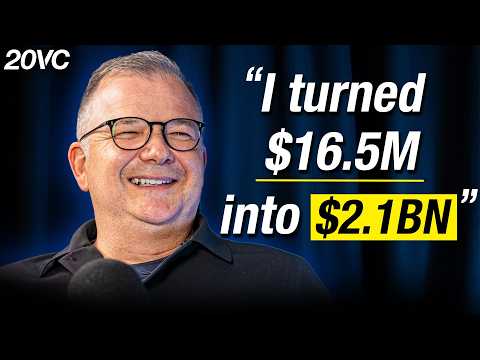
Cem Sertoglu: Lessons from the Greatest Venture Investment in European History | E1228
Cem Sertoglu (guest), Narrator, Harry Stebbings (host)
In this episode of The Twenty Minute VC, featuring Cem Sertoglu and Narrator, Cem Sertoglu: Lessons from the Greatest Venture Investment in European History | E1228 explores inside UiPath’s $2.1B Win And The Craft Of True Seed Investing Cem Sertoglu, founder-turned-investor and early backer of UiPath, breaks down how a $16.5M investment turned into $2.1B and what it revealed about power laws in venture. He contrasts focused, “artisan” early-stage firms with multi-stage asset managers, arguing that great founders choose investors for care, alignment, and time—not just price. The conversation covers how to think about valuation, ownership, reserves, signaling, and board behavior, plus why early-stage rounds should be seen as long-term alignment contracts rather than trades. Sertoglu also reflects on missed deals, loss-making investments, AI bubbles, fund structures, and why patience and discipline matter more than ever in today’s market.
Inside UiPath’s $2.1B Win And The Craft Of True Seed Investing
Cem Sertoglu, founder-turned-investor and early backer of UiPath, breaks down how a $16.5M investment turned into $2.1B and what it revealed about power laws in venture. He contrasts focused, “artisan” early-stage firms with multi-stage asset managers, arguing that great founders choose investors for care, alignment, and time—not just price. The conversation covers how to think about valuation, ownership, reserves, signaling, and board behavior, plus why early-stage rounds should be seen as long-term alignment contracts rather than trades. Sertoglu also reflects on missed deals, loss-making investments, AI bubbles, fund structures, and why patience and discipline matter more than ever in today’s market.
Key Takeaways
Treat early-stage rounds as alignment contracts, not stock trades.
Sertoglu argues that seed and Series A checks are out-of-the-money call options on a distant vision; the real substance is a long-term partnership where founders choose who will occupy a tiny number of high-attention slots on a VC’s cap table for a decade.
Get the full analysis with uListen AI
Founders and markets matter far more than entry price at seed.
He shows that even if UiPath’s seed valuation had been 2x higher, the fund outcome would still have been spectacular; valuation discipline is necessary, but over-focusing on price can cause you to miss power-law winners.
Get the full analysis with uListen AI
Maintain reserves to support misunderstood but promising companies.
UiPath was passed on by dozens of firms multiple times, forcing his fund to bridge it when the market didn’t understand it; this is precisely what reserves should be for—backing conviction when external capital is unavailable.
Get the full analysis with uListen AI
Avoid assuming product–market fit too early and over-scaling GTM.
He sees many companies stall between seed and Series A because they raise too much, hire too fast, and lock into a go-to-market script before truly nailing product–market fit, losing the agility to iterate.
Get the full analysis with uListen AI
Great early-stage investors add value by selective engagement and quiet boards.
Sertoglu emphasizes being deeply prepared but sparing with strong opinions, handling sensitive topics one-on-one, and resisting the social-media-driven urge to “perform value-add” at every meeting.
Get the full analysis with uListen AI
Ownership discipline matters, but dogmatism can be costly.
His funds target 10–20% initial ownership and are willing to pass when they can’t get enough or prices are irrational, yet he acknowledges that in hindsight, tiny stakes in huge winners (like the ElevenLabs example Harry mentions) can still be very meaningful.
Get the full analysis with uListen AI
Fund structure and GP behavior should reflect the true time horizon and risk.
He believes 10-year fund lives are too short for seed, large GP commits can unintentionally make managers more risk-averse, and once companies go public, early-stage VCs should usually hand decisions to LPs via relatively rapid sell-down or in-kind distributions.
Get the full analysis with uListen AI
Notable Quotes
“Every early-stage check is buying a very out-of-the-money call option.”
— Cem Sertoglu
“We turned a $16.5 million investment into $2.1 billion in proceeds.”
— Cem Sertoglu
“Most of the best founders we partner with are looking for co-founder-like partners, not just cash.”
— Cem Sertoglu
“Venture investing is never easy. It’s a very hard profession… the hardest thing people don’t see is how long things take.”
— Cem Sertoglu
“I believe UiPath went from one million to one hundred million ARR in twenty-one months.”
— Cem Sertoglu
Questions Answered in This Episode
How should founders balance taking a higher valuation today against preserving realistic upside for their next round?
Cem Sertoglu, founder-turned-investor and early backer of UiPath, breaks down how a $16. ...
Get the full analysis with uListen AI
What concrete signals can early-stage founders use to know they truly have product–market fit before scaling go-to-market?
Get the full analysis with uListen AI
In a world of AI hype and mega-rounds, where should a seed fund draw the line between rational participation and bubble chasing?
Get the full analysis with uListen AI
How can founders practically evaluate whether a VC will genuinely provide “care” and attention rather than just capital?
Get the full analysis with uListen AI
Given that vintage year is such a strong predictor of returns, what can GPs actually control to outperform their cohort?
Get the full analysis with uListen AI
Transcript Preview
... the best single venture investments. We have 16 and a half million investments that has brought us back 2.1 billion dollars in proceeds. So Fund 1 is 20-time multiple on invested capital. 2.7 of that is non-UiPath, so about 85% of the proceeds of Fund 1 have been UiPath. I believe UiPath went from a million to 100 million ARR in 21 months. At the time, that was, I think, the fastest ever.
Ready to go? (instrumental music plays) Cem, I'm excited for this. So we first did a walk around the park and I was like, "God, I wish this was recorded." So first, thank you so much for joining me.
Thank you, Harry. It's great to be here.
Now, I would love to start, how did you make your way into the world of venture first and come to where you are today? Let's just start there.
I'm a founder-turned-investor. Uh, I started my first company in 1999 in New York. Horribly timed, arguably the worst time in history to start a tech company. Um, it was a company called SelectMinds. Uh, we were building in social networking software, uh, one of the earliest, uh, participants in that space, but hit the crash pretty hard. We survived, ultimately did okay, uh, had a nice exit, and, uh, decided to move to Istanbul, which is where I grew up on Turkish, born and raised in Istanbul, and, uh, initially thinking that was going to be for two years. Uh, when I moved back, I started meeting young Turkish tech companies, mostly consumer internet businesses, and got excited because I, at the time, I think I saw two things that not a lot of people agreed with me on. Um, one is the fact that people behave similarly everywhere, uh, especially in their interaction with technology, with consumer technology. So, uh, at that time, for example, people were telling me, "Oh, you know, uh, people in France will never buy shoes online." And I'm thinking, I look at the US, I look at the UK, and I'm like, "Uh, that's not right. People are people, they're gonna buy shoes online." So, uh, I saw the playing out of consumer internet, uh, in the West and looked for opportunities to, uh, partner with companies that were trying to do the same thing in the rest of the world, uh-
And so you're an angel in these early companies?
I was an angel in these early companies. I got very lucky. I, uh, a few of my early investments turned out to be the biggest exits, uh, at the time in, in the Turkish market. A e-commerce company got sold to eBay, a food delivery company, the leader in Turkey, got sold to Delivery Hero. These were big outcomes, largest exits. So it started to build a ... if it were a commodity, it would be the same thing to raise from a Sequoia, or from us, or from 20VC, or, uh, or from your, uh, you know, dentist who's angel investing. And we all know that that's not the same thing for a founder to be ... It's, you know, it's not cash is green and all equal. So I don't think it is getting commoditized because it's limited. It's, uh, you cannot scale it by just pouring money on it. I think that's what commoditation- commodization implies.
Install uListen to search the full transcript and get AI-powered insights
Get Full TranscriptGet more from every podcast
AI summaries, searchable transcripts, and fact-checking. Free forever.
Add to Chrome