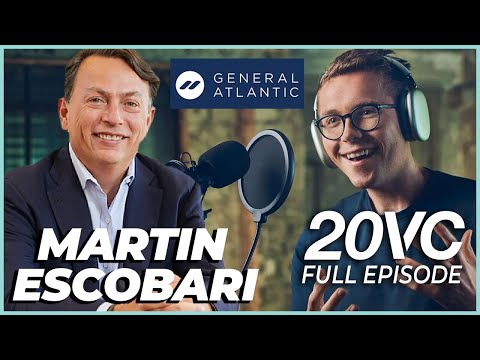
Martin Escobari: How to Invest During a Recession; Negotiation Tips; Developing Markets | 20VC #948
Harry Stebbings (host), Martín Escobari (guest)
In this episode of The Twenty Minute VC, featuring Harry Stebbings and Martín Escobari, Martin Escobari: How to Invest During a Recession; Negotiation Tips; Developing Markets | 20VC #948 explores investor Martin Escobari Explains Surviving Downturns, Fair Deals, Global Ambition Martin Escobari, Co‑President of General Atlantic, traces his journey from a small Bolivian town to leading a global growth equity firm, emphasizing how opportunity and education transformed his life. He explains GA’s data‑driven view that market size, business defensibility, and team quality equally drive outlier outcomes, with market size statistically most decisive. Drawing on past bubbles, he details how GA stayed disciplined through the 2020–2021 frenzy, built guardrails against FOMO, and ensured portfolio companies were fully funded heading into the downturn. He also shares his philosophy on negotiation, decision‑making, keeping a youthful mind, and supporting emerging‑market founders who want to build truly global companies.
Investor Martin Escobari Explains Surviving Downturns, Fair Deals, Global Ambition
Martin Escobari, Co‑President of General Atlantic, traces his journey from a small Bolivian town to leading a global growth equity firm, emphasizing how opportunity and education transformed his life. He explains GA’s data‑driven view that market size, business defensibility, and team quality equally drive outlier outcomes, with market size statistically most decisive. Drawing on past bubbles, he details how GA stayed disciplined through the 2020–2021 frenzy, built guardrails against FOMO, and ensured portfolio companies were fully funded heading into the downturn. He also shares his philosophy on negotiation, decision‑making, keeping a youthful mind, and supporting emerging‑market founders who want to build truly global companies.
Key Takeaways
Prioritize large markets, defensible models, and strong teams—don’t trade one off.
GA’s 43 years of data show that size of market, business defensibility, and team capability are the three most statistically significant drivers of entering the top 10% of outcomes, with market size slightly more important because you can’t outgrow a small market.
Get the full analysis with uListen AI
Use past cycles to build structural guardrails against FOMO and over‑deployment.
After getting hurt in 2000, GA decided never to spend a fund faster than ~3 years and to push companies to fully funded plans; this kept them from overpaying in 2021 and ensured 97% of portfolio companies now have enough runway to play offense in the downturn.
Get the full analysis with uListen AI
Recognize bubble signals: everyone getting rich, new made‑up metrics, and ultra‑fast deals.
Escobari flags three late‑cycle indicators: even weak players making easy money, classic valuation methods being abandoned in favor of contrived metrics, and deal timelines collapsing to days or weeks—signals to emphasize liquidity and discipline, not acceleration.
Get the full analysis with uListen AI
Negotiate for a fair price, not a win‑lose outcome, and be willing to walk away.
He backs into valuation from a target ~25% IRR over five years using realistic exit multiples, starts at that fair price, and avoids protracted haggling; having abundant deal flow and respecting his own time makes it easier to say no when alignment isn’t there.
Get the full analysis with uListen AI
In downturns, survival is the primary goal—“just don’t die.”
Escobari’s Submarino story shows that breaking even, shrinking geography, and enduring humiliation (like a buyer walking away) can still lead to massive outcomes once markets recover; companies must stay alive long enough for the cycle to turn.
Get the full analysis with uListen AI
Avoid growth‑at‑all‑costs unless you’re truly in a winner‑take‑all market.
Only a small minority of markets are genuinely winner‑take‑all; in most “winner‑take‑most” arenas, disciplined followers who listen to signals and husband capital often beat overfunded leaders that burn cash and ignore unit economics.
Get the full analysis with uListen AI
Combine checklists with educated intuition for better investment decisions.
GA standardizes memos and checklists to surface all relevant facts and mitigate bias, but Escobari believes the best investors then “close their eyes” and rely on well‑trained intuition, rather than purely mechanical scoring or rigid theses.
Get the full analysis with uListen AI
Notable Quotes
“A starry-eyed dreaming boy is claustrophobic in a world of limited opportunities.”
— Martin Escobari
“The heroes of the entrepreneurial journey are the managers, not the investors. We are the supply lines.”
— Martin Escobari
“You will never outgrow your market.”
— Martin Escobari
“The wheel of fortune always turns. It’s never sunny always and it’s never rainy always. You just have to be alive for the next sunny time.”
— Martin Escobari
“Think of yourself as a vessel, not a kettle. Money is energy passing through you.”
— Martin Escobari
Questions Answered in This Episode
How can early‑stage founders practically assess whether their market is truly winner‑take‑all or just winner‑take‑most?
Martin Escobari, Co‑President of General Atlantic, traces his journey from a small Bolivian town to leading a global growth equity firm, emphasizing how opportunity and education transformed his life. ...
Get the full analysis with uListen AI
Which concrete guardrails could smaller funds or solo GPs adopt to avoid over‑investing at the top of the next cycle?
Get the full analysis with uListen AI
How should emerging‑market founders think about fundraising strategy now that much of the ‘tourist capital’ has exited their regions?
Get the full analysis with uListen AI
In real time, how can investors distinguish between a constrained TAM and a situation like Uber or Twilio where the market can be radically expanded?
Get the full analysis with uListen AI
What specific habits or practices does Escobari use day‑to‑day to keep his mind ‘young’ and guard against fossilized thinking and dogma?
Get the full analysis with uListen AI
Transcript Preview
Martin, I'm so excited for this. Thank you so much for joining me today. I was sitting with Seba the other day from dLocal, and he was telling me how wonderful you've been as a partner to him. So thank you so much for joining me today.
Harry, I love your podcast and I'm honored to be here.
That is very, very kind of you. I, I also love the artwork behind you. It's much cooler than what I've (laughs) got in my background. But I wanna start with a little bit on you. So now, co-president of GA, where did it start and how did you make your way into the world of venture?
I, I come from a tiny town, population 10,000 in the middle of the Bolivian jungle, and I was born in an oil camp to two doctors, parents who were communists. So the first lucky break in this journey that got me from there to here is against their best thinking, they decided to send me to the American school and I learned English. And that was amazing. Uh, when it came to college, I couldn't afford university, so I was limited to only people who offered scholarships, and that happened to be the good universities in the United States. And so I got into Harvard, and Harvard was life-changing to me. And I came as, as a young freshman and I was the first Bolivian in 354 years to come to Harvard College.
Wow.
And it was, uh, revolutionary, life-changing, and, uh, it's an institution that I'm eternally grateful for. Uh, but that was sort of lucky break number two in my life. Lucky break number two, I, I did college and business school at Harvard. Uh, after business school, I decided to go live in Brazil because I found Brazil fabulous. It's exotic, it's tropical, it's beautiful, the music, and I had fallen in love with my Portuguese instructor-
(laughs)
... who is to this day very grateful. So then 20 years in Brazil, uh, and my first tour of duty in Brazil was an entrepreneur. I was co-founder of the, uh, number one e-commerce company in Brazil in the '90s, the late '90s, company called submarino.com, uh, which became the first Brazilian company to go, tech Brazilian company to go public. It's the first, the first big home run IPO in, in, in, in, uh, post-bubble. Um, and in the context of building Submarino, I met General Atlantic, and we had met about 200 investors. And General Atlantic was different for ways that I hope we, we get to explore during the podcast, and I fell in love. Unfortunately, they didn't fall in love with me and they didn't (laughs) invest in Submarino. Uh, they should have, but they didn't. Uh, and so be it. We built Submarino, we took it public, we sold it. Uh, but after that, I got a call back from, from General Atlantic, and the second time around they did love me and they hired me to run their Brazil office, we expanded that to Latin America. Latin America is now about 15% of what we do. We've done very well over the last 10 years thanks to people like Seba and Cesar at Gympass and some of the people that you've int- you, you, you've interviewed. And about five years ago, they invited me to be chair of our global investment committee in New York. Uh, and for some reason they thought I was qualified, and that's what I've been doing for the last five years, helping global entrepreneurs. Glo- and so GA is massive, right? We manage $80 billion, 15 offices globally. We've been around for 41 years. A fabulous firm, and I'm proud to be a partner in the firm.
Install uListen to search the full transcript and get AI-powered insights
Get Full TranscriptGet more from every podcast
AI summaries, searchable transcripts, and fact-checking. Free forever.
Add to Chrome