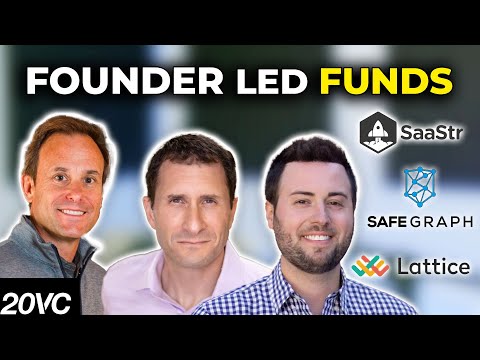
Roundtable #5 with Jack Altman, Auren Hoffman, Jason Lemkin, Harry Stebbings | E1077
Harry Stebbings (host), Jason Lemkin (guest), Auren Hoffman (guest), Jack Altman (guest), Narrator, Harry Stebbings (host), Narrator, Jack Altman (guest)
In this episode of The Twenty Minute VC, featuring Harry Stebbings and Jason Lemkin, Roundtable #5 with Jack Altman, Auren Hoffman, Jason Lemkin, Harry Stebbings | E1077 explores founder-led funds, dual-role CEOs, and the evolving venture playbook The roundtable explores why founders increasingly seek founder-led funds, debating whether operating experience and active company building make for better investors or simply different ones. The guests contrast traditional VCs with “dual-threat” CEOs who both run companies and manage funds, discussing brand, tactical value, governance, and how up-to-date operational knowledge matters. They dig into trade-offs: time allocation, whether investing makes you a worse operator, how much founders should work outside their startup, and if founder-CEOs should be replaced more often. The conversation closes on fund scaling limits, LP appetite for differentiated managers, and how founder-led investors tend to give tougher but longer-term helpful feedback than conventional VCs.
Founder-led funds, dual-role CEOs, and the evolving venture playbook
The roundtable explores why founders increasingly seek founder-led funds, debating whether operating experience and active company building make for better investors or simply different ones. The guests contrast traditional VCs with “dual-threat” CEOs who both run companies and manage funds, discussing brand, tactical value, governance, and how up-to-date operational knowledge matters. They dig into trade-offs: time allocation, whether investing makes you a worse operator, how much founders should work outside their startup, and if founder-CEOs should be replaced more often. The conversation closes on fund scaling limits, LP appetite for differentiated managers, and how founder-led investors tend to give tougher but longer-term helpful feedback than conventional VCs.
Key Takeaways
Founders value founder-investors for current, tactical operating advice.
Operators still in the trenches understand today’s tools, go-to-market motions, and recruiting realities, so their advice is more up-to-date and specific than that of investors who exited a decade ago.
Get the full analysis with uListen
Brand and signal drive demand for founder-led funds as much as experience.
Many founders use brand as a proxy for quality; a well-known operator’s reputation and public work become shorthand for diligence, making “Altman the founder” more compelling than “Altman Capital the firm” alone.
Get the full analysis with uListen
Founder-led capital often comes with tougher, more candid feedback.
Operating founders tend to deliver “kind, not nice” feedback—saying hard things early, similar to demanding customers—because they prioritize long-term outcomes over short-term comfort.
Get the full analysis with uListen
Dual-role operators must time-box investing or risk weakening their company.
Early-stage CEOs generally can’t afford serious investing distractions; only once a company is scaled and marginal CEO hours have diminishing returns does the learning and network from investing justify the time cost.
Get the full analysis with uListen
Extreme founder commitment strongly correlates with at least okay outcomes.
The panelists note that companies where founders remain genuinely at “100%+” effort almost never fully fail; the bigger risk appears when founders mentally check out before the business is truly done.
Get the full analysis with uListen
Venture is trending toward more specialization and team-based execution.
As deal volume explodes, it’s hard for solo GPs to see enough opportunities and do deep diligence; some argue for breaking investing into roles (sourcing, diligence, closing, portfolio support) much like functional specialization in startups.
Get the full analysis with uListen
LPs still want differentiated, edge-driven managers despite a tighter market.
While some LPs are downsizing, those the group sees remain eager to back managers with true differentiation—unique brands, structures, or networks—rather than undifferentiated, average-return funds, including select founder-led vehicles.
Get the full analysis with uListen
Notable Quotes
“Almost everything in running a company has changed over the last seven years.”
— Auren Hoffman
“When I look back at the people who really did me justice in the long term, they told me stuff that sucked to hear on a particular day, but was good over the long term.”
— Jack Altman
“Most good founders have low EQ. I don’t think EQ is one of the highest things on the list.”
— Auren Hoffman
“Eighty-eight percent of SaaS companies that have IPO’d have the founder as CEO at IPO.”
— Jason Lemkin
“We are human, we’re not just a robot. You have other interests…and you have to kind of scratch those itches. The key thing is: are you keeping the main thing the main thing?”
— Auren Hoffman
Questions Answered in This Episode
How should a first-time founder decide between taking a traditional VC lead versus a founder-led fund as their main investor?
The roundtable explores why founders increasingly seek founder-led funds, debating whether operating experience and active company building make for better investors or simply different ones. ...
Get the full analysis with uListen AI
At what stage of a startup’s growth, if ever, does it make sense for a founder-CEO to seriously start investing in other companies?
Get the full analysis with uListen AI
How can founder-led funds maintain rigorous governance and diligence without losing the speed and empathy founders value?
Get the full analysis with uListen AI
If the best companies tend to remain founder-led, under what conditions is replacing the founder actually the right decision?
Get the full analysis with uListen AI
In a world of power-law returns, how should investors balance their time between helping potential breakouts and supporting ‘merely good’ portfolio companies?
Get the full analysis with uListen AI
Transcript Preview
Does investing make you a worse operator? (machine whirring)
I think it does when-
Almost everything in running a company has changed over the last seven years. If you sold your company 10 years ago, you don't know anything about how customer success works, (graphics popping) how new types of sales work. Having somebody who's a little bit more current, that co-founder that you can't hire, can be really appealing. (screen whooshes)
There's many things those of us who've been around for a long time don't like about VCs, (graphics popping) sweating the wrong things. Founder-led funds today are gonna sweat some of the things as much as a traditional investor would be, whose job (graphics popping) is on the line. And I think that's appealing for founders. (screen whooshes)
A lot of founders give much tougher love, or whatever you wanna call it, than I've seen investors do. When I look back at the people who really did me justice in the long term, they told me stuff that sucked (graphics popping) to hear on a particular day, but was good over the long term. So Jason, what is our bet for today?
The bet is... (logo thudding)
I am so excited for this. I've wanted to do this one for quite a while. So we're gonna start off with some intros, quick 30 seconds each. Let's do Jack, Oren, and Jason. Jack, starting with you, who are you? Tell me the two hats. (clicks tongue) Uh, I'm Jack. My founder hat is that I started Lattice in 2015, which is an HR software company. We built a bunch of different products, performance management, employee engagement, compensation, et cetera. Uh, we also now have an HRIS, and so we've kind of built this multi-product company over the years, um, and that's what I spend the majority of my time on. And then over the last four years, I've also become an active early-stage investor, so that's the other one. Orin, over to you.
Sure. Orin Hoffman, CEO of SafeGraph. We're a very boring data company. We sell data on physical places. And then my other hat on the side is, uh, help run Flex Capital. We're a series A, series B, uh, venture capital firm.
Mr. Lemkin?
I'm Jason Lemkin. I run a community and a blog called SaaStr. Uh, and I've been investing for just, just over 10 years now, from a variety of vehicles.
Okay, so we're gonna dive straight in and just try and understand, like, any product which, you know, capital is in some ways, we need to have a reason to exist. Why do founders want other founders as their lead? Let's start with that, and I'm just gonna throw it out into the open and anyone can grab it. Maybe not necessarily lead, but I think at least one of the reasons that founders like to have other founders as investors in general is that it's a good source of tactical advice, um, and general support from somebody who's done the thing that they're doing, and it's relevant. Like, it's not, like, 10 years out of date, which often becomes the case for VCs. My view is actually that I think there's a lot of value to having both active founders and full-time investors, 'cause I think they just provide sort of different perspectives, types of support, vantage points. So I don't encourage founders ever to not have, like, full-time investors involved, but I think both are good. But I think the reasons people want founders are due to just the active hands-on advice that you get from someone who's done what you're doing and is still currently doing it.
Install uListen to search the full transcript and get AI-powered insights
Get Full TranscriptGet more from every podcast
AI summaries, searchable transcripts, and fact-checking. Free forever.
Add to Chrome