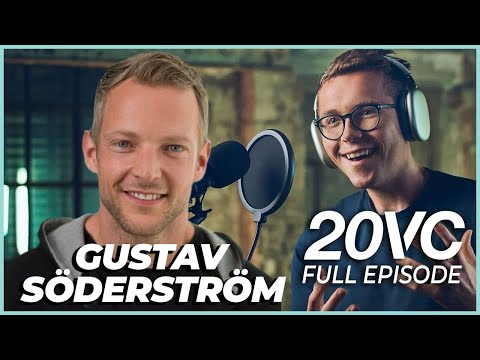
Spotify CTO Gustav Söderström: TikTok's Music; How Olivia Rodrigo Gamed the Algo | 20VC #936
Harry Stebbings (host), Gustav Söderström (guest), Narrator
In this episode of The Twenty Minute VC, featuring Harry Stebbings and Gustav Söderström, Spotify CTO Gustav Söderström: TikTok's Music; How Olivia Rodrigo Gamed the Algo | 20VC #936 explores spotify CTO on macro winds, product bets, and music’s evolving future Spotify CTO/CPO Gustav Söderström recounts his path from failed job seeker to founder to leading Spotify’s product and technology, and how an ownership mindset shapes his leadership. He explains core strategic ideas like never fighting macro winds, deliberately doing the opposite of big competitors, and jumping from well‑optimized but limited "mountains" to taller ones with more upside. The conversation digs into concrete Spotify decisions—mobile freemium, background vs foreground listening, podcasts and video, recommendation over curation, and negotiations with labels—including a near‑death standoff that almost saw a major catalog pulled. Gustav also shares his views on talk-heavy Socratic product culture, synchronizing large organizations, evolving as a leader, and how technology and incentives are reshaping music creation and discovery.
Spotify CTO on macro winds, product bets, and music’s evolving future
Spotify CTO/CPO Gustav Söderström recounts his path from failed job seeker to founder to leading Spotify’s product and technology, and how an ownership mindset shapes his leadership. He explains core strategic ideas like never fighting macro winds, deliberately doing the opposite of big competitors, and jumping from well‑optimized but limited "mountains" to taller ones with more upside. The conversation digs into concrete Spotify decisions—mobile freemium, background vs foreground listening, podcasts and video, recommendation over curation, and negotiations with labels—including a near‑death standoff that almost saw a major catalog pulled. Gustav also shares his views on talk-heavy Socratic product culture, synchronizing large organizations, evolving as a leader, and how technology and incentives are reshaping music creation and discovery.
Key Takeaways
Don’t fight macro winds; reposition to let them push you forward.
Structural shifts like smartphones, broadband, or machine learning can’t be stopped; Spotify’s growth inflected only after it accepted mobile‑first/only usage and rebuilt its model to offer mobile free, rather than clinging to a profitable but outdated "pay for mobility" approach.
Get the full analysis with uListen AI
As a smaller player, avoid mirroring big competitors; occupy the gaps their model can’t serve.
Instead of copying YouTube’s on‑demand foreground music video experience, Spotify licensed and optimized the opposite—background shuffle playback that works exactly where YouTube free stops—capturing the majority of listening use cases.
Get the full analysis with uListen AI
Use debate and models to save expensive build cycles, but accept that models are always incomplete.
Gustav advocates long, structured Socratic debates, multiple mental models, and clear modeling of anomalies (e. ...
Get the full analysis with uListen AI
Big product shifts often mean "jumping mountains"—taking short‑term metric pain for long‑term upside.
When you leave a highly optimized paradigm (a "small mountain") for a higher‑potential one, core metrics often drop while you relearn the terrain; leaders must stomach explaining a year of flat or worse results before new curves (e. ...
Get the full analysis with uListen AI
Licensing constraints deeply shape what’s possible in music products—and can stifle obvious features.
Unlike many consumer apps, Spotify often can’t just build the "best" UX; it must first negotiate the lowest common denominator of rights (lyrics, video, foreground/background, etc. ...
Get the full analysis with uListen AI
Recommendation is replacing curation/social graphs as the dominant discovery mechanism.
Spotify evolved from user playlists and social/curation to editorial and then to ML‑driven recommendation, reflecting a macro shift Mike Mignano calls "social media to recommendation media"—most users won’t invest in self‑curation at scale.
Get the full analysis with uListen AI
Great product leadership combines deep technical literacy with explicit, shareable reasoning—not mystique.
Gustav rejects the idea of product as "art": he repeatedly re‑trained (e. ...
Get the full analysis with uListen AI
Notable Quotes
“You’re just not going to stop these things. The sooner you accept a macro wind and reposition, the better.”
— Gustav Söderström
“If you go up against a bigger company with their strategy, you’re just going to become a lesser version of them.”
— Gustav Söderström
“Writing code is one of the most expensive things you can do. Talk is cheap, so we should do much more of it.”
— Gustav Söderström
“It needs to feel as if the product was built by a single developer for a single user. We’re not doing competitive swimming; we’re doing synchronized swimming.”
— Gustav Söderström
“Incentives and systems drive behavior. You can literally see the chorus moving closer to the beginning of the song.”
— Gustav Söderström
Questions Answered in This Episode
How do you practically distinguish early between a temporary anomaly (like COVID behavior) and a true macro wind that demands a full strategic pivot?
Spotify CTO/CPO Gustav Söderström recounts his path from failed job seeker to founder to leading Spotify’s product and technology, and how an ownership mindset shapes his leadership. ...
Get the full analysis with uListen AI
For a startup facing a powerful platform like YouTube or Apple, how can you systematically identify the "contrarian" positions those incumbents can’t or won’t take?
Get the full analysis with uListen AI
Where is the line between healthy, high‑leverage debate and analysis paralysis in a smaller company that still needs sheer shipping speed to survive?
Get the full analysis with uListen AI
If licensing constraints in music vanished, what specific interactive or "GitHub for music" experiences would most change how artists and fans create together?
Get the full analysis with uListen AI
As recommendation media dominates, how should creators adapt their content and release strategies without becoming entirely dictated by opaque algorithms?
Get the full analysis with uListen AI
Transcript Preview
Gustav, this is an incredibly challenging show for me to do with, like, a serious face because I know you socially. Uh, I think the world of you socially, and so now I get to put on a professional face and welcome you to 20VC. So thank you so much for joining me today.
Thank you for having me. It's an, it's an honor and likewise.
That is, that is very kind. I've also been stalking the shit out of you for the last few days professionally, uh, and so this has been great fun. But I want to start with a little bit on you, Gustav. So tell me, how did you make your way into the world of startups and then come to lead the product org at, you know, one of the generational defining companies of our time with Spotify?
So I'll try to do the, the brief version of the history of my life. Could be a few hours here, but I'll try to do it in a few minutes.
You've got three to four minutes, so just take your time. (laughs)
(laughs) And then we cut. So I'm, I'm sort of actually this, uh, involuntary entrepreneur. I graduated from the Royal Institute of Technology in Stockholm, sort of, uh, electrical engineering, computer science, and then, uh, that was the tail end of the IT crash, so there were literally no jobs to be had. And so I found a group of friends. I wanted to work at one of these big boring Swedish companies, like Ericsson or something.
(laughs)
But I couldn't get a job, so I decided with a bunch of friends to start a company because all these investments had been made during the IT era in, you know, 3G and smartphones and so forth. It was all there, but no one believed in it. So we started this company where you could send text messages over data instead of SMS. And, and already back then, even though you paid per kilobyte, it was still 1/1000 the cost of sending the same, uh, you know, 160 characters over, over text message. And it turns out that people love cheap communication. So that took off in a, in a little bit in, in, uh, Sweden and in the Nordics. The problem was that the carriers back then controlled the world, and they were selling SMS bundles. They didn't like that. So we ended up selling this company to Yahoo! and... because they had the biggest messenger application in the world, but it was desktop only, and they wanted to go big in, in mobile because mobile was starting to happen here, and they had all these relationships with the global carriers. So I ended up working at Yahoo! in Sunnyvale for, for a bit, and I can tell you it was a troubled company already back then.
(laughs)
So fast-forward about two and a half, three years later, and I think four or five CEOs later, I was back in Stockholm trying to figure out what to do, and through a mutual friend I met, uh, Daniel Ek, the founder and CEO, the co-founder and CEO of Spotify. And he showed me this amazing application because Spotify already existed as an ap- application on desktop, and it was simply amazing. But what he wanted, he wanted someone to head up what Spotify mobile was going to be. Because this was 2008, and the iPhone had just come out, but there was no app store yet, and it didn't really have any market share. So the, the world was mostly, you know, Symbian, Sony Ericsson, these, these things. And so I happened to be... you know, I got lucky. I had a moment in time where I knew something, how to develop for lots of different mobile phones that many other people didn't know. So that's how I came into Spotify, starting to head up, uh, product development for mobile.
Install uListen to search the full transcript and get AI-powered insights
Get Full TranscriptGet more from every podcast
AI summaries, searchable transcripts, and fact-checking. Free forever.
Add to Chrome