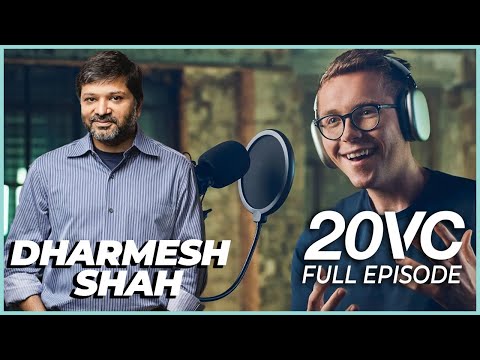
HubSpot Founder Dharmesh Shah: The Ultimate Guide to Company Culture | E896
Harry Stebbings (host), Dharmesh Shah (guest)
In this episode of The Twenty Minute VC, featuring Harry Stebbings and Dharmesh Shah, HubSpot Founder Dharmesh Shah: The Ultimate Guide to Company Culture | E896 explores dharmesh Shah on culture as product, humility, and bold bets Dharmesh Shah, HubSpot’s co-founder, discusses how an introvert built a massive company by treating culture like a product and prioritizing humility, transparency, and low-ego hiring. He explains the concept of “culture debt” and why early hiring mistakes around non-diverse, misaligned people compound for years. Shah outlines how HubSpot tests market risk before product risk, why SMB can be more attractive than enterprise, and his philosophy on pricing, second products, and portfolio-style internal bets.
Dharmesh Shah on culture as product, humility, and bold bets
Dharmesh Shah, HubSpot’s co-founder, discusses how an introvert built a massive company by treating culture like a product and prioritizing humility, transparency, and low-ego hiring. He explains the concept of “culture debt” and why early hiring mistakes around non-diverse, misaligned people compound for years. Shah outlines how HubSpot tests market risk before product risk, why SMB can be more attractive than enterprise, and his philosophy on pricing, second products, and portfolio-style internal bets.
He also shares his personal operating style, insecurities, and how he parents in a radically different financial context than his own upbringing. The conversation ranges from decision-making frameworks with co-founders and resisting the pull to enterprise, to building real communities, angel investing with extreme time constraints, and what systemic changes he expects in how buyers and sellers connect.
Overall, the episode is a practical, candid guide to company culture, product strategy, and founder behavior from someone who has scaled from zero to a global public company.
Key Takeaways
Treat culture like a product you deliberately design and iterate.
Shah argues that culture isn’t slogans on a wall; it should be managed like a product—collect feedback from employees, identify ‘bugs,’ refine over time, and define clear attributes (e. ...
Get the full analysis with uListen AI
Avoid “culture debt” by being intentional about early hires and diversity.
He describes culture debt as the most insidious debt—bad early hires or homogenous founding teams imprint norms that persist long after individuals leave, and you never fully know if you’ve paid off the damage.
Get the full analysis with uListen AI
Hire for low ego and high accomplishment by watching how people assign credit and blame.
The best people share credit when things go right and shoulder responsibility when things go wrong; in interviews and ongoing management, notice whether candidates and employees instinctively do this.
Get the full analysis with uListen AI
Test market risk early by charging money, even for imperfect products.
Most founders over-focus on product risk; Shah recommends stipulating you can build the product and instead de-risk by selling early, picking a simple price, and using month-to-month contracts to see if customers both buy and stay.
Get the full analysis with uListen AI
Resist the gravitational pull to enterprise if your natural home is SMB.
He warns that as you move upmarket, short-term metrics improve but competition intensifies and you lose the iteration speed and scale advantages of SMB; moving up prematurely, or with an enterprise cost structure, is often misguided.
Get the full analysis with uListen AI
Only launch a second product for truly strategic reasons—and go all in.
Valid reasons include stalled growth, a declining category, or a critical adjacency (as with HubSpot’s move from marketing to CRM); adding a second product massively increases complexity, so it must be a game-changing bet, not a side experiment.
Get the full analysis with uListen AI
Institutionalize boldness by allocating explicit resources to high-upside, risky bets.
To avoid regression to the mean, Shah pushes HubSpot to always invest a non-zero share of people and capital into outlier, 10–100x opportunities, celebrating intelligent failures and repeatedly signaling that risk-taking is expected, not optional.
Get the full analysis with uListen AI
Notable Quotes
“Culture is a product.”
— Dharmesh Shah
“The best people shoulder responsibility but share the credit.”
— Dharmesh Shah
“Culture debt is the most insidious form of debt because you never really know if you’ve paid it off.”
— Dharmesh Shah
“Most founders jump straight into product risk. You should stipulate you can build it and focus on whether there’s a market.”
— Dharmesh Shah
“Over the fullness of time, markets become more efficient.”
— Dharmesh Shah
Questions Answered in This Episode
If culture is a product, what specific ‘features’ or behaviors would your current employees say are missing or buggy in your organization?
Dharmesh Shah, HubSpot’s co-founder, discusses how an introvert built a massive company by treating culture like a product and prioritizing humility, transparency, and low-ego hiring. ...
Get the full analysis with uListen AI
Where might you already be accruing culture debt through tolerated behavior or homogenous teams, and how could you start ‘paying it down’ now?
He also shares his personal operating style, insecurities, and how he parents in a radically different financial context than his own upbringing. ...
Get the full analysis with uListen AI
Looking at your roadmap, are you over-optimizing for product risk and under-testing whether anyone will actually pay and stay?
Overall, the episode is a practical, candid guide to company culture, product strategy, and founder behavior from someone who has scaled from zero to a global public company.
Get the full analysis with uListen AI
Is your push toward enterprise genuinely strategic, or is it a reaction to weak product-market fit and the allure of bigger deals?
Get the full analysis with uListen AI
What percentage of your company’s time and resources are explicitly allocated to bold, high-upside bets—and is that percentage actually non-zero in practice?
Get the full analysis with uListen AI
Transcript Preview
(reversing beeps) Three, two, one, zero. You have now arrived at your destination. Dharmesh, my word, I couldn't be more thrilled to be doing this one. I've wanted to do it for quite a while. So thank you so much for joining me today first.
My pleasure. Thanks for having me. It's been, uh, years in the making. I've been thinking about this for a while now, but my introverted self, I keep pushing back on, uh, podcasts, so...
Listen, I am so thrilled that you agreed to it. I have no idea what made my British accent appealing to do. But, uh, I'm thrilled to make it happen. I wanna start also, I heard a little bit of a context that your wife, Kristen, is the reason that you and Brian got together in the first place, scouting him at an MIT Sloan cocktail party. So, can you take me to that party?
Sure.
What happened between you and Brian, and how that led to HubSpot?
Yeah. So, uh, it's, uh, it's- it's a fun story. So, uh, both Brian and I, um, joined this, uh, class at MIT for grad school, it's part of the business school. And they had this kinda mixer, social cocktail party thing, so the incoming students and the classmates could kinda meet each other, and- and significant others were invited. Um, and you don't know me that well, but the worst possible thing you can do to me is put me in a social environment with a bunch of people I don't know and have me make small talk about things, you know, that I don't know anything about or don't care about. And so, um, 'cause I'm the kinda hyper introvert, and- and there's no exaggeration here. Uh, my wife, on the other hand, is not. She's at the other end of that, uh, of that spectrum. She's super friendly, love- loves meeting people. And so what- what she'll do, um, at these kinds of events though, she'll kinda scout the room. And I'll be hiding in a corner somewhere, and she'll go scout the room, she'll talk to people, she'll be parts of little groups, and then she'll come back with a scouting report. It's like, "Oh, yeah, I met Priya over here, she's awesome, she's from tech, uh, I think you'll really like her." And then she came back, and this is interesting, uh, she came back and said, "Yeah, I met this guy, Brian. I don't know if the two of you are gonna hit it off because he's, you know, he's kinda got a sales background, he's really into sports and the Red Sox," and- and it's like, "You just don't have a lot in common." That was her first, you know... And I've known her, you know, now 25 years, and you know, at the time it has been, you know, 10 to 15 years, so... And I trust her judgment. Like, she knows me and- and she's been right pretty much 100% of the time, except this one time, right? So, um, so then classes start, and, um, and I get- kinda get to know Brian, and he's in there and, like, I remember him, you know, from- from the party because I did say hi that evening. Uh, but it was a very kind of... I wasn't curt, I'm still like a pathologically polite self, um, but, you know, we just, uh, you know, didn't connect more than that kind of very brief interaction at that cocktail party. But then we're taking classes, and- and the more classes I take, the more time ar- I'm around him. I'm like, "A, this guy is smart. Yeah, he may have kinda grown up in sales, but he's like no salesperson." And no disparagement intended to salespeople, they're just different, wired differently than I am. Um, and we just hit it off. And then, you know, about midway through, um, kinda graduating, we started noodling on the possibility of us, like, doing a company together. Um, and so... Which is really weird because the one thing I promised my wife is not that I wouldn't spend time with Brian, she was fine with that, but that I would never do another startup, right? Because I had done startups my entire career, that's all I pretty much knew, uh, and then she had known me even before I had done my first startup. And sh- you know, she likes to joke, uh, somewhat jokingly that it's like, "Oh, if I had known you were gonna be an entrepreneur, I'm not sure that this would've worked out." Because, you know, being married to an entrepreneur is not, uh, the easiest thing in the world. Anyway, so I promised her... And that's why I went back to MIT, I'm like, "I'm gonna go to grad school, I'll go get a PhD," and my kinda path was to kinda teach. That was the original idea. I was not gonna do another startup, I promised her I was not gonna do it. Uh, then Brian and I met and we really hit it off. And the reason HubSpot started was two reasons. One, uh, is just I wanted to work with Brian, and two, we both had a shared passion for SMBs. And we can talk more about that later. But that was the kind of the original, it's, you know, it comes down to a cliche, but it's- it's all about the people and it's like, "Okay, this is someone I want to, like, work with and do something with." Um, and it was kinda natural to do a startup, but anyway, that's the story.
Install uListen to search the full transcript and get AI-powered insights
Get Full TranscriptGet more from every podcast
AI summaries, searchable transcripts, and fact-checking. Free forever.
Add to Chrome