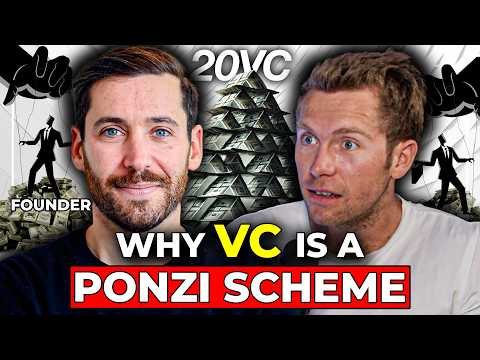
Nicholas Chirls: Why Big VCs Ruin Startups, VC is a Ponzi Scheme Today & Most VCs are Bankers |E1198
Nick Chirls (guest), Harry Stebbings (host)
In this episode of The Twenty Minute VC, featuring Nick Chirls and Harry Stebbings, Nicholas Chirls: Why Big VCs Ruin Startups, VC is a Ponzi Scheme Today & Most VCs are Bankers |E1198 explores nicholas Chirls Explains How Mega VCs Distort Startups And Incentives Nicholas Chirls, founder of Asylum and previously Notation, argues that large venture firms now behave like banks, prioritizing fund size, fee streams, and rapid capital deployment over true company-building and returns. He describes venture’s current incentive structure as a "Ponzi-like" system where management fees and TVPI-driven behavior distort decision-making for both VCs and LPs. Chirls contrasts this with a small, artisanal, thesis-driven model: backing obsessed founders early in markets no one cares about yet, staying lean, and aligning tightly with founders on trust, ownership, and exit decisions. He also explores misalignments between founders and VCs, questions the real value of VC “platform” services, and calls for more honesty about risk, capital intensity, and who should actually be founding companies.
Nicholas Chirls Explains How Mega VCs Distort Startups And Incentives
Nicholas Chirls, founder of Asylum and previously Notation, argues that large venture firms now behave like banks, prioritizing fund size, fee streams, and rapid capital deployment over true company-building and returns. He describes venture’s current incentive structure as a "Ponzi-like" system where management fees and TVPI-driven behavior distort decision-making for both VCs and LPs. Chirls contrasts this with a small, artisanal, thesis-driven model: backing obsessed founders early in markets no one cares about yet, staying lean, and aligning tightly with founders on trust, ownership, and exit decisions. He also explores misalignments between founders and VCs, questions the real value of VC “platform” services, and calls for more honesty about risk, capital intensity, and who should actually be founding companies.
Key Takeaways
Big VCs are optimized for deployment, not outcomes.
Large multi-stage firms behave like banks: junior partners are rewarded for how fast they deploy capital, not the quality of returns, making capital-hungry companies (e. ...
Get the full analysis with uListen
The fee-and-carry model creates Ponzi-like incentives in venture.
Standard 2% management fees over 10 years guarantee GPs ~20% of fund size in fees, even if they never return capital; when LPs and some fund-of-funds are also compensated on paper TVPI, there’s little pressure to mark down or confront permanent loss of capital.
Get the full analysis with uListen
Durable alpha comes from backing things no one cares about yet.
Chirls’ biggest wins (e. ...
Get the full analysis with uListen
Trust beats structure: legal terms rarely save bad relationships.
In real-world outcomes like acquihires, founders and acquirers can route value around investors via retention packages; Chirls argues that preferred vs. ...
Get the full analysis with uListen
Most VC "value-add" is overstated; services don’t decide outcomes.
Chirls has never seen BD or recruiting platforms be the difference between success and failure; the true value a VC can provide is as a deeply trusted, long-term partner helping founders navigate critical strategic and financial decisions, not as a services vendor.
Get the full analysis with uListen
Raising too much too early often harms startups.
High-priced seed rounds (e. ...
Get the full analysis with uListen
Not everyone should be a founder; obsession is the prerequisite.
Chirls stresses that startup building is often “truly awful” even when it works—emotionally, financially, and personally—so people should only do it if they’re genuinely obsessed with a problem, not because culture or Twitter says everyone should be a founder.
Get the full analysis with uListen
Notable Quotes
“Your junior partner at these big firms is sort of like a VP at Goldman. They are compensated and promoted based on money velocity, not money returns.”
— Nicholas Chirls
“The venture Ponzi is you raise a fund, you take 2% management fees for 10 years guaranteed… you don’t have to make a single dollar and you’ve taken 20% of that fund and put it in your pocket.”
— Nicholas Chirls
“The only way I’ve ever made money is to invest in something that no one cares about yet.”
— Nicholas Chirls
“I’ve never found that any VC was truly the difference between success and failure of a company.”
— Nicholas Chirls
“Building a startup is truly awful. It will ruin your life in various different ways… the only people who should do it are the ones who absolutely need to.”
— Nicholas Chirls
Questions Answered in This Episode
If large VCs can still raise mega-funds with index-like returns, what would it actually take—regulatory or market-wise—to force a reset of venture incentive structures?
Nicholas Chirls, founder of Asylum and previously Notation, argues that large venture firms now behave like banks, prioritizing fund size, fee streams, and rapid capital deployment over true company-building and returns. ...
Get the full analysis with uListen AI
How can early-stage founders practically distinguish between an "artisan" small fund that truly stands for something and a boutique that’s just a smaller version of a big bank VC?
Get the full analysis with uListen AI
To what extent should early-stage investors be willing to sacrifice legal protections (e.g., preferred, heavy terms) to win alignment and trust with exceptional founders?
Get the full analysis with uListen AI
How should thoughtful LPs change their diligence and compensation models so they’re not rewarding paper TVPI and fee extraction over realized, long-term DPI?
Get the full analysis with uListen AI
For founders who are truly obsessed but don’t want to get trapped in the high-burn, mega-fund cycle, what does a concrete alternative financing and company-building path look like?
Get the full analysis with uListen AI
Transcript Preview
Your junior partner at these big firms is sort of like a VP at Goldman. They are compensated and promoted based on money velocity, not money returns. What's an ideal company for that model? It's a company that requires insane amounts of capital. Like the foundation models are like a (laughs) a big, big VC firm's dream. They literally require billions and billions of dollars to go buy, effectively, NVIDIA (laughs) GPUs. What is the business model for large venture banks? Deployment. Yeah. It's raise as much money as possible, get that money out the door as soon as possible, and then raise as much money again, and rinse and repeat.
Ready to go? Nick, dude, I am so excited for this. I can't believe it's been quite so many years since we did our last show, but thank you so much for joining me today.
Thank you, Harry. It's a pleasure. We were just talking about this beforehand, but I think the last time we did this show together was almost 10 years ago.
Yeah. Yeah. I was still in Hogwarts back then. Uh, luckily-
Yeah. (laughs)
... uh, Dumbledore let me go. Uh, (laughs) -
(laughs) Nice one.
Uh, I, I want- I wanna-
Nice one.
When we last spoke, you were running Notation. Now we have Asylum. Just talk to me about this. What's changed with Notation and Asylum?
We're launching Asylum this week. Uh, I decided to do a completely insane thing and start an entirely new venture firm, uh, about 10 years into Notation. I ultimately felt like Notation was built for a moment in time. It was the first pre-seed firm in New York and one of the first pre-seed firms in the US, and ultimately, I did not feel like it properly represented who I am and where I think the next 10 years or 15 years of venture go. Um, you know this, Harry, a venture firm is a, a very personal expression of a GP or a set of GPs.
Okay, so Asylum is how big? What check sizes do we write? What's the mission?
$55 million fund. Um, we write 500K to $2 million checks. Um, my mission is, is personal. I mean, I wrote about this in the, in the, in the launch post. Um, can I tell you a quick story?
Yeah, of course.
(laughs)
Love a story.
Okay. Uh, I started my, my first job outta college was at Lehman Brothers in 2007. Uh, I was there for a year, it went bankrupt. I joke that the only good day at Lehman Brothers was the day it went bankrupt for me.
(laughs)
I found startups in New York shortly afterwards, around the financial crisis, and it was everything that Wall Street wasn't. It was creative, and it wasn't all about the money, and there were these young kids building all these creative new things on the internet. It was kind, it was nerdy, it was everything that Wall Street wasn't. I fell in love with it. Fast-forward to 2021, I felt like, um, basically all the same people from Lehman showed up. Highly transactional, all about the money, um, there was no real art or creativity to it. It was very private equity-like, finding the company, dressing it up a little bit, handing it off to the next guy. Um, and I was about as unhappy as I was in 2021 as I was working at Lehman Brothers in 2007. The big firms have gotten huge. Um, they have gigantic AUMs, as you know, and so we now in- internally at Asylum, we call them the big banks. Um, not all that different than Lehman and Goldman and the others back in the day. And (clears throat) my mission now is to provide an alternative to founders, to the big banks, um, and ultimately, over the next five, 10, 15 years, be a gigantic thorn in the si- in the side to the big banks.
Install uListen to search the full transcript and get AI-powered insights
Get Full TranscriptGet more from every podcast
AI summaries, searchable transcripts, and fact-checking. Free forever.
Add to Chrome