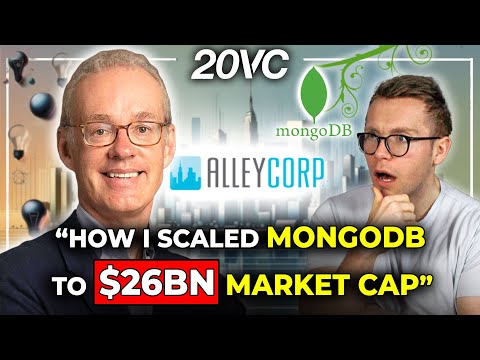
Kevin Ryan: Are the Best CEOs the Best Fundraisers & Why Ownership Should Not Be a Focus in VC|E1138
Kevin Ryan (guest), Harry Stebbings (host)
In this episode of The Twenty Minute VC, featuring Kevin Ryan and Harry Stebbings, Kevin Ryan: Are the Best CEOs the Best Fundraisers & Why Ownership Should Not Be a Focus in VC|E1138 explores kevin Ryan on Venture Discipline, Incubation, and Ignoring Ownership Fetishes Kevin Ryan reflects on building and investing in companies like DoubleClick, MongoDB, Gilt, Business Insider and Meetup, emphasizing the blend of luck, timing, and aggressive execution. He argues that early signs of drive matter more than youthful ‘exceptionalism,’ that markets and people both matter, and that many investors over-index on ownership and price instead of outcome potential. Ryan details AlleyCorp’s research-heavy, company-building model, why his incubations work where others fail, and how he allocates capital, pulls the plug, and thinks about exits. He also addresses macro questions—funding cycles, AI, liquidity, New York’s rise, and politics—while stressing that great CEO selection, not VC “value add,” remains the dominant driver of outcomes.
Kevin Ryan on Venture Discipline, Incubation, and Ignoring Ownership Fetishes
Kevin Ryan reflects on building and investing in companies like DoubleClick, MongoDB, Gilt, Business Insider and Meetup, emphasizing the blend of luck, timing, and aggressive execution. He argues that early signs of drive matter more than youthful ‘exceptionalism,’ that markets and people both matter, and that many investors over-index on ownership and price instead of outcome potential. Ryan details AlleyCorp’s research-heavy, company-building model, why his incubations work where others fail, and how he allocates capital, pulls the plug, and thinks about exits. He also addresses macro questions—funding cycles, AI, liquidity, New York’s rise, and politics—while stressing that great CEO selection, not VC “value add,” remains the dominant driver of outcomes.
Key Takeaways
Early drive matters more than flashy ‘exceptionalism’.
Ryan believes future strong CEOs rarely drift aimlessly; they tend to show early signs of responsibility, focus, and achievement, even if they aren’t teenage unicorn founders, and almost never go from five years of surfing to building billion-dollar companies.
Get the full analysis with uListen AI
Market quality and founder quality must be paired.
He rejects the idea of backing great people in obviously bad markets (e. ...
Get the full analysis with uListen AI
Ownership targets are a distraction; outcome potential is what matters.
Ryan consciously avoids fixating on percentage ownership, preferring to pay up for truly exceptional teams in big, capital-efficient markets, even if that means taking a smaller slice of a much larger, more probable outcome.
Get the full analysis with uListen AI
Incubation can work if it’s focused, expert, and founder-centric.
AlleyCorp’s incubations succeed by doing deep vertical research, bringing in high-caliber CEOs, giving them substantial equity (~40–45%), and concentrating on a few carefully chosen ideas rather than churning out many lightweight projects.
Get the full analysis with uListen AI
Fundraising skill is a critical CEO competency, especially early.
Ryan notes that many great operators are weak fundraisers and get penalized in early rounds; over time numbers matter more, but early-stage success often hinges on a CEO’s ability to tell the story and raise sufficient capital.
Get the full analysis with uListen AI
Most value in VC still comes from picking and supporting the right CEO.
He estimates 90% of value creation comes from the CEO and team; investors add leverage through early help, pattern recognition, and key decisions—especially CEO changes—but they are not the primary drivers of success.
Get the full analysis with uListen AI
Liquidity and VC capital overhang will shape returns for years.
With far more VC capital than opportunities and a constrained IPO/M&A market, Ryan expects prolonged illiquidity; however, he notes that committed capital “will be spent,” especially over a stretched deployment period, keeping venture active but more competitive.
Get the full analysis with uListen AI
Notable Quotes
“The thing I don’t think about is our ownership.”
— Kevin Ryan
“If someone makes you an offer you can’t refuse, don’t refuse it.”
— Kevin Ryan
“It’s not as simple to say, ‘Just back good people.’”
— Kevin Ryan
“By definition, companies only die because they run out of cash. The question is why.”
— Kevin Ryan
“There’s nothing more fun in life than going after a new area… and seeing it work.”
— Kevin Ryan
Questions Answered in This Episode
How should early-stage investors systematically balance market risk versus founder quality when they conflict?
Kevin Ryan reflects on building and investing in companies like DoubleClick, MongoDB, Gilt, Business Insider and Meetup, emphasizing the blend of luck, timing, and aggressive execution. ...
Get the full analysis with uListen AI
What specific signals does Ryan look for to decide whether an incubated idea deserves more capital or should be killed?
Get the full analysis with uListen AI
In a world of powerful incumbents and AI, where are the real greenfield opportunities for startups over the next decade?
Get the full analysis with uListen AI
How can first-time founders who are weak fundraisers realistically improve that skill without sacrificing focus on product and team?
Get the full analysis with uListen AI
Given the current illiquidity, how should VCs and founders rethink their expectations around time-to-exit and interim secondary liquidity?
Get the full analysis with uListen AI
Transcript Preview
There's actually a lot of VC money, tons of cash sitting on the sidelines. That money is not gonna be given back. That money is gonna be spent. Here's the thing that I don't think about, which is our ownership. Sometimes we're paying a big price, and we're paying a big price 'cause it's an incredible team and an incredible opportunity. If someone makes you an offer you can't refuse, don't refuse it. Take it.
Ready to go? (upbeat music) Kevin, I'm so excited for this. Listen, I've heard so many good things from so many people, so thank you so much for joining me, first off.
No, very excited to be here.
Now, this, I know is a weird question, but I just think we're so shaped by our early years in a lot of cases. When you think back to growing up, how would your parents and teachers have described the young Kevin Ryan?
You know, in some ways, I haven't actually either progressed or changed that much from high school. So, you know, in high school, I was interested in, um, I was running student organizations. I was head of the student council. Uh, I did a lot of sports. I was very interested in public policy. And frankly, today, those are still a lot of my interests. You know, I have always been a CEO from a very early age. I was president of my fifth grade class and my sixth grade class. Um, so, you know, people wanted, thought I, I should be elected to do these things, and I love doing them. I love managing people. I love working with people. Uh, I'm still very interested in, in sports, in athletics, uh, and very interested in public policy.
Okay, so we both are in the people selection business. I have this weird thesis that the best people always show early signs of exceptionalism. No one comes out of McKinsey at 28 and suddenly becomes exceptional. They show it in their early years. Do you agree with that? And do you think that the best do show early signs of exceptionalism always?
So we have to define exceptionalism, and we have to think about also not just a job. I think people make a mistake in only looking at the extreme. So yeah, like, oh, Mark Zuckerberg, age 19, you know, dropped out of Harvard, was entrepreneurial. You know, the vast majority of successful CEOs of, of companies are people who, you know, went to good colleges, did well, exceptional, exceptional in that way, may have done two years at McKinsey, um, but were truly interesting. They weren't necessarily crazy entrepreneurial. I'll give you an example. I was the first investor in Ualá, which is a mobile bank in Argentina.
Yeah.
And there's a guy named Pierpaolo Barbieri. It's a... People thought a bank in Argentina is an insane idea. This is six, seven years ago. It's currently worth about $2 billion. I've been on the board since then. He is, you know, was Phi Beta Kappa at Harvard, did work at McKinsey, was truly exceptional, and then now is managing 1,500 people. I, I wouldn't use the McKinsey example that you used. I would say that no one just, you know, is a surfer for five years and then at 26 all of a sudden launches a billion dollar company. That doesn't happen as much. They, they show drive and focus and success before.
Install uListen to search the full transcript and get AI-powered insights
Get Full TranscriptGet more from every podcast
AI summaries, searchable transcripts, and fact-checking. Free forever.
Add to Chrome