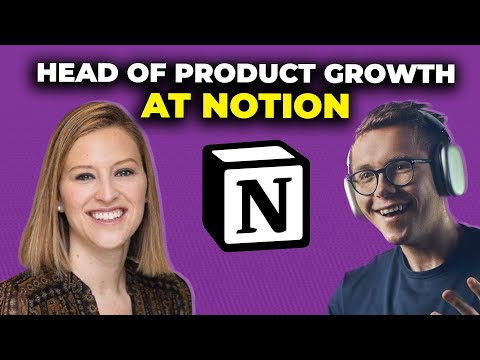
Lauryn Isford: Product Growth Secrets from Facebook, Airtable, BlueBottle, Dropbox & Notion | E1037
Lauryn Isford (guest), Harry Stebbings (host)
In this episode of The Twenty Minute VC, featuring Lauryn Isford and Harry Stebbings, Lauryn Isford: Product Growth Secrets from Facebook, Airtable, BlueBottle, Dropbox & Notion | E1037 explores lauryn Isford Reveals How World-Class Products Engineer Compounding, Sustainable Growth Lauryn Isford, Head of Growth at Notion and former growth leader at Dropbox, Facebook, Blue Bottle, and Airtable, breaks down how modern product-led growth (PLG) really works in practice.
Lauryn Isford Reveals How World-Class Products Engineer Compounding, Sustainable Growth
Lauryn Isford, Head of Growth at Notion and former growth leader at Dropbox, Facebook, Blue Bottle, and Airtable, breaks down how modern product-led growth (PLG) really works in practice.
She defines growth as building mechanisms that systematically kickstart, fuel, and scale business outcomes once product–market fit is in place, emphasizing rigorous data use paired with strong product judgment.
Isford dives deeply into user onboarding, activation metrics, experimentation, and how to successfully layer sales-led motions on top of PLG without internal conflict.
She also shares hiring frameworks for early growth roles, common onboarding and growth mistakes, and what she has learned as an angel investor advising PLG and developer-focused startups.
Key Takeaways
Treat growth as a system to scale proven product–market fit, not a band-aid.
Growth’s job is to build mechanisms that bring in the right users, help them find value quickly, and systematically expand usage and revenue—after the core product already works for a real segment.
Get the full analysis with uListen AI
Onboarding should be assertive, personalized, and progressive—not a wall of tooltips.
High-impact onboarding guides most users through a small number of critical actions, tailored to their use case (e. ...
Get the full analysis with uListen AI
Define activation metrics that are broad, retention-linked, and revisable.
Activation should correlate with long-term retention and include both engagement and a meaningful action, but shouldn’t be so narrow that only a tiny fraction of users qualify; expect to revisit the definition as your product and customer base evolve.
Get the full analysis with uListen AI
PLG and sales-led motions can reinforce each other when designed as one engine.
Early-stage companies should usually focus on a single motion, but at scale you can use self-serve PLG to create a large pool of educated users and then deploy sales to upsell and expand, provided you explicitly manage tradeoffs between self-serve and sales revenue.
Get the full analysis with uListen AI
Hire different growth archetypes for acquisition vs in-product optimization.
For top-of-funnel, hire a growth marketer; for improving activation, conversion, and monetization in-product, hire an engineer or technical PM who can drive meaningful product changes, not just marketing campaigns.
Get the full analysis with uListen AI
Avoid over-reliance on micro-optimizations and constant A/B tests at early stages.
Insisting every change be an experiment and focusing on tiny UX tweaks (e. ...
Get the full analysis with uListen AI
Use retrospectives to separate hypothesis failure from execution failure.
Missing goals can be valuable when the hypothesis is disproven and you learn why; it’s only a problem when poor execution prevented a fair test, so retros should explicitly distinguish between these and update future bets accordingly.
Get the full analysis with uListen AI
Notable Quotes
“I would define growth as the practice of kickstarting, fueling, and scaling business outcomes.”
— Lauryn Isford
“Growing a business is a game of inches.”
— Lauryn Isford
“Time to value is critical. The large majority of users who sign up in a product-led motion will not come back.”
— Lauryn Isford
“An activation metric should correlate with long-term retention… and you should recognize that it will evolve.”
— Lauryn Isford
“The biggest red flag to me is a heavy bias towards experimentation… it suggests an over-focus on optimization rather than an ability to think more critically about how the product serves the user.”
— Lauryn Isford
Questions Answered in This Episode
How should an early-stage startup with very little data practically choose its first activation metric without overfitting to a tiny user base?
Lauryn Isford, Head of Growth at Notion and former growth leader at Dropbox, Facebook, Blue Bottle, and Airtable, breaks down how modern product-led growth (PLG) really works in practice.
Get the full analysis with uListen AI
What are concrete examples of “assertive” onboarding flows that work well for complex horizontal tools beyond Airtable and Notion?
She defines growth as building mechanisms that systematically kickstart, fuel, and scale business outcomes once product–market fit is in place, emphasizing rigorous data use paired with strong product judgment.
Get the full analysis with uListen AI
How can founders detect the right moment to layer in a sales-assisted motion on top of PLG without undermining self-serve growth?
Isford dives deeply into user onboarding, activation metrics, experimentation, and how to successfully layer sales-led motions on top of PLG without internal conflict.
Get the full analysis with uListen AI
In a resource-constrained startup, how would you prioritize between improving onboarding, building new features, and driving top-of-funnel acquisition?
She also shares hiring frameworks for early growth roles, common onboarding and growth mistakes, and what she has learned as an angel investor advising PLG and developer-focused startups.
Get the full analysis with uListen AI
What specific differences should a growth leader keep in mind when moving from a consumer growth role to a B2B SaaS PLG role?
Get the full analysis with uListen AI
Transcript Preview
It's helpful to do an exercise in correlation, and ideally causation, to understand if some early things that users do in the product ultimately correlate with retention, as I mentioned before. But that exercise is not one I would spend too much time on, because the reality is, especially in earlier stages, your customer base is going to evolve and change pretty dramatically in the years following when you define that metric. And you'll probably want to change it and revise it to something that reflects actually what your users are doing today with the features that you've launched, um, rather than the ones that were focused yesterday. So, um, I wouldn't spend too much time really trying to find the perfect metric, recognizing that it will evolve.
Lauren, this is such a joy to do. I've heard so many good things from many prior guests on the show, so thank you so much for joining me today.
Thank you for having me. I'm so excited to be here.
Now, I would love to start, I'd love some context, and I also want to start with a definition, because I get confused by growth. It's thrown around as a word so much. So, how do you define growth and how did you make your way into the world of growth for you?
Great opening question. I would define growth as the practice of kickstarting, fueling, and scaling business outcomes. So, ideally, once you have a product with market fit, you focus on growing and scaling that product by building the mechanisms that fuel and accelerate its growth, that could be bringing more customers to the product, helping those customers get more value, helping them progress to different outcomes. Generally, all of this would be in service of maximizing the number of users or total amount of revenue that a business or a product generates.
So, how, what would you, what would you say then was your first role in growth if you were to diagnose that entry point?
It actually was quite a coincidence. I joined Dropbox as part of a program that they called the Dropbox Rotation Program, where when you graduated from school, they placed you on a variety of teams, and the very first team that I worked on after I graduated was Dropbox's growth team. Uh, I worked for someone named Giancarlo, who now is the CRO at Zapier, who built an incredible growth engine for Dropbox's self-serve business, and that was really my first exposure to the world of growth, which at the time didn't even really have a formal name, but now has become really a staple part of a number of consumer and SaaS software businesses.
So, when I was looking at your history, Lauren, I looked at the incredible companies, and I thought, "We normally do a quick fire round at the end, but there's, like, several amazing companies here that I want to understand what you took from them in a relatively condensed timeframe." And so we're gonna do a quick fire on a lesson from each company and how it impacted your mindset. (laughs) And so I'm gonna start in chronological order. Dropbox, what was the biggest lesson and how did it impact your mindset?
Install uListen to search the full transcript and get AI-powered insights
Get Full TranscriptGet more from every podcast
AI summaries, searchable transcripts, and fact-checking. Free forever.
Add to Chrome