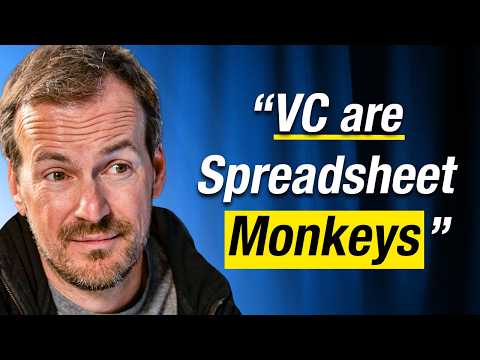
Plural Partner, Taavet Hinrikus: Why Founders Will Realise Multi-Stage Funds Damage Seed Rounds
Taavet Hinrikus (guest), Harry Stebbings (host)
In this episode of The Twenty Minute VC, featuring Taavet Hinrikus and Harry Stebbings, Plural Partner, Taavet Hinrikus: Why Founders Will Realise Multi-Stage Funds Damage Seed Rounds explores founder-VC Taavet Hinrikus Attacks Misaligned Venture Models, Backs Deep Tech Taavet Hinrikus, co-founder of Wise and partner at Plural, explains why traditional venture structures—especially high management fees and multi-stage mega-funds—create deep misalignment with both founders and LPs. He argues early-stage investing should be led by operators with real scar tissue, substantial personal capital at risk, and a genuine belief that each deal can be a 100x outcome, not a safe 5x. Hinrikus outlines Plural’s model: low fees, large GP commitment, GPs co-investing personally in every deal, high-conviction pacing, and brutally honest IC discussions, alongside skepticism of liquidation preferences and oversized boards. He also makes a strong geopolitical case that Europe must rapidly fund sovereign deep tech in defense, energy, space, and security, or risk dependence on the US and China.
Founder-VC Taavet Hinrikus Attacks Misaligned Venture Models, Backs Deep Tech
Taavet Hinrikus, co-founder of Wise and partner at Plural, explains why traditional venture structures—especially high management fees and multi-stage mega-funds—create deep misalignment with both founders and LPs. He argues early-stage investing should be led by operators with real scar tissue, substantial personal capital at risk, and a genuine belief that each deal can be a 100x outcome, not a safe 5x. Hinrikus outlines Plural’s model: low fees, large GP commitment, GPs co-investing personally in every deal, high-conviction pacing, and brutally honest IC discussions, alongside skepticism of liquidation preferences and oversized boards. He also makes a strong geopolitical case that Europe must rapidly fund sovereign deep tech in defense, energy, space, and security, or risk dependence on the US and China.
Key Takeaways
Replace fee-maximizing VC structures with true alignment and GP risk.
Hinrikus criticizes the standard 2–2. ...
Get the full analysis with uListen AI
Only do seed deals where you can plausibly imagine a 100x outcome.
Plural’s bar is that if they can’t see a path to 100x from entry, they won’t do the deal, even if a 5x looks nearly guaranteed. ...
Get the full analysis with uListen AI
Operator-VCs bring better partnership and pre–product-market-fit judgment.
Hinrikus argues most European GPs lack real operating experience, which weakens their ability to assess founders and help before metrics exist. ...
Get the full analysis with uListen AI
Reserves allocation must be a collective, non-automatic decision.
Plural treats follow-on capital as a finite, scarce resource: the lead writes a memo, but reserves require a majority vote because “marking up your own homework” is dangerous. ...
Get the full analysis with uListen AI
Founders should fight hard for dilution and thoughtful cap table design.
Hinrikus calls VCs a commodity and says no investor will truly defend founder ownership; founders must do that themselves. ...
Get the full analysis with uListen AI
Avoid unnecessary friction: rethink liquidation preferences, legal fees, and bloated boards.
He’s skeptical of liquidation prefs at early stage (“we’re here for unlimited upside, 1x downside”) and rejects the norm that companies pay investor legal fees—Plural pays its own from the management company. ...
Get the full analysis with uListen AI
Europe must massively fund sovereign deep tech to secure its future.
Hinrikus believes the Ukraine war and US political volatility prove Europe can’t depend on American defense and critical infrastructure. ...
Get the full analysis with uListen AI
Notable Quotes
“We are a commoditized product, Harry. VCs are a commodity.”
— Taavet Hinrikus
“Fundamentally, the idea of collecting a two, two and a half percent management fee does not really make sense. It does not align us with the outcomes.”
— Taavet Hinrikus
“If we can't imagine 100x, we should not be entertaining the idea of this deal.”
— Taavet Hinrikus
“The only person to fight for your ownership is yourself. No VC will ever fight for the founder’s ownership.”
— Taavet Hinrikus
“Do not be that asshole. There are plenty of stories out there of respectable VCs not picking up the phone during the bad times.”
— Taavet Hinrikus
Questions Answered in This Episode
If founders adopted Plural’s 100x-only mindset, how would that change the types of companies they choose to build and the investors they work with?
Taavet Hinrikus, co-founder of Wise and partner at Plural, explains why traditional venture structures—especially high management fees and multi-stage mega-funds—create deep misalignment with both founders and LPs. ...
Get the full analysis with uListen AI
What practical steps can emerging managers take to reduce fees and increase GP commit without compromising their ability to operate a firm?
Get the full analysis with uListen AI
How can founders best evaluate whether a multi-stage fund writing a small early check will genuinely support them in future rounds versus treating it as an option?
Get the full analysis with uListen AI
What specific policy changes in procurement and regulation would most rapidly unlock deep tech and defense innovation in Europe?
Get the full analysis with uListen AI
How might Europe balance the need for technological sovereignty with the benefits of global collaboration, particularly in AI, defense, and healthcare infrastructure?
Get the full analysis with uListen AI
Transcript Preview
Do not be that asshole. (whoosh) There are plenty of stories out there of respectable VCs not picking up the phone during the bad times. (whoosh) We are a commoditized, uh, product, Harry. VCs are a commodity. You can press 'em down. Fundamentally, the idea of collecting a 2, 2 and a half percent management fee does not really make sense. It does not align us with the outcomes. If we can't imagine 100X, we should not be entertaining this idea of this deal. (upbeat music)
Ready to go? (clicking) Taavo, dude, I'm so excited for this. I've wanted to make this one happen for years, so thank you so much for joining me.
Finally, I'm so glad to be here.
Well, dude, the pleasure is all mine. Now, I want to start before Plural. You were a prolific angel. Can you just start on the investing career there, how it went, whether you liked it, and the transition to Plural?
So I made my first angel investment probably about 20 years ago, and I think, you know, through the years of building, building Wise and still working at Skype, I was like, I met other people who were building businesses. I was excited about what they were doing. I wanted to be part of the journey and wrote the small an- angel ticket. I went into overdrive once I stopped running Wise, doing 30, 40, 50 deals a year. That was fun, you know, but I think it was... It started feeling to me a little bit Wall Street-esque, high-speed deployment. I think it's been... it was a great portfolio strategy, I think the portfolio has done really well, but it felt it wasn't, it wasn't very kind of mission-aligned. I thought there is something more that can be done, and that's kind of was the beginning of thinking, "Hey, we should start Plural. We should really think about getting founders who have scar tissue from building companies to become investors."
What was the single best investment from that period?
So one of the things I, I missed out on investing in Bolt's seed round. I was too busy building, uh, building Wise, but then, a couple years later, I was really impressed with Marcus, and I spent a bunch of time, and I spent a lot of my limited liquidity buying up secondaries in, in Bolt in, like, 2017.
Love that. I mean, Marcus is fantastic, and what a great story. Um, I just want to start, then, with a core question, which is, you said there about it felt a little bit like Wall Street. That kind of hit when you said it, because it made me think of Doug Leone. He said on the show to me that venture has turned from a boutique cottage industry into a commoditized, um, high-volume industry. Do you agree with that transition from boutique community to high-volume commoditized industry?
I think a lot of that rings a bell, but I think we need to unpack that a little bit more. I think, you know, it's very different if you're talking about deploying big checks in mid or late stage. It's very different if you're doing high-speed investing in early stage, kind of what I did as an angel. It's very different to what we do at Plural, which is backing the most ambitious founders, and sometimes there's no one else who wants to back them. I think we need to unpack this into different parts of the venture ecosystem, and different parts, I think, are going through different journeys.
Install uListen to search the full transcript and get AI-powered insights
Get Full TranscriptGet more from every podcast
AI summaries, searchable transcripts, and fact-checking. Free forever.
Add to Chrome