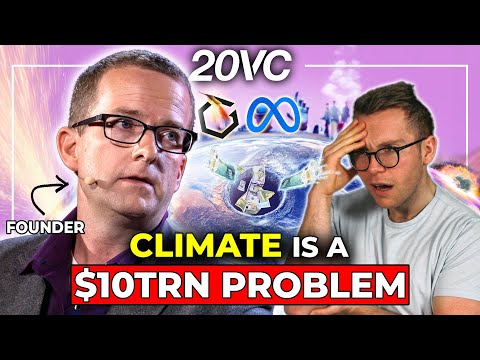
Mike Schroepfer: Former Meta CTO on "Why The Best Leaders are Like Music Conductors" | E1158
Mike Schroepfer (guest), Harry Stebbings (host), Narrator, Harry Stebbings (host)
In this episode of The Twenty Minute VC, featuring Mike Schroepfer and Harry Stebbings, Mike Schroepfer: Former Meta CTO on "Why The Best Leaders are Like Music Conductors" | E1158 explores former Meta CTO explains leadership, climate-tech investing, and the energy future Mike Schroepfer (“Schrep”), former Meta CTO and now climate-tech investor, discusses how his operating experience at scale shapes his views on leadership, boards, and building companies.
Former Meta CTO explains leadership, climate-tech investing, and the energy future
Mike Schroepfer (“Schrep”), former Meta CTO and now climate-tech investor, discusses how his operating experience at scale shapes his views on leadership, boards, and building companies.
He outlines his philosophy of being a board member and investor—backing great teams, managing risk pragmatically, and treating boards as high‑leverage strategic resources, not pass‑fail exams.
The conversation then pivots to climate and energy: why cheap, clean energy is the biggest rate limiter on human progress, how to think about climate-tech financing, and why he’s optimistic about solar, storage, and eventually fusion.
He closes with candid reflections on stress, parenting, money, and why he remains fundamentally optimistic about technology’s ability to improve both the climate and human welfare.
Key Takeaways
Treat leadership like conducting an orchestra, not playing every instrument.
Even with great individual performers, outcomes are poor if people are miscast, misaligned, or playing from different ‘song sheets’; the leader’s core job is role fit, coordination, and making it possible for everyone to do the best work of their lives.
Get the full analysis with uListen AI
Use boards as strategic resources, not as performance juries.
High-functioning boards work when founders bring real strategic dilemmas (e. ...
Get the full analysis with uListen AI
Check inertia regularly; speed matters, but direction still decides your upside.
Teams naturally keep running in whatever direction their first wins pull them, which can trap them in local maxima; founders must periodically zoom out on market size and strategy, balancing ‘move fast’ with recognizing when a problem demands deliberate planning (e. ...
Get the full analysis with uListen AI
In climate tech, design for fast, capital-efficient de‑risking and early revenue.
Schroepfer favors technologies where core technical risk can be proven with tens of millions (not billions), commercial units can be built and replicated, and the value proposition is ‘cheaper or better’ for customers—with climate benefits as a powerful but secondary bonus.
Get the full analysis with uListen AI
Prioritize market and regulatory risk carefully; back teams that can navigate both.
He ranks market risk and regulatory risk as the hardest because they’re largely outside founders’ control, while technical risk is often more assessable; thus he looks for teams with both deep grit and credible paths through policy, timing, and market adoption.
Get the full analysis with uListen AI
Cheap clean energy is becoming the main bottleneck—and the main opportunity.
He argues availability of low-cost, clean power is now the biggest rate limiter on human progress, unlocking everything from synthetic fuels to decarbonized industrial heat, and sees solar plus storage and, later, fusion as likely to dramatically change economics within the next decade or two.
Get the full analysis with uListen AI
As an investor, don’t try to outsmart either the entrepreneur or the market.
His worst misses came from loving a founder but disliking the initial market (only to watch them pivot successfully) or over-falling in love with a technology without enough customer or market proof; he emphasizes humility, asking ‘what must be true for this to be huge? ...
Get the full analysis with uListen AI
Notable Quotes
“I describe a good leader as sort of like a conductor of an orchestra. I can have the best players in the world, but if they're all playing from a different song sheet, it's gonna sound terrible.”
— Mike Schroepfer
“Building a company feels like it's big moments, but it's more a game of inches.”
— Mike Schroepfer
“Availability of cheap, clean energy is probably the biggest rate limiter to human progress right now.”
— Mike Schroepfer
“My thesis is: your pitch to customers is ‘we are cheaper or we are better,’ and then, ‘oh by the way, we're good for the environment.’”
— Mike Schroepfer
“The biggest mistakes I’ve made are trying to outsmart the market or outsmart the entrepreneur.”
— Mike Schroepfer
Questions Answered in This Episode
How can founders practically detect when their organization’s ‘inertia’ is pulling them toward a local maximum instead of the largest long-term opportunity?
Mike Schroepfer (“Schrep”), former Meta CTO and now climate-tech investor, discusses how his operating experience at scale shapes his views on leadership, boards, and building companies.
Get the full analysis with uListen AI
What frameworks can boards and CEOs use together to decide when speed should trump planning, especially in hard-tech or infrastructure-heavy businesses?
He outlines his philosophy of being a board member and investor—backing great teams, managing risk pragmatically, and treating boards as high‑leverage strategic resources, not pass‑fail exams.
Get the full analysis with uListen AI
Given his emphasis on market and regulatory risk, how would Schroepfer advise a climate-tech founder whose product is technically sound but relies on future policy shifts?
The conversation then pivots to climate and energy: why cheap, clean energy is the biggest rate limiter on human progress, how to think about climate-tech financing, and why he’s optimistic about solar, storage, and eventually fusion.
Get the full analysis with uListen AI
How should non-technical investors rigorously assess technical risk in climate and energy companies without over-relying on founder narratives?
He closes with candid reflections on stress, parenting, money, and why he remains fundamentally optimistic about technology’s ability to improve both the climate and human welfare.
Get the full analysis with uListen AI
If clean energy does become abundant and cheap in the 2030s, which entirely new categories of companies or products does Schroepfer expect to emerge first?
Get the full analysis with uListen AI
Transcript Preview
Building a company, it feels like it's big moments, but it's more a game of inches. I describe a good leader as sort of like a conductor of an orchestra. It's like, I can have the best players in the world, but if they're all playing from a different song sheet, it's gonna sound terrible. As I learned more about climate, I'm like, "This is a $10 trillion problem." Availability of cheap, clean energy is probably the biggest rate limiter to human progress right now.
Ready to go? (upbeat music) Schrap, I am so excited for this. As I just said, I spoke to JC, Julien Courdina, I just spoke to Dan Rose. They said wonderful things, so thank you so much for joining me.
I've been so excited. I've gotten a lot of feedback from people who can't wait for me to be on this, so I'm, I'm very excited too.
They said, "Oh my God, poor you. You've gotta spend an hour and a half with Harry? Christ."
(laughs)
Um, listen, I wanna start with a question. I think so much goes back to childhood, honestly. If you were to think about how your parents or your teachers would have described a 10-year-old Schrap, what would they have said and how would they have described you?
I mean, I don't know if nerd was in their lexicon, but probably. I was like, I was thinking about this and I was remembering my dad took me on this one weekend trip to Disney World, and like, they had one of those, like, you know, cartoonish sketch artists or whatever. And I wish I still had it, because like, what they did was like, me at the computer with a little bubble that says, "Oh no, bugs in my software." You know? And this, I was probably 10 or 12 or something like that, 'cause they're like, like, "What are your hobbies and stuff?" And I was like, "I like computers." You know, I was a, I was a kind of nerdy, smart, nice, nice kid. So that's probably what they'd say.
(laughs) I love that. Um, poor you. I mean, what, what a, what a rude cartoonist. Um, listen, I think, I think along the journey, you get many yeses and nos, and they really shape a lot of how you are and how you think. If I ask, what was your most memorable yes, and what was your most memorable no, and how did each shape how you think, what's the first that comes to mind?
It's probably (laughs) gonna be my wife going out with me and then eventually marrying me. So, 'cause I think that that is, like, having a partner in life who's smarter than you and supportive and, and you can work with, um, and build a life together, I think is, is a phenomenal gift. So that's, that's an easy one. That's the yes. I think the nos, you know, it's not one no, it's a rapid sequence of nos in succession, which is when I was trying to raise money for my startup. (laughs)
Install uListen to search the full transcript and get AI-powered insights
Get Full TranscriptGet more from every podcast
AI summaries, searchable transcripts, and fact-checking. Free forever.
Add to Chrome