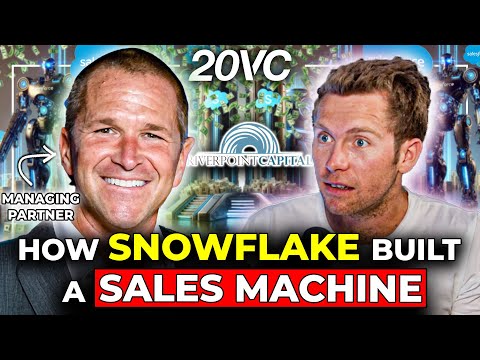
Chad Peets: Why Most Sales Reps Underperform & Remote Reps Ignore Development | E1193
Chad Peets (guest), Harry Stebbings (host)
In this episode of The Twenty Minute VC, featuring Chad Peets and Harry Stebbings, Chad Peets: Why Most Sales Reps Underperform & Remote Reps Ignore Development | E1193 explores chad Peets Explains Why Modern Sales Orgs Fail And Reps Stagnate Chad Peets, longtime sales recruiter and Sutter Hill investor, argues that most founders don’t understand what great sales leadership looks like and therefore hire the wrong CRO, misbuild their orgs, and misalign product and sales. He explains Sutter Hill’s model of hiring a CRO pre‑product to drive true customer discovery, shape the roadmap, and build the sales playbook from day one. Peets lays out how to design profiles, processes, incentives, enablement, and CS so reps actually perform and businesses scale efficiently instead of bloating headcount and missing forecasts. He’s adamant that today’s biggest problem is reps who won’t sacrifice to develop, especially in remote/inside roles, and insists that intensity, development obsession, and in‑office learning still separate top performers from everyone else.
Chad Peets Explains Why Modern Sales Orgs Fail And Reps Stagnate
Chad Peets, longtime sales recruiter and Sutter Hill investor, argues that most founders don’t understand what great sales leadership looks like and therefore hire the wrong CRO, misbuild their orgs, and misalign product and sales. He explains Sutter Hill’s model of hiring a CRO pre‑product to drive true customer discovery, shape the roadmap, and build the sales playbook from day one. Peets lays out how to design profiles, processes, incentives, enablement, and CS so reps actually perform and businesses scale efficiently instead of bloating headcount and missing forecasts. He’s adamant that today’s biggest problem is reps who won’t sacrifice to develop, especially in remote/inside roles, and insists that intensity, development obsession, and in‑office learning still separate top performers from everyone else.
Key Takeaways
Founders usually hire the wrong CRO because they don’t know what ‘great’ looks like.
Peets says the most common mistake to $10M ARR is a mis‑hired CRO who then builds the wrong org; founders need advisors/boards who truly understand elite sales leadership and can define the right profile before hiring.
Get the full analysis with uListen AI
Hire a CRO pre‑product to own discovery and shape the roadmap.
Sutter Hill brings in a CRO before GA so thousands of prospect conversations inform what gets built, which ICP to prioritize, and which features actually expand sellable TAM, instead of hoping engineering guesses right.
Get the full analysis with uListen AI
Great sales orgs hard‑wire collaboration between product and sales around ICP expansion.
The CRO should co‑own the roadmap with product, tying specific features to ICP expansion and headcount plans; if product misses commitments, reps are blocked, forecasts miss, and friction and churn escalate.
Get the full analysis with uListen AI
Process and profile discipline beat ‘committee’ hiring and ad‑hoc interviews.
Peets insists on tight, binary interview steps run only by people expert at selling or qualifying, a clear rep profile, and refusing “my buddy” hires or extra opinionated interviewers (e. ...
Get the full analysis with uListen AI
Incentives must be engineered to drive the exact behaviors the business needs.
Whether it’s paying more on expansion than land, tying reps to the full customer journey, or avoiding over‑booking in consumption models, compensation design is how you prevent misbehavior and unlock the right motion.
Get the full analysis with uListen AI
Customer success should ensure value and utilization, not replace sales in expansion.
Peets believes expansion is still sales; CS should drive implementation, usage, and internal champions while working tightly with AEs, instead of becoming a dumping ground for post‑land revenue responsibility.
Get the full analysis with uListen AI
Top inside sales reps must be in the office and obsessed with development.
He views refusal to commute as a red flag: in‑office reps learn faster, absorb cross‑functional context, and signal they’re willing to sacrifice for career growth—whereas many modern reps, in his view, simply don’t care enough.
Get the full analysis with uListen AI
Notable Quotes
“You need a salesperson to create the sales playbook. What does a VP of engineering know about creating a sales playbook?”
— Chad Peets
“If you have a low gross retention number, you’ve got problems.”
— Chad Peets
“If a sales inside salesperson is not willing to make the sacrifice of a 30‑minute commute every day to further his own career, I don’t want that person.”
— Chad Peets
“If you’re gonna make a decision after three weeks, there needs to be an HR issue. Otherwise, your job is to make that rep successful.”
— Chad Peets
“In order to make the right hire, you first have to know what you’re looking for, and most of them don’t even know what they’re looking for.”
— Chad Peets
Questions Answered in This Episode
How can an early‑stage founder without Sutter Hill’s resources practically implement a ‘CRO pre‑product’ approach?
Chad Peets, longtime sales recruiter and Sutter Hill investor, argues that most founders don’t understand what great sales leadership looks like and therefore hire the wrong CRO, misbuild their orgs, and misalign product and sales. ...
Get the full analysis with uListen AI
What specific traits and career patterns would you use today to define a high‑potential enterprise AE or CRO profile?
Get the full analysis with uListen AI
How should a CEO reset unrealistic revenue targets and headcount plans when a board has already “sold” an aggressive forecast to investors?
Get the full analysis with uListen AI
In a world shifting heavily to remote work, how could a company realistically preserve the in‑office learning advantages Peets values?
Get the full analysis with uListen AI
What concrete steps can a founder take to repair a broken relationship and trust gap between product and sales teams?
Get the full analysis with uListen AI
Transcript Preview
We bring in a CRO pre-product. You need a sales person to create the sales playbook. How- what does a VP of engineering know about creating a sales playbook? Any inside sales person should recognize that by being in the office, they are gonna get better faster. If a sales- inside sales person is not willing to make the sacrifice of a 30-minute commute every day to further his own career, I don't want that person. Y- you have to care and be willing to sacrifice to do exceptional things to be exceptional. And what I find today is people are not willing to do that.
Ready to go? Chad, I don't think I've ever been quite so excited about doing a show following a discussion pre-us starting recording. So, this is gonna be a lot of fun. Thank you for joining me today.
Yeah. No. I appreciate that. Based on the people that, uh, you've interviewed in the past, I- I find that hard to believe, but I'm humbled that you said it, so thank you.
Do you know what also? I spoke to Chris Deignan and Mike Spicer before this show, and like, if you want like hard heavyweights who are incredible at what they do saying someone is the best in the world at what they do, I'm like, "Oh, shit." (laughs)
It's my brothers. It's my brothers.
He's gonna be- he's gonna be good. So I'm looking forward to this. So I wanna start off with just a little bit, though, in terms of context. How did you make your way into sales first? And let's start there.
I'll give you the- the short version, but, um, I saw the movie Wall Street when I was 12 years old, and I knew I wanted to be a stockbroker.
(laughs)
Um, I knew that. So I went to USC. I studied finance. I graduated from USC. I went to Merrill Lynch to be a stockbroker and that was, uh, 1997 and 1998. And at that time, that industry was changing. It was becoming a fee-based industry, less about trading stocks and more about just fee-based. And- and that's not what I wanted to do, one. Two, I was turned off a bit because it was such product pushing. By that I mean, "Hey, go sell this product to your customers. We're gonna charge one and a half points. This is the shit we want you to sell this week." And I didn't feel at the time, like, w- w- does it matter if that's the right product for the customer? It was just, "We're gonna go push that product." The other thing that was clear to me was to be successful in that industry, I was gonna have to accumulate hundreds of millions of dollars in assets. And I was 22 years old, I looked like I was 16, and I would likely have had to call friends and family to raise money, and I was never going to do that. Um, I- I just simply was not comfortable doing that. So at the time, I had a client that came in, and I was doing some financial planning for him. And his wife said to him, "You should hire this kid." And, uh, and I was all arrogant and shit at the time. I was like 22. I was making... I think I made 100 grand my first year outta school. I thought it was all the money in the world. And I s- and I kinda chuckled. I said, "Shit, man. You can't afford me." And, uh, just arrogant and smug. And- and he's like, "How much money you make?" I said, "I make 100 grand this year." He started laughing at me. He said, "You don't even know what real money is. You have no idea." And just put me right in my fucking place. And he said, "Look, I run the largest software sales recruiting firm in the country. I think you could do it. Um, you should come talk to me." "Wow, okay." So, I went and talked to him and decided I'm gonna get into software sales recruiting at, uh, 22 years old. Changed my entire path. I had a wife at home. I was going from making $100,000 to being a- a recruiter with, uh, no base salary, um, and it was all gonna be on me. And I- my wife said, "You're gonna do what?" I said, "Yeah. We're gonna- we're gonna give this a shot." And, uh, first year there, they- they were the largest firm in the country. I was the number one guy at the company first year there. I was the number one guy at the company every year I was there. And then in 2001, the bubble burst, the partners turned on each other, um, and basically both tried to hire me away from the others. And I said, "Hey, look. I- I- I can't be in business with people that are... If you guys are gonna do this to each other, you're gonna do it to me." So I started Pietzen Associates 2001. That's when I- I had that experience.
Install uListen to search the full transcript and get AI-powered insights
Get Full TranscriptGet more from every podcast
AI summaries, searchable transcripts, and fact-checking. Free forever.
Add to Chrome