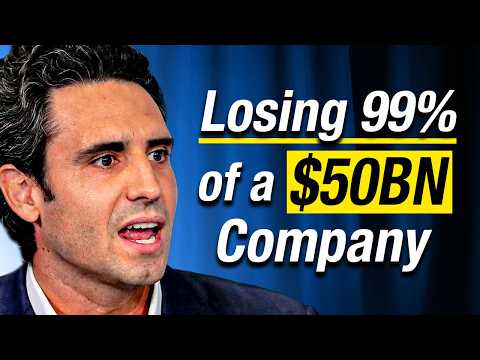
Carvana CEO & Co-Founder, Ernest Garcia: Building a $50B Company, Losing 99% and Coming Back
Ernest (Ernie) Garcia (guest), Harry Stebbings (host)
In this episode of The Twenty Minute VC, featuring Ernest (Ernie) Garcia and Harry Stebbings, Carvana CEO & Co-Founder, Ernest Garcia: Building a $50B Company, Losing 99% and Coming Back explores carvana’s Ernie Garcia on risk, resilience, and ruthless public markets Carvana CEO and co‑founder Ernie Garcia unpacks the company’s journey from an unfundable, capital‑intensive idea to a $50B business that saw its stock fall 99% and then recover. He explains why stubborn conviction, vertical integration, and taking layered risk were essential, and how true near‑death experiences often come from capital scarcity and debt. Garcia contrasts operators and strategists, warns against abstraction and status‑driven hires, and describes how to build resilient teams that don’t disintegrate under public scrutiny. He also dives into parenting, happiness versus achievement, and why being public is a cold but powerful forcing function for discipline and long‑term success.
Carvana’s Ernie Garcia on risk, resilience, and ruthless public markets
Carvana CEO and co‑founder Ernie Garcia unpacks the company’s journey from an unfundable, capital‑intensive idea to a $50B business that saw its stock fall 99% and then recover. He explains why stubborn conviction, vertical integration, and taking layered risk were essential, and how true near‑death experiences often come from capital scarcity and debt. Garcia contrasts operators and strategists, warns against abstraction and status‑driven hires, and describes how to build resilient teams that don’t disintegrate under public scrutiny. He also dives into parenting, happiness versus achievement, and why being public is a cold but powerful forcing function for discipline and long‑term success.
Key Takeaways
Stubborn conviction is essential when your vision breaks investor pattern-matching.
Carvana refused to become a light software layer on top of dealerships and insisted on full vertical integration to control customer experience and economics, even though that choice made fundraising harder and created extra near‑death experiences.
Get the full analysis with uListen AI
Risk is often less risky than it appears because you have more moves than you think.
Garcia argues that when your back is against the wall, strong problem‑solvers can find unexpected levers—fundraising angles, efficiency gains, or cost cuts—so big swings are survivable more often than post‑hoc stories suggest.
Get the full analysis with uListen AI
True defensibility comes from stacking hard-to-replicate layers: physical, business, and software.
In an AI world where software is increasingly copyable, Carvana’s logistics infrastructure, reconditioning centers, and integrated finance/trade‑in processes create complexity that software alone can’t easily duplicate.
Get the full analysis with uListen AI
Marrying operators and strategists unlocks both execution and ceiling of potential.
Operators keep the wheels turning and get from zero to one, while conceptual strategists define the upper bound of ambition; the most productive leaders, like Amazon’s Jeff Wilke in Garcia’s view, are fluent in both frameworks and minute operational details.
Get the full analysis with uListen AI
Leaders must fight abstraction by staying close to the ‘iron’.
Scale naturally pushes people up the pyramid into meetings and one‑on‑ones; Garcia intentionally embeds himself in a few critical projects, sitting behind the true ‘owner’ at their screen to solve problems in real workflows instead of only reviewing slides.
Get the full analysis with uListen AI
Hiring for deeply respected people beats hiring for pedigree or prior role experience.
Garcia would rather back someone highly respected by someone he respects than someone with brand‑name credentials, and he warns against charismatic, framework‑heavy storytellers who avoid being wrong and can waste huge amounts of organizational energy.
Get the full analysis with uListen AI
Being public is a painful but powerful forcing function for discipline and focus.
Public markets are “cold” and “ruthless,” judging only results, which Garcia believes builds organizational resilience and surfaces real problems; he views IPOs as a way to create non‑negotiable pressure and would rather maximize IPO proceeds than aim for a feel‑good first‑day pop.
Get the full analysis with uListen AI
Notable Quotes
“You don’t wanna be a reaction to other people’s reduced view of what you are.”
— Ernie Garcia
“Risk is less risky than most people believe because when your back is against the wall, you have more moves than you think.”
— Ernie Garcia
“The more important of the two for getting from zero to one is the operator, but the ceiling of your possible success is a function of the conceptual thinker.”
— Ernie Garcia
“When you’re public, it’s just results. It’s cold. It’s ruthless.”
— Ernie Garcia
“There’s no stories of companies where people just cheer the whole time and it’s like a standing slow clap that never ends.”
— Ernie Garcia
Questions Answered in This Episode
How can early-stage founders decide when to stick stubbornly to their vision versus when to adapt it to fit investor expectations and available capital?
Carvana CEO and co‑founder Ernie Garcia unpacks the company’s journey from an unfundable, capital‑intensive idea to a $50B business that saw its stock fall 99% and then recover. ...
Get the full analysis with uListen AI
What concrete practices can leaders adopt to systematically combat abstraction and stay close to ‘where the work is actually happening’ as their organizations scale?
Get the full analysis with uListen AI
How should companies weigh the trade‑offs between equity dilution and taking on potentially dangerous debt during aggressive growth phases?
Get the full analysis with uListen AI
In an era where AI erodes many software moats, how can non‑Carvana businesses practically build similarly defensible stacks of physical, business, and software layers?
Get the full analysis with uListen AI
Given Garcia’s emphasis on unconditional love and real struggle in shaping ambition, how can ambitious parents in affluent environments intentionally design experiences that build drive without causing trauma?
Get the full analysis with uListen AI
Transcript Preview
The pressure of scale pushes everyone up the pyramid. I think that if you wanna make the biggest difference, it's like, get in the game. You don't wanna be a reaction to other people's reduced view of what you are. When you're public, it's just cold. It's ruthless. It- it's, uh, it's just results. No one's ever gonna clap for you. What's more important to you, is- is it important to succeed or is it important to have the best personal life that you can have?
Ready to go? (instrumental music plays) (clock ticks) Ernie, I am so excited for this, dude. I am a massive fan of the Carvana business. I've known Dan for a while. Neal Mehta has sung your praises for years. So thank you so much for joining me today.
Excited to be here, thanks.
Now, when I was stalking the shit out of you, you once-
(laughs)
... said that entrepreneurs are stubborn egomaniacs (laughs) .
(laughs)
Can I ask you-
Yeah.
... when you reflect on that, do you think you're a stubborn egomaniac?
Can we jump to the next question, please? (laughs)
(laughs)
Here's what I'll say. I- I think, um, truth is oftentimes, um ... Like, you- you can, you can find a positive word or a negative word to describe almost anything. And I think it comes down to, like, you know, what are you trying to get across? And I think sometimes it's more impactful to communicate with the surprising choice (laughs) of ... And so I think that there's a lot of good that comes out of being stubborn. I think there's a lot of good that comes out of self-belief, uh, which could also be, you know, restated as being an egomaniac. Um, but I do think that's what entrepreneurs are. I think it's really hard to sit in a room with a bunch of people who tell you you can't and to believe that you can if you're not stubborn and if you don't have maybe, you know, a touch too much self-belief. So I think that is, uh, that is a characteristic of entrepreneurs, in my opinion.
When did being stubborn in the Carvana journey help, strategically, the business in a very significant way?
I think, um, many, many times. So even if I go back to, you know, six months into the business. We were out trying to raise money. Uh, you know, we went to Silicon Valley. We talked to every fund that you could possibly imagine and basically, it was just like we were capital intensive. Um, you know, we were operationally intensive. Uh, we had, like, industrial components to our business and everyone wanted us to be software and everyone would just ask the question, like, "Can't you just be a software layer on top of dealerships?" And I do think that there's a very good chance we actually would've been successful raising money had we made that, uh, that choice. But I think that we kinda believed that vertical integration was very important. Honestly, I think, every bit as much so for control over the entirety of the customer experience as for the economic benefits and strategic benefits that come from being totally stacked and having access to all the economics. But- but that was just, like, a core belief that we had. We were like, "We don't believe you can give customers the experience that we want to give them unless you do it all." And I think, you know, you face, like, a really tough choice there. You're like, okay, you have really smart people that are proven, that have backed lots of companies that have done well before, that are basically indirectly telling you they don't really think that what you're gonna do is- is gonna work. Um, and- and you can kind of bend to that and you can choose to- to kind of shift in that direction and build, like, a software layer or you can, you know, be stubborn (laughs) , um, and- and you can persist. And I think we chose the latter, and I think making that choice led to at least one extra near-death experience. Uh, but the truth is, I think- I think most companies that take a big swing generally have multiple, uh, near-death experiences. And so I think avoiding, you know, one extra one to- to kinda sacrifice the things you deeply believe is- is not worth it, so we- we went ahead and just kept doing what we were doing.
Install uListen to search the full transcript and get AI-powered insights
Get Full TranscriptGet more from every podcast
AI summaries, searchable transcripts, and fact-checking. Free forever.
Add to Chrome