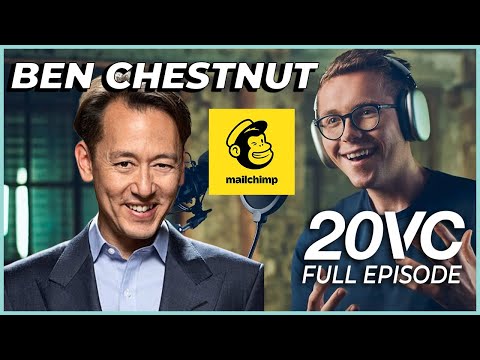
Ben Chestnut: Why I Sold MailChimp; How My Kids Found Out I Was a Billionaire | E959
Harry Stebbings (host), Ben Chestnut (guest), Harry Stebbings (host), Narrator
In this episode of The Twenty Minute VC, featuring Harry Stebbings and Ben Chestnut, Ben Chestnut: Why I Sold MailChimp; How My Kids Found Out I Was a Billionaire | E959 explores mailchimp’s Accidental Rise: Misfit Founder on Leadership, Money, and Meaning Ben Chestnut explains how Mailchimp evolved accidentally from a side project at his web design agency into a massive SaaS business, with freemium pricing as the true growth unlock after years of trial-and-error. He frames his entrepreneurial philosophy through stories of his immigrant mother’s kitchen salon and his father’s stoic, military-influenced parenting, which shaped his views on leadership, discipline, and taking the hard path.
Mailchimp’s Accidental Rise: Misfit Founder on Leadership, Money, and Meaning
Ben Chestnut explains how Mailchimp evolved accidentally from a side project at his web design agency into a massive SaaS business, with freemium pricing as the true growth unlock after years of trial-and-error. He frames his entrepreneurial philosophy through stories of his immigrant mother’s kitchen salon and his father’s stoic, military-influenced parenting, which shaped his views on leadership, discipline, and taking the hard path.
As Mailchimp scaled from a small creative shop to a 1,000+ person company, Ben had to evolve from a hands-off creative founder into a more operational, ‘hands off, eyes on’ leader, ultimately realizing he wasn’t energized by pure operations and learning to lean on others. He reflects on identity, aging, and why he finally decided to sell to Intuit after two decades of independence, driven less by money and more by mission continuity, fit, and timing.
The conversation also explores Ben’s emotional intelligence, the psychological impact of being a lifelong misfit, how he keeps humility amid success, his relationship with money, and his intent to spend the next years “exploring his own mind” and learning to be content and “not want.”
Key Takeaways
Side projects can become the main business if you measure them honestly.
Mailchimp began as a small internal tool for agency clients; only after Ben separated its revenue from the agency in Excel did he see it was growing while the agency was flat, prompting the pivot to focus fully on software.
Get the full analysis with uListen AI
Freemium can be a true unlock—but usually only after many failed ‘silver bullets.’
After five years of trying features, PR, and other growth hacks, Mailchimp’s accidental move to freemium rapidly grew users from hundreds of thousands to millions, with user count doubling year over year for several years.
Get the full analysis with uListen AI
Leadership must evolve from ‘hands off’ to ‘hands off, eyes on’ as companies scale.
Early on, Ben thrived by hiring strong creatives and getting out of their way; at 500–1,000 employees he had to become more explicit with goals, metrics, and accountability, relying on managers rather than telepathy and vibes.
Get the full analysis with uListen AI
Personal pain and misfit status can be powerful but double-edged motivators.
Being bullied and discounted fueled Ben’s drive to prove his value and stay stubbornly independent, but it also made him resistant to political pressure and sometimes colder or more uncompromising than situations required.
Get the full analysis with uListen AI
Discipline is mostly about deleting bad habits, not forcing heroic effort.
For fitness and performance, Ben focused on removing blockers—late-night TV, sugar drinks, poor sleep—rather than just ‘trying harder,’ showing that environmental and habit design often matter more than willpower alone.
Get the full analysis with uListen AI
A business is something you do, not who you are—eventually.
Ben describes how, in his 40s, as friends and family died, he realized his identity could no longer be synonymous with Mailchimp; that shift in perspective made selling thinkable after decades of reflexively saying no.
Get the full analysis with uListen AI
Humility and cultural grounding protect against ego inflation after success.
By valuing paying customers over press, inviting employees to literally deface his magazine covers, and growing wealth gradually rather than overnight, Ben kept status from distorting his behavior or values.
Get the full analysis with uListen AI
Notable Quotes
“To me, being a little bit more American, I was born here, my father was born here—he thought about business differently. He was always talking about, ‘How does this unlock? How does this scale?’ I always dreamed of my mother just scaling out of the kitchen.”
— Ben Chestnut
“Sometimes it’s not always better to be faster. When stuff’s really, really hard, look at your feet and just keep marching one foot at a time. Left, right, left.”
— Ben Chestnut
“My leadership style was a little bit hands-off, which can be good, but it was also eyes-off. The guidance I got was ‘hands off, eyes on.’”
— Ben Chestnut
“The only reason I’m still doing this is because no one can fire me.”
— Ben Chestnut
“What I want the most is to not want. I think it means learning to be content with what you’ve got.”
— Ben Chestnut
Questions Answered in This Episode
How can founders realistically tell when a side project is outgrowing their core business and deserves full focus?
Ben Chestnut explains how Mailchimp evolved accidentally from a side project at his web design agency into a massive SaaS business, with freemium pricing as the true growth unlock after years of trial-and-error. ...
Get the full analysis with uListen AI
What safeguards or metrics should a SaaS company put in place before committing to a freemium model?
As Mailchimp scaled from a small creative shop to a 1,000+ person company, Ben had to evolve from a hands-off creative founder into a more operational, ‘hands off, eyes on’ leader, ultimately realizing he wasn’t energized by pure operations and learning to lean on others. ...
Get the full analysis with uListen AI
How can creative founders develop the ‘hands off, eyes on’ operating style without losing their energy or authenticity?
The conversation also explores Ben’s emotional intelligence, the psychological impact of being a lifelong misfit, how he keeps humility amid success, his relationship with money, and his intent to spend the next years “exploring his own mind” and learning to be content and “not want.”
Get the full analysis with uListen AI
In what ways can childhood experiences of being a misfit positively and negatively shape a person’s leadership style?
Get the full analysis with uListen AI
How should a founder think about the ‘right time’ to sell: is it primarily about personal life stage, market conditions, or company readiness?
Get the full analysis with uListen AI
Transcript Preview
Ben, I am so excited for this. I had the most wonderful discussion with your sister beforehand. But thank you so much for joining me today.
Glad to be here. Thanks for inviting me.
I wanted to-
And I hope she didn't give you too much dirt.
Oh, she gave me so much dirt. But we're gonna get into that-
(laughs)
... later.
(laughs)
We were just chatting now, and you said to me that you're an accidental entrepreneur. And so talk to me, how did you come to found Mailchimp? And what was that aha moment for you?
Well, you know, I always wanted to be a designer, you know. I, I, I loved drawing when I was a kid. I had a couple of businesses, um, in grade school. You know, I, I used to sell... I would get those little 3M sticky pads and I would draw animations, li- little cartoon flip books, and I would sell those on the bus.
Wow.
Um, and, and, you know, that's how I got my taste of business. And I, you, you know, moved on to selling candy, comic books, m- uh, my own comic books that I would draw. Uh, and I, and I still maintain that Mailchimp is really just the end of a series of pivots from grade school. But I, I always wanted to be a car designer. You know, I went to industrial design school. I kinda, along the way, fell in love with web design. You know, I got an internship at an appliance company, and I learned how to design appliances. And I was really bad. I was good at designing things on the computer, but I was really bad with my hands. I didn't have the dexterity to kind of use that X-ACTO blade and cut foam models, uh, like you're supposed to do. You gotta... You have to do that with... when you design cars as well. I was really bad at it. And, you know, the mentors that I had at the time were like, "Yeah, you're... All of these refrigerators are lopsided." So one of them, you know, gently nudged me towards the, the Silicon Graphics machine and said, "You m- you might wanna try 3D rendering instead." (laughs) And so I, I, I fell in love with that machine. I fell in love with computers. I never went back. I learned web design that summer internship. Uh, and yeah, I got into that the next, the next semester and never went back.
You mentioned Mailchimp being kind of the result of a series of kind of continuous pivots. I love that description. When did you realize, "Oh, oh wow, this is a real thing"? Was it a millionaire or 10 millionaire or international offices? When was that, "Oh, this is real"?
It took me a long time to realize that. I mean, it was, it was an accidental kind of a business. We built it for just a couple of our customers who are having problems sending out email newsletters. Our real business was doing web design. And it was just sort of we built it on the side, and it kinda got annoying to log in and use it on behalf of our customers. So we just made it self-serve. We just said, "You log in, you use it, and pay with a credit card 'cause we're tired of cashing the checks as... or depositing all these little, you know, $50 checks." Um, I was driving to the bank too much. And so great problem to have, but it was also very, very annoying that way. And so anyways, we made it totally self-serve, and it just started to grow organically. But we never took it seriously. We just focused on our web design business. And I don't know, maybe three or four years went by, and we were so... We were exhausted from running an agency. I mean, the billable hours game, we... selling to clients, we were bad at it. And, um-
Install uListen to search the full transcript and get AI-powered insights
Get Full TranscriptGet more from every podcast
AI summaries, searchable transcripts, and fact-checking. Free forever.
Add to Chrome