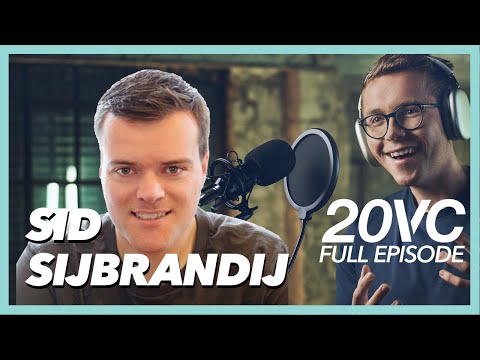
Sid Sijbrandij: How I Founded GitLab; Remote Work vs In-Person; CEO Coaches | 20VC
Sid Sijbrandij (guest), Harry Stebbings (host)
In this episode of The Twenty Minute VC, featuring Sid Sijbrandij and Harry Stebbings, Sid Sijbrandij: How I Founded GitLab; Remote Work vs In-Person; CEO Coaches | 20VC explores gitLab CEO Sid Sijbrandij on Remote Work, Leadership, and DevOps Platforms Sid Sijbrandij, co-founder and CEO of GitLab, recounts how GitLab grew from an open source project into a 1,500+ person, fully remote public company and DevOps platform leader.
GitLab CEO Sid Sijbrandij on Remote Work, Leadership, and DevOps Platforms
Sid Sijbrandij, co-founder and CEO of GitLab, recounts how GitLab grew from an open source project into a 1,500+ person, fully remote public company and DevOps platform leader.
He explains why remote-first was both organic and intentional, emphasizing structured informal communication, written culture, and asynchronous work as core enablers of scale.
Sid dives into his leadership evolution—delegation, transparency with guardrails, feedback culture, and situational leadership—plus the critical role of CEO coaches and well-run boards.
He also outlines why DIY DevOps toolchains are “dead,” the rise of unified DevOps platforms, and how his new vehicle, Open Core Ventures, is creating companies around open source projects.
Key Takeaways
Remote work scales better than co-located work, but requires deliberate support for informal communication.
GitLab found remote becomes more advantageous as headcount grows, yet companies must intentionally create ‘water cooler’ moments—like coffee chats and optional team hangouts—to build trust and culture.
Get the full analysis with uListen AI
Hybrid only works when everyone’s in the office on the same days; mixed remote/in-office hierarchies fail.
Sid argues the successful hybrid model synchronizes office days, while setups where some are always remote and others mostly in-office push top remote talent to leave for fully remote environments where they’re on equal footing.
Get the full analysis with uListen AI
Strong written and asynchronous cultures reduce dependency on meetings and increase clarity.
GitLab’s 2,000+ page handbook and norm of ‘no presenting in meetings’ free meetings for Q&A and decisions, but Sid notes that for urgent, high-stakes, low-context topics, synchronous conversations are still best.
Get the full analysis with uListen AI
Transparency should be ‘by default’ but with clearly defined, explicit exceptions.
GitLab publishes a long list of non-transparent topics (e. ...
Get the full analysis with uListen AI
Cultivating psychological safety around feedback requires public gratitude, never punishing messengers, and self-critique.
Sid emphasizes openly thanking people for feedback (even when wrong), banning blame-the-messenger remarks, and modeling self-criticism so others feel safe challenging even the CEO’s behavior.
Get the full analysis with uListen AI
Effective board management means minimizing presentation time and clearly asking for help on specific issues.
GitLab pre-records board presentations and uses meeting time for discussion; Sid stresses telling board members the top 2–3 areas where you genuinely want input to avoid low-priority tangents and unhelpful follow-up work.
Get the full analysis with uListen AI
DIY DevOps toolchains are becoming obsolete as integrated platforms take over.
Maintaining custom integrations across many “best-of-breed” tools is expensive and suboptimal; Sid sees the market rapidly shifting to single DevOps platforms like GitLab, which simplify workflows and improve deployment outcomes.
Get the full analysis with uListen AI
Notable Quotes
“Remote works better the bigger you are… if you're 1,500 people, you can't be in the same room anymore.”
— Sid Sijbrandij
“When people say they long back to the office, they don't mean the furniture.”
— Sid Sijbrandij
“At GitLab, you're not allowed to present in meetings… in the call, it's just Q&A.”
— Sid Sijbrandij
“Feedback doesn't have to be correct in order for you to welcome it.”
— Sid Sijbrandij
“DIY DevOps is dead… selecting 10 best-in-class solutions and maintaining custom integrations is no longer working.”
— Sid Sijbrandij
Questions Answered in This Episode
How can a traditionally office-based company practically transition to a GitLab-style remote and asynchronous culture without breaking productivity or morale?
Sid Sijbrandij, co-founder and CEO of GitLab, recounts how GitLab grew from an open source project into a 1,500+ person, fully remote public company and DevOps platform leader.
Get the full analysis with uListen AI
What specific metrics or signals should leaders watch to know if their remote informal communication efforts are actually building trust?
He explains why remote-first was both organic and intentional, emphasizing structured informal communication, written culture, and asynchronous work as core enablers of scale.
Get the full analysis with uListen AI
Where should a growing startup draw its own transparency boundaries, especially around fundraising and personnel matters?
Sid dives into his leadership evolution—delegation, transparency with guardrails, feedback culture, and situational leadership—plus the critical role of CEO coaches and well-run boards.
Get the full analysis with uListen AI
How can CEOs realistically reduce their reliance on synchronous meetings when investors, customers, and teams are conditioned to default to calls?
He also outlines why DIY DevOps toolchains are “dead,” the rise of unified DevOps platforms, and how his new vehicle, Open Core Ventures, is creating companies around open source projects.
Get the full analysis with uListen AI
For organizations heavily invested in DIY DevOps toolchains, what is a pragmatic migration path toward an integrated platform without disrupting existing delivery pipelines?
Get the full analysis with uListen AI
Transcript Preview
(beeping) Three, two, one, zero. You have now arrived at your destination.
Sid, this is such a joy to do. It's been so long since our last discussion. I was trying to think. It's like three or four years. I mean, I was young when we last spoke. But thank you so much for joining me again today, Sid.
Yeah, it's a pleasure. It feels on one hand like yesterday, and on the other hand, so much has happened since. So thanks-
I mean-
... for having me back.
Not at all, but so much has happened. But I, I do want to start, and for those that missed our last episode, you know, GitLab today, public company, incredible success story. Would love to just provide some context and go back to the beginning. What was that founding moment and how did it all start? In a very succinct two to three minutes.
Yeah. It started when I saw, uh, GitLab, which was created by my co-founder Dmitri. Um, he started it because he wanted to be... have a better way of collaborating at work. And he thought it made so much sense to make that open source, and I thought so too. So GitLab is a DevOps platform, which means you can do anything from planning what you're gonna build software-wise to building it, testing it, making it secure, rolling it out, monitoring it, and improving it. And he thought that made so much sense to collaborate, and in the first year, 300 people joined. Today, we have hundreds of people joining every month to make it better. GitLab is being used by millions of people. This deserves more than just an open source project where everyone is just working for the love of it. This needs full-time people, and today GitLab is over 1,500 people.
I mean, it, it's incredible to see and also kind of incredible to see the different stories actually of the employees. You know, I know many of your team members and seeing them talk about bluntly how they live, which is what we're gonna come on to next, which is, you know, you've always been a remote first company, many, many years ahead of everyone else who's now doing it. And so I want to hone in here a little bit, and I actually spoke to Darren, your head of remote before the show, and he said, "First of all," you know, a lot of people ask, "Well, how do you do it?" Ask instead why, because as I said, it was a very contrarian thing that you did many years ago. So Darren asked bluntly, "It seems you're wired pretty differently with remote being the best solution inherently to you. What shaped this? Was it conviction? Was it personal experiences? Why did you always feel it was right?"
We started off as a remote company. Um, I had... I hired people, but well, the first person I hired was in... Uh, I was in the Netherlands, and the first person was Martin in Serbia. And then we hired Dmitri in Ukraine, and it, it kept going like that. And then even if I hired Dutch people, they, they would come to my house and we would co-work for a few days, and then they would just work from wherever they were. So it organically evolved like that. And then people were skeptical. So we said, "Look, if it... if it stops scaling, we'll stop doing it." But in fact, remote works better the bigger you are. Like if you're seven people, it's probably better to be in a room together if that's practical. If you're 1,500 people, what's the... what's the advantage? You can't be in the same room anymore. You can hardly be in the same building. So remote scales a lot better and because people were skeptical of it, we invested a lot in the things you need to do to be remote. Every company during the pandemic discovered, "Hey, we can work remote." But what they are not intentional about is facilitating informal communication, because that takes more time and effort. It takes a lot less time and effort and money than having an office building. But you still need to be very intentional about that.
Install uListen to search the full transcript and get AI-powered insights
Get Full TranscriptGet more from every podcast
AI summaries, searchable transcripts, and fact-checking. Free forever.
Add to Chrome