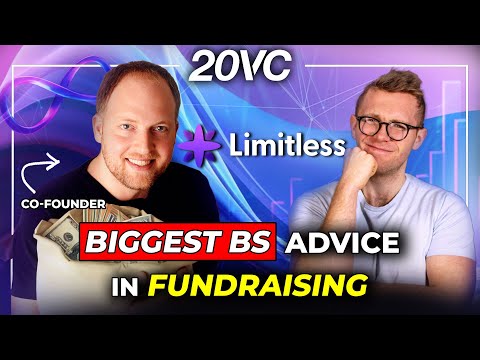
Dan Siroker: Second-Time Founders Are More Investable & Why Not To Hire People Out of College |E1153
Dan Siroker (guest), Harry Stebbings (host)
In this episode of The Twenty Minute VC, featuring Dan Siroker and Harry Stebbings, Dan Siroker: Second-Time Founders Are More Investable & Why Not To Hire People Out of College |E1153 explores dan Siroker Explains Smarter Fundraising, Hiring, And Second-Time Founders’ Edge Dan Siroker, founder of Optimizely and Limitless, unpacks what he learned building, pivoting, and scaling companies, and why second-time founders are often more investable and effective. He contrasts first- vs second-time founder behavior across focus, hiring, fundraising, and control, and explains why following his gut would have avoided some of Optimizely’s biggest missteps. A large portion of the discussion centers on running fundraising processes intelligently—how to think about valuation, dilution, investor minimums, signaling, boards, and secondary liquidity for employees. He also covers building lean senior teams (and why he doesn’t hire straight out of college), launching products well, and why problem-obsessed founders—not AI-for-AI’s-sake—will win.
Dan Siroker Explains Smarter Fundraising, Hiring, And Second-Time Founders’ Edge
Dan Siroker, founder of Optimizely and Limitless, unpacks what he learned building, pivoting, and scaling companies, and why second-time founders are often more investable and effective. He contrasts first- vs second-time founder behavior across focus, hiring, fundraising, and control, and explains why following his gut would have avoided some of Optimizely’s biggest missteps. A large portion of the discussion centers on running fundraising processes intelligently—how to think about valuation, dilution, investor minimums, signaling, boards, and secondary liquidity for employees. He also covers building lean senior teams (and why he doesn’t hire straight out of college), launching products well, and why problem-obsessed founders—not AI-for-AI’s-sake—will win.
Key Takeaways
Second-time founders are usually more focused and capital-efficient.
With hindsight, they know only a handful of decisions truly matter, so they emphasize focus, smaller teams, and fewer but higher-impact initiatives—rather than the activity overload typical of first-time founders.
Get the full analysis with uListen AI
Things that work tend to show signs quickly; pivot if they don’t.
Siroker echoes advice that real pull shows up as early ‘glimmers of hope’—if you don’t see them after your best experiments, it’s usually better to pivot, and the right pivot should feel like “coming home” to a more natural problem and path.
Get the full analysis with uListen AI
Don’t chase the highest valuation; optimize for long-term fit and scalability.
He turned down billion-dollar Series A offers in favor of a lower valuation and better lead investor, arguing that overpricing rounds creates future pain and that great funds will flex ownership ‘minimums’ for the right company.
Get the full analysis with uListen AI
Run fundraising as a deliberate, time-boxed process, not ad hoc meetings.
He batches investor conversations into defined weeks, runs them in parallel (often publicly), and frames rounds as selling a percentage of the company while letting the market set price—avoiding being anchored by investors’ ‘how much are you raising? ...
Get the full analysis with uListen AI
Founders must stay in the details where it matters and never abdicate responsibility.
Hiring senior executives doesn’t remove the CEO’s duty to understand key details, challenge decisions, and be bought in—because when executives leave, the founder is still ‘holding the bag’ for those choices.
Get the full analysis with uListen AI
Titles and comp send strong cultural signals; use them carefully.
Siroker prefers ‘head of’ over inflated C-/VP titles early, treats fixation on titles as a red flag, pays cash competitively, and keeps internal comp coherent enough that if everyone saw everyone’s pay, it would feel fair.
Get the full analysis with uListen AI
Letting employees sell vested stock can increase, not decrease, retention.
Contrary to common investor advice, he structures liquidity opportunities (e. ...
Get the full analysis with uListen AI
Notable Quotes
“Things that work tend to work really fast.”
— Dan Siroker (quoting advice from Elad Gil)
“The main thing is that the main thing should stay the main thing.”
— Dan Siroker
“First-time founders brag about how many employees they have. Second-time founders brag about how few employees they have.”
— Dan Siroker
“Always taking the highest price is almost certainly gonna be a mistake.”
— Dan Siroker
“The best companies to back now are founders obsessed with problems, not solutions.”
— Dan Siroker
Questions Answered in This Episode
How can a first-time founder practically build the kind of focus and discipline that usually only comes after a first startup’s scars?
Dan Siroker, founder of Optimizely and Limitless, unpacks what he learned building, pivoting, and scaling companies, and why second-time founders are often more investable and effective. ...
Get the full analysis with uListen AI
Where is the real line between being ‘appropriately persistent’ and ‘too slow to pivot’ when early traction is ambiguous rather than clearly bad?
Get the full analysis with uListen AI
What specific signals should a founder look for to know it’s time to move upmarket into enterprise without abandoning a working product-led motion?
Get the full analysis with uListen AI
How far should founders go in protecting control (super-voting shares, board structure, etc.) before it starts to materially hurt their ability to raise?
Get the full analysis with uListen AI
In an AI-saturated landscape, how can an investor reliably distinguish between a truly problem-obsessed founder and one reverse-engineering a ‘problem’ around a favorite technology?
Get the full analysis with uListen AI
Transcript Preview
(instrumental music plays) I very much believe you should either be in fundraising mode or not. Always saying the highest price is almost certainly gonna be a mistake. When an investor asks, "How much are you raising?" more often than not, they're actually asking, "How much do you think you're worth? Let's start the negotiation on valuation right now." Because 20% is what they want. If you say, you know, "We're worth... Uh, yeah, we're raising $10 million," they just take $10 million divide it by 0.2, and then that's what they think that you think your valuation is.
Ready to go? (instrumental music plays) Dan, I am so excited for this. We've gone back and forth on Twitter. I've obviously been a huge admirer of yours from afar for a long time. So, thank you so much for joining me.
Thank you. The feeling is mutual. I've been a bit of... a big admirer of the show and glad to be on it.
Now, I think great entrepreneurs are shaped by their early years. And so, I'd just love to go back. When you think about how your parents or how your teachers would have described the 10-year-old Dan, what do you think they would have said?
They would have been very, um, astute to notice that I was very into computers. So from a very early age, uh, we always had a computer around. And I owe my mom's boss, she was working as a secretary at Stanford, and her boss was Professor Hector Garcia Molina. And he had this amazing generosity where every time he would buy himself a new computer for home, he'd always have my mom buy the same one for herself. And then me of- me and my twin brother actually got to play with it a lot. So, uh, we'd always have the latest and greatest thing at home because of his generosity. And that, I think, propelled me to what I'm doing today, because I'm into computers, which is, uh, something I've been doing ever since I was 10 and even maybe younger.
I love that. What a great guy. What an awesome influence. Uh, along the way, we have many great yeses and many hard nos in life. And I find that they shape us, the highs and the lows. When you think about a great yes that you think really shaped you, and also a really shit no, what comes to mind for each, before we dive in?
Yes, uh, was about eight years ago when my now wife said yes (laughs) to getting married. Any other yes I've gotten from venture capitalists or employees or kind of pales in comparison to that big yes, so I can't really, um, compare. And then nos, there's one cl- there's one pattern of nos I've gotten that now my team knows is the, the most motivating no I get, which is the version of a no that starts with, "No, that's not possible." And I'm a big believer in technology's ability to do things that were thought of as impossible before. Um, and so I think since probably very young, 'cause I know this has been going on now for at least a decade, I'm very motivated when somebody has a cynical or pessimistic view on what technology can do. And there's nothing more motivating to me than hearing that and then trying to prove them wrong by showing them, by building the demo, by building the product, uh, by building the feature to prove that that is something that techno- technology can do. And in some ways, every version of every startup I've ever done is some, there's some seed of that idea that's said, "No, that that's not possible," that motivated me to persevere.
Install uListen to search the full transcript and get AI-powered insights
Get Full TranscriptGet more from every podcast
AI summaries, searchable transcripts, and fact-checking. Free forever.
Add to Chrome