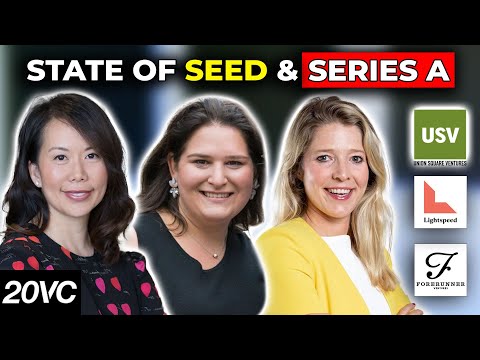
Roundtable #6 with Rebecca Kaden, Nicole Quinn, Eurie Kim, Harry Stebbings | E1083
Nicole (Nicky) Quinn (guest), Eurie (Yuri) Kim (guest), Rebecca Kaden (guest), Harry Stebbings (host)
In this episode of The Twenty Minute VC, featuring Nicole (Nicky) Quinn and Eurie (Yuri) Kim, Roundtable #6 with Rebecca Kaden, Nicole Quinn, Eurie Kim, Harry Stebbings | E1083 explores vC Titans Debate Seed Valuations, AI Hype, and Venture’s Reset Harry Stebbings hosts a roundtable with Eurie Kim (Forerunner), Rebecca Kaden (USV), and Nicole Quinn (Lightspeed) to dissect how venture is evolving across seed, Series A–C, and growth in a post‑2021 world.
VC Titans Debate Seed Valuations, AI Hype, and Venture’s Reset
Harry Stebbings hosts a roundtable with Eurie Kim (Forerunner), Rebecca Kaden (USV), and Nicole Quinn (Lightspeed) to dissect how venture is evolving across seed, Series A–C, and growth in a post‑2021 world.
They debate whether traditional seed funds can still win hot deals against multistage giants, how macro cycles are (and aren’t) impacting early-stage pricing, and why many B and C rounds now represent a brutal filter for companies without real momentum and efficiency.
The group analyzes AI as a massive, durable platform shift—especially at the application layer—while warning about inflated entry prices and emphasizing that real value will accrue to products that solve concrete problems, not just “AI companies.”
They predict more down rounds, higher mortality, selective M&A, a partial pullback by LPs, and a return to less consensus-driven, more thesis-led investing, with renewed collaboration between seed specialists and multistage firms.
Key Takeaways
Seed is still competitive, but hustle and non-consensus theses give specialist funds an edge.
Despite multistage platforms pushing earlier, focused seed firms that see founders before it’s obvious, have sharp perspectives on less crowded themes, and bring tangible help can still win allocations or co-lead with larger funds.
Get the full analysis with uListen AI
Valuations at seed and Series A have held up overall, but pressure is building.
Data from Lightspeed shows average seed and A prices are roughly flat vs. ...
Get the full analysis with uListen AI
Momentum plus efficiency plus large markets are now mandatory for strong Series A–B rounds.
Investors are still willing to pay premiums for companies with real traction, great unit economics, and deep markets—especially in AI—but growth alone without sustainable economics or a compelling market narrative no longer clears at prior valuations.
Get the full analysis with uListen AI
Down rounds with clean terms are preferable to structured “pretend” valuations.
The group encourages founders to accept valuation resets rather than complex structures that haunt future rounds; while down rounds hurt morale and can cause employee turnover, they are often better than overhang that distorts incentives.
Get the full analysis with uListen AI
AI is a durable platform shift whose biggest value may sit at the application layer.
While foundational models may concentrate some value, the panel is most excited about AI being embedded into consumer and business products to drastically cut costs and time—creating what Nicole calls a 'lottery of time' and unlocking new experiences and services.
Get the full analysis with uListen AI
Many companies funded in the frothy era will die rather than get acquired.
With public comps down, large acquirers focused on core operations, and M&A teams mostly analyzing rather than transacting, the panel expects higher mortality and relatively modest M&A or acqui-hires, rather than a big rescue wave.
Get the full analysis with uListen AI
Venture is shifting away from consensus hot deals toward thesis-led, problem-first investing.
The speakers foresee less chasing of 'hot' rounds and more focus on solving real problems (even in unsexy sectors like auto body shops or hospital systems), using tech—including AI and crypto rails—as enablers rather than the core story.
Get the full analysis with uListen AI
Notable Quotes
“AI is akin to winning the lottery. It is the lottery of time.”
— Nicole Quinn
“We are exiting the time of consensus-based venture capital… the myth of a hot deal is a myth.”
— Rebecca Kaden
“You have to have a real business at some point in time.”
— Eurie Kim
“Seed valuations are gonna go down… the strategy of very large funds writing $2 million checks does not work.”
— Rebecca Kaden
“Companies die from indigestion rather than starvation.”
— Nicole Quinn
Questions Answered in This Episode
How should a founder today weigh taking a higher valuation from a multistage fund versus a lower-priced round with a specialist seed investor who will be more hands-on?
Harry Stebbings hosts a roundtable with Eurie Kim (Forerunner), Rebecca Kaden (USV), and Nicole Quinn (Lightspeed) to dissect how venture is evolving across seed, Series A–C, and growth in a post‑2021 world.
Get the full analysis with uListen AI
Given the expected crunch at B and C, what concrete milestones should a seed or Series A company target to maximize its chances of raising follow-on capital?
They debate whether traditional seed funds can still win hot deals against multistage giants, how macro cycles are (and aren’t) impacting early-stage pricing, and why many B and C rounds now represent a brutal filter for companies without real momentum and efficiency.
Get the full analysis with uListen AI
In AI, where do you see the most underexplored application opportunities that can justify today’s higher entry prices without relying on winner-take-all infra bets?
The group analyzes AI as a massive, durable platform shift—especially at the application layer—while warning about inflated entry prices and emphasizing that real value will accrue to products that solve concrete problems, not just “AI companies.”
Get the full analysis with uListen AI
How can founders manage employee expectations and equity morale when facing a necessary down round after a 2021-style valuation?
They predict more down rounds, higher mortality, selective M&A, a partial pullback by LPs, and a return to less consensus-driven, more thesis-led investing, with renewed collaboration between seed specialists and multistage firms.
Get the full analysis with uListen AI
If venture is moving away from consensus hot deals, what practical steps can emerging managers take to build truly differentiated theses that LPs will back in a tougher fundraising environment?
Get the full analysis with uListen AI
Transcript Preview
AI is akin to winning the lottery. It is the lottery of time. If OpenAI really do the, like, App Store of AI, then that's gonna be like a new Search. The valuations are going to be slightly higher but honestly, that's worth paying for.
I guess if you are trying to find the Google AI equivalent, think about all the applications that have come on top of that and that's just like a Wild West.
We're seeing across the board, investors are very hesitant to come in and re-price things, and to do the down round and deal with the anti-dilution and navigate the messiness.
What is your spiciest take today?
I mean, I would say...
I am so excited for this. I've wanted to do this one for a while. So I want to start with a little bit of intros from each of us. So let's start with you, Yuri, and then let's go Rebecca, and then Nicky. Yuri, over to you.
All right. I'm Yuri. Uh, (laughs) I'm a partner at 400 Ventures. We invest in all things consumer, um, and we've been in business for the last 13 years now, thinking about the changing behavior and different evolution of, um, needs and priorities of consumers and how that bubbles into real business ideas.
Rebecca?
I'm Rebecca Kadin. I'm a managing partner at Union Square Ventures, a New York-based early-stage venture fund portfolio that's increasingly global. We like to invest early and look for businesses with core network effects in markets that we believe you can tip over that are in moments of transformation where you can go direct, avoid gatekeepers that are sitting on the edge and working toward the center.
Nicky?
Hi, folks. Um, I'm Nicole Quinn, um, or Nicky as margarita-drinking good friends like Harry call me. (laughs)
Who we keep on forcing you to respond to. (laughs)
No, I love it. That's what all good friends call me. Well, I am, um, a GP at Lightspeed Venture Partners. Um, when I started nearly a decade ago, we were raising $700 million funds. They're now $7 billion funds. Um, and so we really scaled because it's so important to us that when we invest in the generational change businesses at the seed or series A, because we'd love to be first institutional capital in, then we really want to stay with them through the journey, and so for us, we've been raising growth funds, then opportunity funds to stay with those companies and invest in, like, the pre-IPO round. We can even talk about the benefits of that later. Um, but for us, it really is investing in companies and just staying with them for, as very active, helpful investors across sectors. I run consumer, then we have enterprise, healthcare, fintech, crypto, um, and yeah, the generational change companies of tomorrow.
I mean, Nicky-
What's the difference of a growth fund and an opportunity fund?
Install uListen to search the full transcript and get AI-powered insights
Get Full TranscriptGet more from every podcast
AI summaries, searchable transcripts, and fact-checking. Free forever.
Add to Chrome