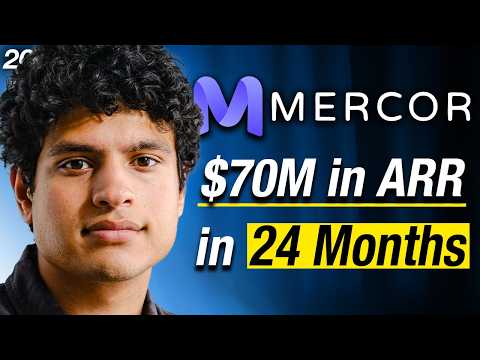
Adarsh Hiremath @ Mercor: The Fastest Growing Startup in Silicon Valley | E1261
Adarsh Hiremath (guest), Harry Stebbings (host)
In this episode of The Twenty Minute VC, featuring Adarsh Hiremath and Harry Stebbings, Adarsh Hiremath @ Mercor: The Fastest Growing Startup in Silicon Valley | E1261 explores mercor Builds AI-Powered Global Labor Marketplace, Redefining Recruiting And Work Harry Stebbings interviews Mercor co-founder Adarsh Hiremath about building one of Silicon Valley’s fastest-growing startups, now at tens of millions in ARR, 30+ people, and a recent $100M round at a $2B valuation. Hiremath explains how Mercor evolved from a student dev shop into an AI-first talent marketplace that automates end-to-end hiring and powers post-training work for top AI labs. He argues that as software becomes commoditized and model performance plateaus on generic data, expert human labor and talent assessment become the key bottlenecks and the primary moat. The conversation covers Mercor’s intense in-person culture, its network effects, views on the future of SaaS and AI models, and a long-term vision to become the unified, global labor market infrastructure.
Mercor Builds AI-Powered Global Labor Marketplace, Redefining Recruiting And Work
Harry Stebbings interviews Mercor co-founder Adarsh Hiremath about building one of Silicon Valley’s fastest-growing startups, now at tens of millions in ARR, 30+ people, and a recent $100M round at a $2B valuation. Hiremath explains how Mercor evolved from a student dev shop into an AI-first talent marketplace that automates end-to-end hiring and powers post-training work for top AI labs. He argues that as software becomes commoditized and model performance plateaus on generic data, expert human labor and talent assessment become the key bottlenecks and the primary moat. The conversation covers Mercor’s intense in-person culture, its network effects, views on the future of SaaS and AI models, and a long-term vision to become the unified, global labor market infrastructure.
Key Takeaways
Treat co-founder selection like choosing a debate partner: 50/50 ownership and relentless feedback.
Hiremath likens his policy debate partnership to an early startup; mutual dependence, rapid iteration on performance, and trust under pressure made it the perfect training ground for founding Mercor.
Get the full analysis with uListen AI
Build the marketplace by fully automating both sides of the transaction early.
Mercor started by manually recruiting exceptional Indian engineers for a dev shop, then automated candidate sourcing and later the company side, evolving into a scalable two-sided labor marketplace without a traditional sales team.
Get the full analysis with uListen AI
Index heavily on people who deeply care; skills are teachable, genuine care is not.
Mercor’s hiring philosophy is that technical and GTM skills can be trained, but intrinsic motivation and care for the mission cannot, which is how they justify and sustain their intense 9–9–6, in-person culture.
Get the full analysis with uListen AI
Human expert data—not generic human data—is becoming the main bottleneck in AI progress.
As models improve, tasks like evals, SFT, and RLHF require humans who outperform the model in narrow domains; Mercor’s core competency is talent assessment to find those experts, which doubles as both product and moat.
Get the full analysis with uListen AI
In a world where software costs approach zero, defensibility comes from network effects and data flywheels.
Hiremath predicts software will be commoditized by coding agents; winning companies will be those with strong marketplaces and proprietary outcome data (e. ...
Get the full analysis with uListen AI
The next generation of SaaS will replace entire services end-to-end, not just offer tools.
He argues future SaaS looks more like fully automated agencies—Mercor aims to be a fully automated recruiting function, from sourcing to assessment to placement, priced like software but delivering service-level outcomes.
Get the full analysis with uListen AI
Scaling culture is harder than scaling software; early cultural DNA must be protected deliberately.
With 50%+ monthly growth, Mercor sees constant process breakage; Hiremath notes the first ~20 people set the strongest, most durable culture, and preserving that while hiring fast is critical to building a “legendary” company.
Get the full analysis with uListen AI
Notable Quotes
“Being a recruiter is the highest prestige position in any company.”
— Adarsh Hiremath
“Human data and talent assessment have actually become the same thing.”
— Adarsh Hiremath
“The businesses that succeed in a world where software costs approach zero will be built on network effects.”
— Adarsh Hiremath
“Scaling culture is harder than scaling software.”
— Adarsh Hiremath
“We didn’t intend on fundraising; the rounds sort of came to us.”
— Adarsh Hiremath
Questions Answered in This Episode
If software is commoditized by AI, what new forms of defensibility besides network effects and proprietary data will matter most?
Harry Stebbings interviews Mercor co-founder Adarsh Hiremath about building one of Silicon Valley’s fastest-growing startups, now at tens of millions in ARR, 30+ people, and a recent $100M round at a $2B valuation. ...
Get the full analysis with uListen AI
How should young, ambitious people decide whether to drop out for a startup when early traction and funding are still uncertain?
Get the full analysis with uListen AI
What are the ethical and societal implications of a unified global labor market where one platform mediates most hiring decisions?
Get the full analysis with uListen AI
As AI handles 60–90% of many knowledge tasks, how should education and career planning evolve toward specialization and sophistication?
Get the full analysis with uListen AI
How can companies build an intense, high-output culture like Mercor’s 9–9–6 model without burning people out or excluding diverse working styles?
Get the full analysis with uListen AI
Transcript Preview
The round was 100 million.
And the price was?
It was at 2 billion, yeah. (instrumental music plays) I think we'll live in a world with many, many models with different use cases. We're already seeing this with a lot of application layer companies, where they all have these specialized use cases for how they wanna leverage the models. (instrumental music plays) I think being a recruiter is the highest prestige position in any company. The recruiter is the one who controls the talent inflows and outflows of every company. And pretty much, you can gather all you need to know about a company from seeing the talent inflows and outflows. (instrumental music plays) The businesses that succeed in a world where software costs approach zero will be built on network effects.
Ready to go? (instrumental music plays) Adosh, I am so excited for this, dude. Listen, I've heard so many good things from Pat Grady, from Nico, from Anil, from Scott Sandell even, so thank you so much for joining me.
Thank you for, uh, having me. Really, really a big fan of the pod.
That is very, very kind of you, dude. But I did my stalking beforehand, and everyone told me about your mastery of debating, you and your co-founder Surya. You were debate champions. How did debate prepare you for founding a company? Let's start there.
Yeah. Well, I mean, one thing about Brendan, Surya, and I is that we actually go quite a ways back. So, I actually first met Surya when I was 10 years old. Um, and the reason we got along so well is because we were pretty much the only elementary schoolers who wanted to compete in high school debate. So, at the time, we did Lincoln-Douglas debate, which is sort of, like, a one-on-one debate format. Surya and I actually even debated each other, uh, a couple times. And then we ended up at the same high school, Bellarmine, which is also where I met Brendan. Um, and then all three of us were on the debate team together. Surya and I decided to do policy, so we ended up being debate partners together and then going on and competing in all of these nat- national tournaments. Um, but, but debate is a lot like founding, uh, in a lot of ways, right? Like, I like to think of my debate partnership with Surya as sort of my first startup, just because we had 50/50 equity in each other's success. If one of us were to mess up, it would tank the odds for both of us. Uh, there's, like, this constant feedback loop after every debate round about whether you won or lost. Picking the right debate partner is, like, the most important decision you can make in policy debate. And similarly, picking the right founding team is the most important decision you can make while starting a company. So, there's that parallel, and then there's just the immense amount of ownership, right? You know, we both have a stake in each other's success.
Install uListen to search the full transcript and get AI-powered insights
Get Full TranscriptGet more from every podcast
AI summaries, searchable transcripts, and fact-checking. Free forever.
Add to Chrome