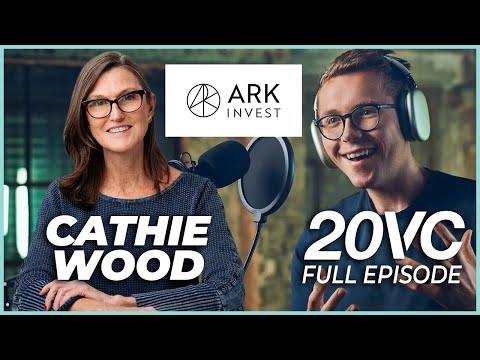
Cathie Wood: Elon & Twitter; Why Facebook is a Value Stock Now; ARK's Performance | 20VC #949
Harry Stebbings (host), Cathie Wood (guest)
In this episode of The Twenty Minute VC, featuring Harry Stebbings and Cathie Wood, Cathie Wood: Elon & Twitter; Why Facebook is a Value Stock Now; ARK's Performance | 20VC #949 explores cathie Wood Defends Disruptive Innovation, Active Investing, And ARK’s Future Cathie Wood discusses her journey in finance, her rejection of benchmark-driven passive investing, and why she believes disruptive innovation is massively underpriced in public markets. She explains ARK’s research-led, high-conviction approach, how they manage extreme volatility, and why concentration and continuous re-underwriting are core to their risk management. Wood outlines ARK’s new retail-focused venture/interval fund, its 0% carry structure, and how ARK aims to give non‑accredited investors access to private innovation usually reserved for institutions. She also shares her views on Tesla, Facebook/Meta as a value stock, Elon Musk’s Twitter acquisition, and her long-term vision for ARK as both an innovation investor and global education platform.
Cathie Wood Defends Disruptive Innovation, Active Investing, And ARK’s Future
Cathie Wood discusses her journey in finance, her rejection of benchmark-driven passive investing, and why she believes disruptive innovation is massively underpriced in public markets. She explains ARK’s research-led, high-conviction approach, how they manage extreme volatility, and why concentration and continuous re-underwriting are core to their risk management. Wood outlines ARK’s new retail-focused venture/interval fund, its 0% carry structure, and how ARK aims to give non‑accredited investors access to private innovation usually reserved for institutions. She also shares her views on Tesla, Facebook/Meta as a value stock, Elon Musk’s Twitter acquisition, and her long-term vision for ARK as both an innovation investor and global education platform.
Key Takeaways
Disruptive innovation is underrepresented and mispriced in benchmark-driven portfolios.
Wood argues that decades of flows into passive indices have overinflated large-cap benchmarks while leaving many non-index innovative companies down 80–90%, creating what she sees as a structural opportunity for active, innovation-focused investors.
Get the full analysis with uListen AI
Risk management at ARK is driven by concentration and explicit hurdle rates, not diversification by benchmark.
ARK requires a minimum 15% expected annualized return over five years; when a stock falls below that on their models (e. ...
Get the full analysis with uListen AI
Volatility is accepted as the price of long-term exposure to breakthrough technologies.
Wood maintains conviction through deep, ongoing research; when prices collapse but fundamentals and theses hold, ARK averages down and treats drawdowns as raising future return potential rather than invalidating their approach.
Get the full analysis with uListen AI
Sharing research openly can be a strategic advantage, not a weakness.
In an era of ubiquitous information, ARK publishes its work in real time on social media; this builds investor understanding, helps battle-test assumptions publicly, and has supported unusually strong asset retention despite steep drawdowns.
Get the full analysis with uListen AI
Retail investors should have structured access to private innovation, not just institutions.
The new interval/crossover fund is designed specifically for non‑accredited investors, with no carry and daily NAV, reflecting Wood’s belief that knowledge—not income thresholds—should define who can participate in high-growth private markets.
Get the full analysis with uListen AI
Evergreen venture structures benefit from flexibility in secondaries and check types.
Because the fund is open-ended and not bound by traditional VC constraints (like strict caps on secondaries), ARK can use tools like secondaries and convertibles and start at later stages (Series B) while they scale and build track record.
Get the full analysis with uListen AI
Some dominant tech platforms are transitioning from growth to value stories.
Wood sees Facebook/Meta as becoming a value stock due to enormous, durable engagement metrics but questions the timing and capital intensity of its metaverse bet, which she views as ahead of mainstream readiness.
Get the full analysis with uListen AI
Notable Quotes
“We are not a generalist strategy. We’re focused exclusively on a slice of the market, and that slice is truly disruptive innovation.”
— Cathie Wood
“If you don’t have a five-year investment time horizon, maybe we’re not right for you, because we are a very volatile strategy.”
— Cathie Wood
“Information is ubiquitous. It’s how you put it together. In a few years, it will seem provincial for firms to say, ‘We don’t share our research because it’s our secret sauce.’”
— Cathie Wood
“We believe today that truly disruptive innovation is priced at $7–8 trillion globally and is going to $210 trillion in the next eight to ten years.”
— Cathie Wood
“Because of our structure, we want to be with companies from early stage to mega-cap—and we can.”
— Cathie Wood
Questions Answered in This Episode
How would ARK’s thesis change if innovation adoption curves slow materially due to regulation or geopolitical fragmentation?
Cathie Wood discusses her journey in finance, her rejection of benchmark-driven passive investing, and why she believes disruptive innovation is massively underpriced in public markets. ...
Get the full analysis with uListen AI
What specific metrics or signals would cause ARK to conclude that one of its core innovation platforms (e.g., autonomous driving or genomics) is overhyped or structurally impaired?
Get the full analysis with uListen AI
How can retail investors realistically assess whether they have the ‘knowledge’ Cathie suggests should replace wealth-based accreditation?
Get the full analysis with uListen AI
In an environment where many innovative companies remain unprofitable for long periods, how does ARK distinguish between temporary market mispricing and genuine business fragility?
Get the full analysis with uListen AI
If passive investing is as dangerous as Cathie argues, what should a traditional 60/40 or index-heavy investor concretely do over the next 3–5 years to reposition?
Get the full analysis with uListen AI
Transcript Preview
Kathy, I'm very excited for this. I've been looking forward to it for a long time. So thank you so much for joining me today.
Oh, I'm really happy to be here, Harry. I know you have one of the best VC podcasts, if not the best, uh, VC podcast. So we are thrilled, given that we are such a newbie in the space.
That is very, very kind of you. I, I, I needed that ego inflation.
(laughs) .
But I want to (laughs) start with a little bit on you. I did my research and I read your, you know, incredible backstory. Take me back to the beginning. How did you make your way into the world of finance at, I believe, at the tender age of 24?
Actually, it was the tender age of 20. And, uh, and I was introduced to Capital Group, which is a very well-known, very large, uh, asset manager on the West Coast, LA, by Art Laffer. Uh, Art Laffer, if you know Laffer curve, supply side economics, uh, he's very well-known for that. I knew very little about the investment business and, but I was fascinated by economics, uh, generally, and thinking about the way the world was going to work in the future. And so he thought I'd be a good candidate. So that's where I started.
So I, I, I love that as a starting point. I always believe that we're this kind of function of our histories. And so with that as a starting point, y- everyone's running from something, and everyone's running towards something. You know, I spent thousands of pounds in therapy to figure mine out.
(laughs) .
Um, uh, what are you running from, Kathy? And what are you running towards?
Well, uh, uh, I've been very clear that one of the things that I've been running from in the traditional asset management world is indexed-based investing. Uh, so benchmarks you've heard, the S&P 500, NASDAQ, uh, Russell, uh, MSCI. And, uh, and I've watched our industry, um, go through an arc, actually. A-R-C, not A-R-K. Uh, and i- in the early '80s when I s- uh, when I r- moved to New York, um, indexing and benchmarks weren't a thing. Uh, we were all investing in the future, trying to figure out how the world was going to work. Uh, and the '80s and '90s were very much like that. And then we got the tech and telecom bubble and bust, and that was the first, "Oh my gosh." And then '08, '09, and what happened during the last 20 years is we've had a move towards benchmark sensitivity, or passive investing. Outright just, "Let me invest with the benchmarks, that's safety." And, uh, we actually think it, that is becoming a very dangerous way to invest. Because if we're right about the amount of innovation that is evolving today, so we've f- we've centered our research in investing around five innovation platforms, uh, genomic sequencing, uh, robotics, energy storage, artificial intelligence, and blockchain technology. Uh, and, and those are all converging. So it's becoming a- very disruptive to the traditional world order. And I think, even though, uh, the onus, uh, or the burden of proof is on us, because passive has done so well over the past 20 years, it's been self-fulfilling as more and more assets moved into passive, or benchmark-sensitive. Uh, I think the pendulum has swung too far. And especially given how much innovation is evolving now, that it's really going to destroy the way the world has worked, and create a whole new world.
Install uListen to search the full transcript and get AI-powered insights
Get Full TranscriptGet more from every podcast
AI summaries, searchable transcripts, and fact-checking. Free forever.
Add to Chrome