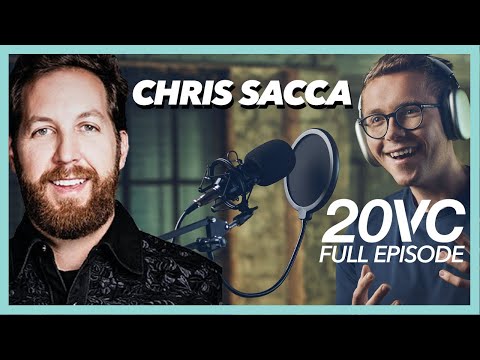
Chris Sacca's True Unfiltered Opinion on Facebook and Softbank | Full Interview
Narrator, Harry Stebbings (host), Chris Sacca (guest), Narrator
In this episode of The Twenty Minute VC, featuring Narrator and Harry Stebbings, Chris Sacca's True Unfiltered Opinion on Facebook and Softbank | Full Interview explores chris Sacca On Money, Parenting, Climate Bets, And Calling Out Power Chris Sacca traces his path from leveraged day-trading and early angel bets in Photobucket and Twitter to building Lowercarbon Capital, explaining how painful losses and outsized wins shaped his attitude toward risk, money, and status. He talks candidly about designing a healthy relationship with wealth, marriage, and parenting, emphasizing gratitude, service, and avoiding raising entitled kids in an over-optimized, monoculture tech world. Sacca details why he stepped back from classic tech VC, then returned with obsessive focus on climate, arguing that new economics, computing, and biology make climate startups both highly profitable and planet-scale. Throughout, he is bluntly critical of Facebook, SoftBank, and weak venture behavior, and lays out how he thinks great VCs, managers, and founders should actually operate.
Chris Sacca On Money, Parenting, Climate Bets, And Calling Out Power
Chris Sacca traces his path from leveraged day-trading and early angel bets in Photobucket and Twitter to building Lowercarbon Capital, explaining how painful losses and outsized wins shaped his attitude toward risk, money, and status. He talks candidly about designing a healthy relationship with wealth, marriage, and parenting, emphasizing gratitude, service, and avoiding raising entitled kids in an over-optimized, monoculture tech world. Sacca details why he stepped back from classic tech VC, then returned with obsessive focus on climate, arguing that new economics, computing, and biology make climate startups both highly profitable and planet-scale. Throughout, he is bluntly critical of Facebook, SoftBank, and weak venture behavior, and lays out how he thinks great VCs, managers, and founders should actually operate.
Key Takeaways
Separate luck from talent to avoid ego-driven investing.
Sacca’s $12M trading rise and $4M collapse taught him that up-markets often reflect luck, not genius; he now assumes gains are mostly fortune and treats losses as signals to improve skill and hustle, which keeps him grounded when making big, concentrated bets.
Get the full analysis with uListen AI
Design your relationship with money around freedom, not comparison.
He and Crystal interviewed both thriving and ruined rich people, learning to avoid endless status games, excessive property ownership, and letting wealth dictate life; instead they use money to remove anxiety for family, fund causes, and create options without becoming “prisoners to their stuff.”
Get the full analysis with uListen AI
Raise kids with gratitude, work, and loss—not optimized résumés.
Sacca rejects the arms race of elite schools, early coding, and over-specialized sports; his kids muck stables, participate in philanthropy, and are allowed to lose, because he believes privilege makes them more at risk of becoming “assholes” than average kids.
Get the full analysis with uListen AI
Insist on ownership mentality and radical candor in teams.
He only works with “A-teamers” who bring full effort, own their mistakes, and can run major pieces of the business; feedback is delivered by clearly expressing disappointment and then asking, “What do you think we should do next? ...
Get the full analysis with uListen AI
Build a reputation so the best founders seek you out.
Rather than chasing every deal, Sacca focuses on being conspicuously useful—storytelling, company-building, hiring help—so elite founders and co-investors proactively bring him opportunities; the discipline is in picking the few where his involvement materially improves the odds of success and ownership is meaningful.
Get the full analysis with uListen AI
Climate-tech is now both a moral imperative and a huge profit pool.
He argues that shared labs, cheap compute, and machine learning have slashed climate startup costs while markets (energy, chemicals, food, buildings, transport) are the biggest in history; companies like Heart Aerospace and Solugen show you can beat fossil-based incumbents simply by being cheaper and better.
Get the full analysis with uListen AI
To avert mass suffering, pair decarbonization with carbon removal and sunlight reflection research.
Sacca believes clean energy, new materials, and carbon sequestration will arrive but not fast enough, so humanity must also seriously research solar radiation management (e. ...
Get the full analysis with uListen AI
Notable Quotes
“You learn over time to invert that curve: when things are going up, it's lucky; when things are going down, it's some lack of talent and you need to double down and hustle.”
— Chris Sacca
“Our kids growing up with some privilege are at higher risk for being assholes than average kids.”
— Chris Sacca
“I just have no time in my life for B‑teamers, let alone C‑teamers or D‑teamers.”
— Chris Sacca
“Facebook is a cancer and they know it.”
— Chris Sacca
“We are going to transition to a clean energy economy… it’s just not going to happen fast enough unless we also research reflecting sunlight back into space.”
— Chris Sacca
Questions Answered in This Episode
How should an early-career investor practically build the kind of reputation that makes top founders and co-investors seek them out, rather than always chasing deals?
Chris Sacca traces his path from leveraged day-trading and early angel bets in Photobucket and Twitter to building Lowercarbon Capital, explaining how painful losses and outsized wins shaped his attitude toward risk, money, and status. ...
Get the full analysis with uListen AI
What concrete steps can tech workers and parents take to avoid raising the “surplus of assholes” Sacca worries about, especially in high-achievement environments?
Get the full analysis with uListen AI
Given his harsh view of Facebook and SoftBank, what governance or structural changes does Sacca think would meaningfully curb their negative impact without killing innovation?
Get the full analysis with uListen AI
How can LPs and existing funds systematically replicate Sacca’s approach to backing diverse managers and including HBCUs in a way that is financially attractive rather than purely charitable?
Get the full analysis with uListen AI
What specific criteria does Lowercarbon use to judge whether a climate-tech company can both remove gigatons of carbon and realistically become a multi-trillion-dollar business?
Get the full analysis with uListen AI
Transcript Preview
(beeping) Three, two, one, zero. You have now arrived at your destination.
Kris, my word. I've only waited seven years for this one. I've been so looking forward to doing this for such a long time. So thank you so much for joining me today, Kris.
Oh, man. Last time I saw you, we were in Stockholm-
(laughs)
... sharing some Heinekens on stage at Daniel Ek's event, which is an all-time event. Uh, and so it's really fun to ke- to, uh, to catch up with you again, man.
Do you know what? I like to think that I'm a very logical and representable speaker. After a couple of Heinekens when I was about 18 years old, I was not so (laughs) solid as I should be. But I do, I do wanna start with a little bit of context. I always love this question, which is like, fundamentally, how did you make your first move into investing and what was the first check for you?
You know, the first check for me... I mean, I'd been doing deals on behalf of Google for a while, uh, and, and even before that at a company called Spedera. So where I was general counsel and... I don't tell many people I'm a lawyer, so we'll keep that between us. But, uh-
(clears throat)
... but general counsel and head of biz dev and corp dev and stuff like that. And so... And then even before that, as a lawyer, I was adjacent to all these deals. I was watching other people do deals. I'd be in the room taking the notes when John Doerr was, uh, was receiving a pitch and stuff like that as his outside counsel. Uh, and so, so I was always close to deals. But the very first one I did on my own, uh, was a company called Photobucket, which we ultimately sold for 330 million dollars, which sounded like all the money in the world at the time. You know, Flickr had sold for like $25 to 35 million. And so to be able to 10X that with Photobucket was insanity. Uh, and, and we felt (laughs) just so lucky to have gotten that deal done. But that check I wrote was literally a credit card check for me. Uh, I didn't have any cash on hand. I was at Google and I was vesting, but I hadn't sold any stock yet. And so I literally, um, I went into that one with $50,000 of credit card checks. My second investment was Twitter. And that one was funny because Evan Williams was... I'd already been working with the company and helping them out, but Evan went and circled up investors for the round and he's like, "Hey, I've got you down for 25K. 25K good? Okay, I got you for 25K." And I now see, you know, now that I've got some money and I've been privileged, like why that's kind of the baseline number that people use. But at the time, that was incredibly material for me. And I was kind of embarrassed to admit that like, that 25 really mattered. So I'm like, "Oh yeah, 25 sounds great, man. I'm all over it." And then-
Install uListen to search the full transcript and get AI-powered insights
Get Full TranscriptGet more from every podcast
AI summaries, searchable transcripts, and fact-checking. Free forever.
Add to Chrome