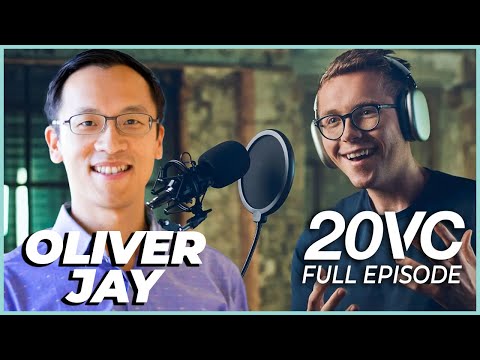
Oliver Jay: How To Create and Execute a World-Class Sales Playbook | 20VC #889
Oliver Jay (guest), Harry Stebbings (host), Narrator
In this episode of The Twenty Minute VC, featuring Oliver Jay and Harry Stebbings, Oliver Jay: How To Create and Execute a World-Class Sales Playbook | 20VC #889 explores oliver Jay Explains Building Agile Sales Playbooks For Product-Led Startups Oliver Jay (OJ), former sales leader at Dropbox and Asana, explains how to build and scale a world-class sales motion, especially in product-led growth (PLG) companies. He distinguishes between two ‘playbooks’: the early discovery playbook (who to sell to, how, and why it matters) and the later repeatable process playbook, which only becomes real once you have significant AE scale. OJ argues founders must be deeply involved in the first playbook, hire customer-facing people early for learning (not just revenue), and prioritize agility and insights over premature process. He also dives into hiring, onboarding, compensation, and the critical CEO–head of sales partnership, emphasizing that sales should be seen as a strategic problem‑solving function, not a second-class citizen to product.
Oliver Jay Explains Building Agile Sales Playbooks For Product-Led Startups
Oliver Jay (OJ), former sales leader at Dropbox and Asana, explains how to build and scale a world-class sales motion, especially in product-led growth (PLG) companies. He distinguishes between two ‘playbooks’: the early discovery playbook (who to sell to, how, and why it matters) and the later repeatable process playbook, which only becomes real once you have significant AE scale. OJ argues founders must be deeply involved in the first playbook, hire customer-facing people early for learning (not just revenue), and prioritize agility and insights over premature process. He also dives into hiring, onboarding, compensation, and the critical CEO–head of sales partnership, emphasizing that sales should be seen as a strategic problem‑solving function, not a second-class citizen to product.
Key Takeaways
Separate the discovery playbook from the process playbook.
Early on, focus on defining your personas, value proposition, and acquisition motion; only later, once you have around 20 ramped AEs, does it make sense to lock in a formal, repeatable sales process.
Get the full analysis with uListen AI
Founders must own the initial playbook and customer learning.
Because product, messaging, and target persona are still fluid, founders need direct exposure to customers to iterate toward product–market fit before delegating more mechanical sales processes.
Get the full analysis with uListen AI
Hire customer-facing generalists early, not always a head of sales.
If you’re creating a new category, start with hungry, smart, customer-facing people to explore who the buyer is and how to sell; reserve hiring a head of sales for clearer, established categories with defined buyers and budgets.
Get the full analysis with uListen AI
Design interviews around a few core competencies and how answers are delivered.
OJ prioritizes traits like reverence for product and making others better, tested via behavioral questions and observing passion and ownership, plus a prepared demo/presentation to surface real potential.
Get the full analysis with uListen AI
Avoid early rigid commission plans; use flexible variable comp instead.
With no historical baseline, targets and commission rates are almost guaranteed to be wrong; instead use bonuses, logo-based goals, or team incentives while keeping room to iterate without legal and motivational debt.
Get the full analysis with uListen AI
Onboard reps with product and market immersion before sales tactics.
Start them in support to learn real product issues, then educate them on market and competition (e. ...
Get the full analysis with uListen AI
Treat outbound as a company-wide initiative, not a quick fix for plateauing PLG.
Successful outbound usually targets different senior buyers with different value messaging and deal sizes, requiring alignment across product, marketing, and talent—not just buying lists and blasting cold emails.
Get the full analysis with uListen AI
Notable Quotes
“You either build product or you sell product. Everything else is supporting one of those two.”
— Oliver Jay
“In your first two AEs there is no playbook. You’re piloting.”
— Oliver Jay
“I’d rather focus on agility than repeatability at the beginning.”
— Oliver Jay
“If you need to manufacture competition between early reps, you probably hired the wrong people.”
— Oliver Jay
“What salespeople do at the core is help customers solve their problems… they’re not second-class citizens to product.”
— Oliver Jay
Questions Answered in This Episode
How can an early-stage founder practically structure month-by-month ‘learning sprints’ to build the first discovery playbook?
Oliver Jay (OJ), former sales leader at Dropbox and Asana, explains how to build and scale a world-class sales motion, especially in product-led growth (PLG) companies. ...
Get the full analysis with uListen AI
What concrete signals should a startup look for to decide it’s time to layer in a true head of sales?
Get the full analysis with uListen AI
How should PLG companies measure the effectiveness of their earliest sales hires when revenue is not yet the primary goal?
Get the full analysis with uListen AI
What mechanisms work best to systematically bring “voice of customer” from sales back into product and roadmap decisions?
Get the full analysis with uListen AI
How can a startup safely transition from flexible variable compensation to more formal commission plans without breaking trust or culture?
Get the full analysis with uListen AI
Transcript Preview
Three, two, one, zero. You have now arrived at your destination.
Oj, this is such a joy to do. I heard so many good things from Danny Herzberg before the show, and many other guests, so thank you so much for joining me today.
Oh, I'm so happy to be here.
That is very, very kind of you. I've been looking forward to this one. But I wanna start with some context. So you've worked in some of the most incredible hypergrowth companies, from Dropbox to Asana. Tell me, how did you make your way into sales and come to lead some of these incredible sales orgs?
Uh, you know, I... First couple of years my, in my career was in finance. I, I, I was in first starting equity research at Morgan Stanley and covering tech companies. That was my first exposure to how the, sort of the intersection of tech and business. Um, then I went over to venture, uh, and, and I worked at NEA for a bit. Uh, loved, loved my time there. In that experience, I really saw how amazing some, uh, investors were bas- sort of leveraging their operating background to help founders.
Mm-hmm.
So I got that curious about operating, and all the GPs I really admired, they were like, "Hey, you should operate, and if you're gonna operate, you either build product or you sell product. Everything else is supporting one of those two." And I was like, "Oh, interesting." And, and just one thing led to another. I just hap- ... It was like 50/50. I went down the sales path, and that was the, that was the path I ended up on.
I love that. I love that kind of simplicity of you either build or you sell. Um, I do wanna ask that, you know, when we look back at the time, six years Asana, four years Dropbox, at pivotal moments of scaling for both companies, when you think back to that, and if you isolate one or two key takeaways from each, what would you say they would be, looking back and reflecting?
So, drop- Dropbox, I think for me, number one, is that, uh, technology is just fundamentally diff- uh, adopted differently in businesses. B2B businesses, uh, are, uh, no longer by the traditional top-down way in terms of how technology is used in, in companies. Uh, employees get to pick, right? And that started with Apple with the iPhone in, in probably around, what, 2000 and, 2010, right, when people had this BYOD move, and Dropbox was the, was the company that shattered and started the BYOA move. And so th- I think that's number one. And so as a result, number two is that, you know, PLG is fundamentally is a very different kind of go to market than traditional B2B sales. I think that's the main thing I took from Dropbox. Had the opportunity to then apply that to Asana. And, I think what I learned at Asana was, if I had to pick one thing, it would be this concept of product-led growth sales and traditional enterprise sales. You know, at, when I first joined Asana, and even today, when I talk to a lot of people, I think there is this predominant view of that you can, you got to pick one or the other. And, at Asana, we pioneered, and we, we try to do both at the same time. And, and I think the results were quite positive, and I think it dem- My takeaway is that it is possible. Uh, it's hard, but it is possible.
Install uListen to search the full transcript and get AI-powered insights
Get Full TranscriptGet more from every podcast
AI summaries, searchable transcripts, and fact-checking. Free forever.
Add to Chrome