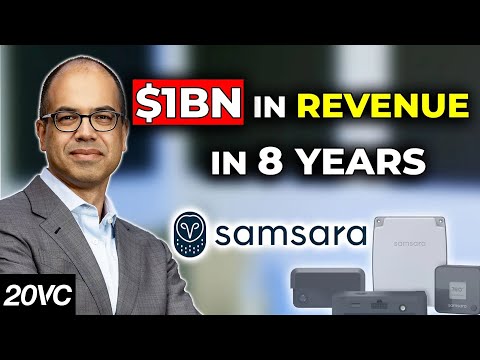
Sanjit Biswas: Samsara's $18BN Market Cap & $1BN in ARR in 8 Years | E1092
Harry Stebbings (host), Sanjit Biswas (guest)
In this episode of The Twenty Minute VC, featuring Harry Stebbings and Sanjit Biswas, Sanjit Biswas: Samsara's $18BN Market Cap & $1BN in ARR in 8 Years | E1092 explores samsara CEO on product-market fit, scaling, and long-term allocation Sanjit Biswas, co-founder and CEO of Samsara, reflects on building two multibillion‑dollar companies, contrasting his tech‑first approach at Meraki with Samsara’s market‑first, problem‑led strategy.
Samsara CEO on product-market fit, scaling, and long-term allocation
Sanjit Biswas, co-founder and CEO of Samsara, reflects on building two multibillion‑dollar companies, contrasting his tech‑first approach at Meraki with Samsara’s market‑first, problem‑led strategy.
He explains how to find and not force product‑market fit, when to launch second products, and why founder‑led sales and deep customer time remain central even at $1B+ ARR.
Biswas details Samsara’s capital allocation philosophy (including a 70/20/10 R&D model), the transition from doing unscalable work to building scalable processes, and the trade‑offs of going hybrid for talent access.
He also discusses hiring at scale, stage‑fit mistakes, his evolving relationship to money after a large exit, and balancing being a public‑company CEO with being a parent.
Key Takeaways
Product–market fit should feel like market pull, not internal declaration.
Biswas advises founders to avoid arbitrary PMF metrics and instead “listen for the wow”: customers stop you in demos, call colleagues into the room, and proactively ask to buy—clear signs the product is being pulled out of your hands.
Get the full analysis with uListen AI
Use customers to prioritize second products; don’t over‑rotate on focus.
Samsara launched its second major product (dash cameras/safety) when customers repeatedly asked for it, long before maxing out growth on product one, and focused on problems that 80% of customers shared to ensure leverage.
Get the full analysis with uListen AI
Rehire yourself regularly to stay useful to the company’s next stage.
Biswas literally writes a new job description for himself every year or two, checking whether his time matches what the company needs 3–5 years out, and intentionally drops beloved hands‑on work that no longer scales.
Get the full analysis with uListen AI
Adopt a structured capital allocation model to balance now vs. later.
Samsara uses a 70/20/10 R&D allocation—70% on scaling existing products, 20% on near‑term bets, 10% on longer‑term seeds—so it can plant new product and geography bets early while still supporting the core.
Get the full analysis with uListen AI
Be ruthless about scalability, even when customers like the product.
Their machine‑vision line worked and delivered value, but required highly custom installs, making it more like services than software; they shut it down and redeployed the team to scalable AI features embedded in core products.
Get the full analysis with uListen AI
Hire for stage fit and deal style, not just resumes and domain.
Some of his biggest hiring mistakes were bringing in big‑company execs too early or skipping references; he prioritizes experience with the right deal motion (high‑velocity vs. ...
Get the full analysis with uListen AI
Hybrid work can be a net win if it massively expands talent TAM.
Moving to flexible work let Samsara tap 10–30x more sales and tech talent in new geographies and closer to customers; the increased access and proximity outweighed the collaboration drag of not being fully in‑office.
Get the full analysis with uListen AI
Notable Quotes
“Product–market fit is something you don’t want to force. Get out there with customers and listen for the wow.”
— Sanjit Biswas
“Companies pay to have their problem solved, so when we talk about revenue growth, for me it’s actually impact and problem‑solving growth.”
— Sanjit Biswas
“With Samsara, we said, ‘If we do this right, we will scale 10X and then 10X again.’ So we need to be building for the long term.”
— Sanjit Biswas
“I go through a process I call rehiring myself… I actually write a job description for what the company needs from me in the next couple of years.”
— Sanjit Biswas
“The CEO is the chief capital allocator of the company.”
— Sanjit Biswas
Questions Answered in This Episode
How can early‑stage founders practically distinguish between polite interest and true ‘pull’ when testing for product–market fit?
Sanjit Biswas, co-founder and CEO of Samsara, reflects on building two multibillion‑dollar companies, contrasting his tech‑first approach at Meraki with Samsara’s market‑first, problem‑led strategy.
Get the full analysis with uListen AI
What frameworks can leaders use to decide when a successful but unscalable product or line of business should be shut down?
He explains how to find and not force product‑market fit, when to launch second products, and why founder‑led sales and deep customer time remain central even at $1B+ ARR.
Get the full analysis with uListen AI
How early is “too early” to launch a second product line, and what signals should override the usual advice to stay focused?
Biswas details Samsara’s capital allocation philosophy (including a 70/20/10 R&D model), the transition from doing unscalable work to building scalable processes, and the trade‑offs of going hybrid for talent access.
Get the full analysis with uListen AI
In a hybrid or remote environment, what specific rituals or processes best preserve the high‑bandwidth customer and internal learning Biswas values?
He also discusses hiring at scale, stage‑fit mistakes, his evolving relationship to money after a large exit, and balancing being a public‑company CEO with being a parent.
Get the full analysis with uListen AI
How should founders design their own ‘rehire myself’ process to evolve their role as the company scales from seed to IPO and beyond?
Get the full analysis with uListen AI
Transcript Preview
What do you think are the biggest mistakes founders make with product-market fit?
Well, I think some of it has to do with... With Samsara, we said, "We need to be building for the long term," which means you're allocating capital for the long term. If we do this right, we will scale 10X and then 10X again. Companies pay to have their problem solved, and so when we talk about things like revenue and revenue growth, for me it's actually impact and problem-solving growth. I think product-market fit is something you don't want to force. Get out there with customers, with beta testers, and listen for the wow. What we've done in the past is kind of what we call an... (screwing sound)
Sanjit, I have just heard the most wonderful things from the one and only Doug Leone. I've spoken to many others. So first, thank you so much for joining me today.
Well, thanks for having me, Harry.
Not at all. But I want to start with a bit of a weird one, but one of, um, (laughs) your friends and colleagues told me that I had to start with your first tech project, taking your school online. So what did that teach you about technology and about people?
Yeah, it's funny. It's, uh, the kind of Wayback Machine test, so that's probably a, a 30-year-old story at this point. We're talking, like, the early, mid-90s. And the project that I had was to try to bring my high school online, and this is, like, right at the beginning of the web browser, so I'm kinda dating myself here, but, you know, probably (laughs) before you were born, but, you know, like, the World Wide Web was brand new, and I just thought it'd be really cool to... I went to public school here in California. I thought it'd be cool to bring 1,600 high school kids online and kinda see what happens. I was a techie, and so I'd been kind of online even at a young age, um, and wanted to find a way to make it accessible. Back then, it was very kind of, um, elaborate to get online. You needed to download a bunch of software, FTP, and all kinds of crazy stuff, and I thought, you know, the typical student isn't gonna figure that out. How do we make it just work out of the box? So, um, sat there, typed in 1,600 names from the high school yearbook 'cause I couldn't get the roster from the administration, so just kind of brute forced it. We set up, uh, web browsers and web servers so you could actually check your email using the web instead of having to sit at a command line, which is kinda how things worked back then. We brought our high school newspaper online. So it was really a kind of fun time, and everyone got into it. Um, and by the way, I was a new student, and I'd just moved from Texas, and probably what my friends didn't tell you is I was pretty scrawny. I was like a 12-year-old freshman, by the way, so I'd skipped a grade or two along the way. Just moved from a, you know, different state, which is practically a different country, and it was a great way to meet people. So I got to meet everyone in the school, quite literally, from, you know, the high school football team captain to, like, the newspaper editor to, you know, everyone else that was in my grade. So really fun experience, taught me a lot about how diverse people are, like lots of different things that they wanted to do online, things that they were curious about, but also how fun technology can be, 'cause it, like, really blew peoples' minds. Like, this is like, you're going from disconnected, like, there's no smartphones, there's no internet, to, "Oh my God! Like, look at all this stuff online."
Install uListen to search the full transcript and get AI-powered insights
Get Full TranscriptGet more from every podcast
AI summaries, searchable transcripts, and fact-checking. Free forever.
Add to Chrome