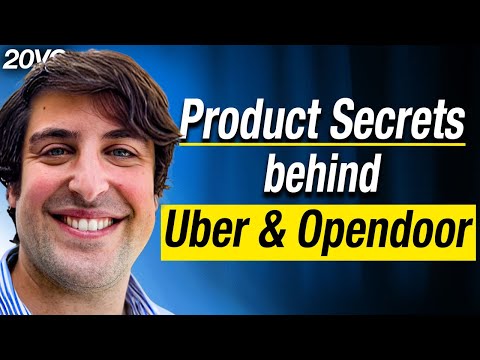
Brian Tolkin, Head of Product @Opendoor: How to Hire the Best Product Teams | E1257
Harry Stebbings (host), Brian Tolkin (guest)
In this episode of The Twenty Minute VC, featuring Harry Stebbings and Brian Tolkin, Brian Tolkin, Head of Product @Opendoor: How to Hire the Best Product Teams | E1257 explores brian Tolkin Reveals How To Build, Prioritize, And Hire Product Teams Brian Tolkin, Head of Product at Opendoor and former Uber product leader, discusses his biggest product wins and mistakes, notably UberPool’s upfront pricing and missteps in defaulting users into Pool. He explains how AI is collapsing traditional product-development workflows while leaving core PM skills—customer understanding, problem definition, and business alignment—unchanged.
Brian Tolkin Reveals How To Build, Prioritize, And Hire Product Teams
Brian Tolkin, Head of Product at Opendoor and former Uber product leader, discusses his biggest product wins and mistakes, notably UberPool’s upfront pricing and missteps in defaulting users into Pool. He explains how AI is collapsing traditional product-development workflows while leaving core PM skills—customer understanding, problem definition, and business alignment—unchanged.
Tolkin dives into prioritization frameworks, OKRs, and the trade-offs between speed, simplicity, and product quality, especially in high-velocity environments and operationally complex businesses like Uber and Opendoor.
He also explores how to scale from single to multi-product, manage tech debt versus growth, and why CEOs should act as CPOs early on. A large portion of the conversation focuses on hiring: what a ‘true product team’ looks like, how to match PMs to problems, and why longer tenures dramatically increase effectiveness.
Key Takeaways
Deeply understand underlying data and infrastructure before launching complex products.
Uber’s China launch exposed how weak mapping/routing data and complex road systems can undermine core value (good matches and price), showing that foundational data quality can make or break a product.
Get the full analysis with uListen AI
Never optimize business metrics by tricking users or overriding their intent.
Defaulting riders into UberPool boosted liquidity but violated user expectations; Tolkin now sees that as prioritizing business needs over user respect, a mistake he’s ‘deeply internalized.’
Get the full analysis with uListen AI
AI shrinks cycles and artifacts, but PM fundamentals stay constant.
PRDs may give way to rapid prototypes and shared tools, yet the hard part remains: synthesizing user input, data, and constraints into good decisions that work for the business.
Get the full analysis with uListen AI
Prioritization must be tied to time horizon and company stage.
Frameworks like impact–confidence–effort only work when matched to whether you’re in land-grab growth (optimize for survival and revenue now) or in a mature phase (where tech/experience debt pay-down becomes critical).
Get the full analysis with uListen AI
Go multi-product by sandboxing and leveraging existing advantages, not by weakening the core.
New products should use your unique assets (customers, capabilities, or geography) and be insulated enough that failure doesn’t damage the main product or experience.
Get the full analysis with uListen AI
Hire PMs for specific problem types and team needs, not generic ‘smart athletes.’
Different problems require different PM ‘spikes’ (technical, design, ops, analytical); Tolkin emphasizes ‘you hire your strategy’ and that mis-hires often stem from role ambiguity or poor fit, not candidate quality.
Get the full analysis with uListen AI
Velocity matters enormously, but you still need a clear success bar and definition of ‘simple.’
Shipping fast creates learning and momentum, but you must avoid shipping below a minimum quality bar and define simplicity relative to the necessary complexity of the product (e. ...
Get the full analysis with uListen AI
Notable Quotes
“You have to earn the right to exist in the future, and paying down tech debt doesn’t pay the bills.”
— Brian Tolkin
“Good PMs have to do both: understand what works for the user and what works for the business.”
— Brian Tolkin
“You hire your strategy.”
— Brian Tolkin
“If you’re focused on everything, you’re not focused on anything.”
— Brian Tolkin
“Computers are deterministic. Humans in the real world are not.”
— Brian Tolkin
Questions Answered in This Episode
How would Tolkin adapt his product-development process if he were starting a fully AI-native product team today?
Brian Tolkin, Head of Product at Opendoor and former Uber product leader, discusses his biggest product wins and mistakes, notably UberPool’s upfront pricing and missteps in defaulting users into Pool. ...
Get the full analysis with uListen AI
What specific signals should a growth-stage startup watch to know it’s time to start aggressively paying down tech and experience debt?
Tolkin dives into prioritization frameworks, OKRs, and the trade-offs between speed, simplicity, and product quality, especially in high-velocity environments and operationally complex businesses like Uber and Opendoor.
Get the full analysis with uListen AI
How can PMs in pure software companies apply lessons from ops-heavy environments like Uber and Opendoor without overcomplicating their products?
He also explores how to scale from single to multi-product, manage tech debt versus growth, and why CEOs should act as CPOs early on. ...
Get the full analysis with uListen AI
What are practical ways to diagnose whether a new product experience is failing due to poor execution vs. temporary user resistance to change?
Get the full analysis with uListen AI
How should founders concretely decide which ‘type’ of PM (technical, design-heavy, ops-heavy, etc.) to hire first given their specific product and market?
Get the full analysis with uListen AI
Transcript Preview
What was the single best product decision you made?
Upfront pricing for UberPool. When we first launched, it was variable pricing depending on whether you matched or not. You opened the Uber app, you say, "This is where I'm going," and, and it was just like, "Okay." And then based on minutes and miles, it, the cost would post how to calculate, and so we built upfront pricing where you'd see that beforehand.
Ready to go? (instrumental music plays) Brian, dude, I am so excited for this. I've wanted to make this happen for a while, so thank you so much for joining me today.
Thank you for having me. I'm, I'm super excited as well. This'll be great.
Dude, I spoke to so many people that worked with you at Uber, and I heard that you were instrumental in the China Pool Uber launch, which allowed Uber to compete directly with Didi in major cities. This is what everyone told me.
Yeah.
What are your biggest lessons from that time and launching China Pool so efficiently?
We were launching in China. At the same time, we were standing up a Chinese, uh, uh, a data center in China, and there was all sorts of technical issues with the day before launch getting everything to work properly. And we were launching for, uh, in Chengdu, um, uh, which is a city in China, um, that... By the way, a city of, like, 20 million people that most people at Uber had never heard of. And we were launching for, for rush hour 'cause the product re- relies heavily on liquidity to, to make efficient matches and, um, all that stuff. And so, uh, it, it wasn't working and it was, you know, 9:00 PM, 10:00 PM, 11:00 PM, uh, midnight, 1:00 AM. I think I s- slept 30 minutes on the floor of the Chengdu Uber office. Launched at, like, 5:30 or maybe 6:00 AM, um, and, uh, knock on wood, we were able to figure it out and, and it, and it sort of worked.
What are your biggest product lessons-
Yeah.
... from doing that launch-
Yeah.
... and from that time with Uber in China?
My biggest product lessons are (laughs) , uh, one, um, underlying data, like understanding the components that make your work, that make a product work really, really matter. So in our case, um, we are trying to do matches, um, between two riders for, for UberPool. The thing that works, the thing that customers care about is, uh, the quality of the match and the price of the ride. The thing that drivers care about is also somewhat, uh, the quality of the match. Um, and those things depend on having really good mapping and routing data. And the reality is, in China, there's no Google Maps. It's much more difficult to have, have, uh, routing and mapping data. And so we had to work really, really hard, uh, to try and figure out how we can make good matches work, and the reality is when we first launched, there, there weren't that good, that good of matches, and the road infrastructure in, in China is very, very challenging. You have massive highways and overpasses and, like, all this complexity that, that, um, is just a little bit simpler in, in, in places like the US. And I think we underappreciated the complexity of, um, how you would make good matches without awesome underlying road data.
Install uListen to search the full transcript and get AI-powered insights
Get Full TranscriptGet more from every podcast
AI summaries, searchable transcripts, and fact-checking. Free forever.
Add to Chrome